

Boys and Dolls: A New Era of Play
I could not be more excited to welcome my dear friend Kristen Johnson to the blog today to share about her new passion project that so closely aligns with my values when it comes to raising boys - it's dang near scary.
My boys love dolls. My almost-four-year-old carries a baby doll regularly with him to school. He loves to dress dolls, talk to them, give them milk, and dance with them. His dolls are in his toy set and just another part of his pretend play routine. No big deal to him.

I could not be more excited to welcome my dear friend Kristen Johnson to the blog today to share about her new passion project that so closely aligns with my values when it comes to raising boys - it's dang near scary.
My boys love dolls. My almost-four-year-old carries a baby doll regularly with him to school. He loves to dress dolls, talk to them, give them milk, and dance with them. His dolls are in his toy set and just another part of his pretend play routine. No big deal to him.
But dolls seem to be a big deal to adults. Especially when boys play with dolls. There’s a lot of Internet chatter about the topic of boys and dolls. Generally, the public commentary of the moment seems to agree that boys should play with dolls.
Why, then, is the world of dolls so askew?
The makers and the buyers of dolls have until now allowed dolls—which are just little people—to be almost entirely one gender. I’m sure this doesn’t come as a surprise to you, but that gender is female. Dolls are girls. Even most baby dolls are girls. It is extremely rare to find a normal-looking boy doll in the 3-9 age range.

This phenomenon of doll gender imbalance has not gone unnoticed. In a hugely popular viral Internet moment, we saw one mom make an “American boy” doll for her son. That mom (Gina DeMillo Wagner) wrote about the experience: “A year ago, when my daughter turned 7, she received one of American Girl’s popular ‘Truly Me’ dolls, customized to look like her. My son, naturally, wanted a doll that looks like him, too. Trouble is, there are no 18-inch ‘American Boy’ dolls available.” Wagner did something about it, but the only way she could figure how to do so was to buy a girl doll, remove her makeup and cut her hair to create a boy doll.
How odd that she could not just go buy a boy doll.
The imbalance among dolls impacts all children. We all know the problem: Girls are told that they should be playing with dolls, creating a lifelong impression that somehow the action of nurturing, caretaking, and even play with like-aged children and babies belongs to females. In turn, boys are sent the message that they should not be playing with dolls. This creates a lifelong impression that their job is NOT to be nurturing, caretaking, and playing with like-aged children and babies.
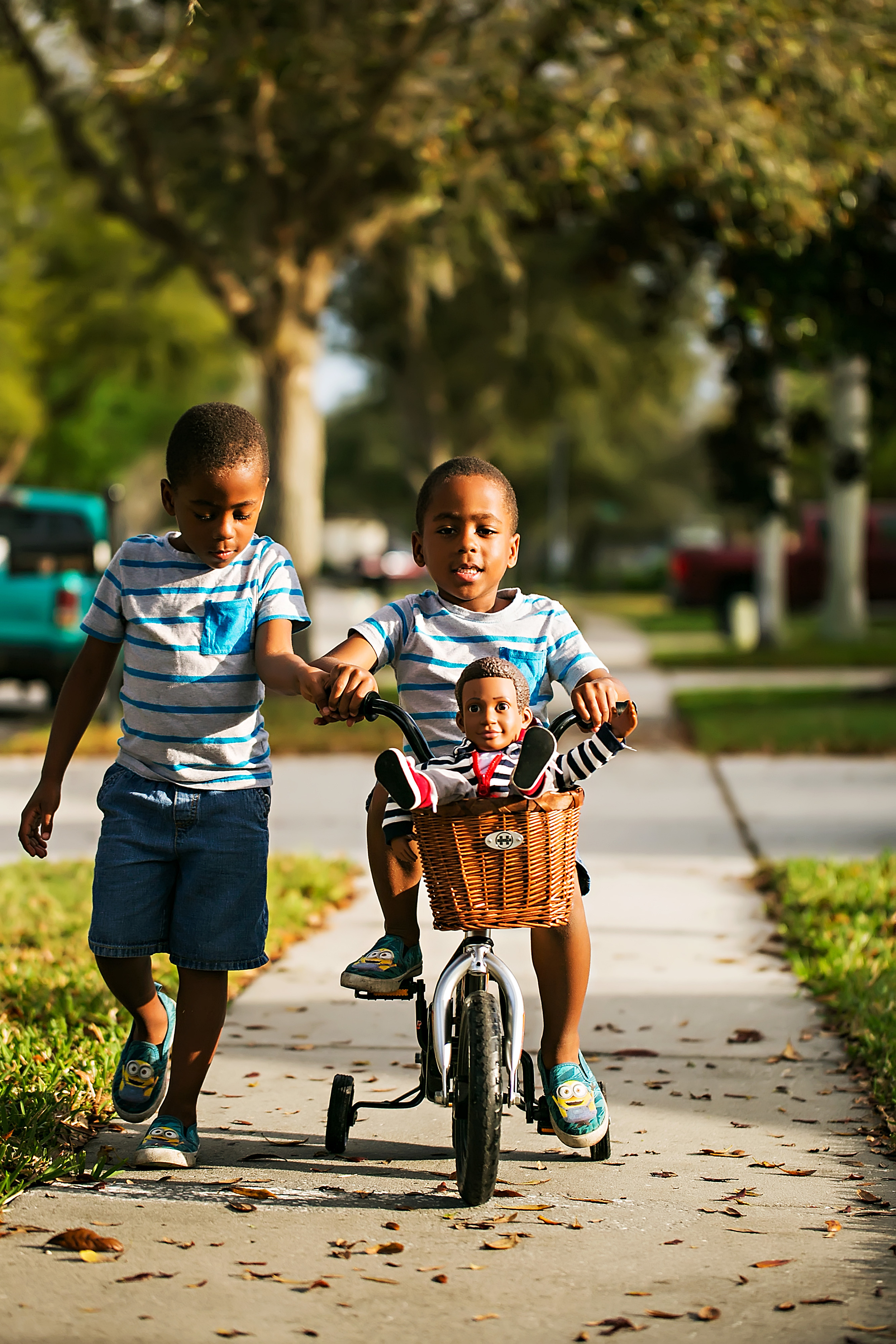
Our kids deserve better than this. My sons are onto something when they play with dolls. They’re relating. They’re oblivious to stereotypes. And we should keep them that way.
Okay, so what’s the problem and solution?
The problem is that modern-day toys still send antiquated messages.
Our kids cannot walk into a toy store and choose from an array of dolls. They can’t find a doll that looks like them, and sometimes they can’t even find a doll that is their gender or race.
The solution is for real, really real, to stock the doll sections of toy aisles with a healthy variety of dolls. So simple. Kids’ imaginations can do most of the work, but let’s give them access to a full painters’ palette rather than a single choice.
Choice is what matters. No one wants to go to a restaurant only to be served one dish. Add some variety, let kids choose how to play, and watch the happiness grow. Let’s give the boy and girl dolls.
Beyond evening the playing field, encouraging all our young’uns to engage in free and imaginative play with dolls has massive benefits on their childhood development. The skills developed are countless, but just to name a few, an occupational therapist, a speech-language pathologist, and a clinical psychologist (all also moms) identified these:
- Cognitive, fine motor, and self-help skills
- Speech and language skills
- Social and emotional skills
Based upon my lowly observations as a mom myself, though, despite these great benefits of playing with dolls, boys are still discouraged from doing so. Change in the doll world is moving at a snail’s pace. So I have decided to do something about it. If the solution is to get more variety into the stores, then let’s do it!

Next month I am launching a new company, Boy Story, designed to bring diverse boy dolls to the toy aisles for all kids. Boy Story’s main product is 18” ball-jointed Action Dolls. They are boys (for now—girls will be added as the selection becomes more balanced). Each boy doll comes with a story to get the imagination fired up. My dream is to walk into a toy store and see a selection of dolls more representative of the world we live in. Diverse, evenly marketed to both boys and girls, and fun.
FUN - most of all. Once we’ve gotten rid of the stereotypes that have plagued our toys for generations, that’s what will emerge. Fun.
For me, and pretty much for every parent I know, that’s really the goal here. Provide toys that are a joy to play with. We want the moments of our kids’ lives to be fun, carefree, and filled with play. Our childhood time is precious. Why waste it having to struggle through an explanation over pink and blue aisles? Or spend time explaining to my son why all the dolls available only wear dresses? Let’s give our kids the diverse tools they need to grow into loving and open-minded adults.
On April 13th, you can help my mission to level the playing field. Boy Story is launching a Kickstarter campaign to raise enough money for production of our first run of Action Dolls. We hope you’ll join in, back our project, and contribute to this positive change!
Stay tuned and follow us here:
facebook.com/boystorydolls
twitter.com/boystorydolls
instagram.com/boystorydolls
Our newsletter for all the latest updates! http://eepurl.com/bEX4Z5

Kristen Johnson is an international lawyer living in Qatar, family devotee, and social changer. She can't decide whether to lean in or lean back, but with two young sons, her hands always seem to be full. Her village is her rock: her husband, family, friends, and colleagues. She co-founded Boy Story with her sister, Katie Jarvis, a brilliant designer, goofball aunt, and the-girl-you-can't-stop-laughing-with.

The Real Problem With Pink Legos
My daughter turned four at the beginning of February. She’s interested in building things, pretend play, super heroes, and animals. Between those interests and the twin gift-giving holidays of her birthday and Christmas, my partner and I have had a lot of conversations about Legos in the last couple of months.
My daughter turned four at the beginning of February. She’s interested in building things, pretend play, super heroes, and animals. Between those interests and the twin gift-giving holidays of her birthday and Christmas, my partner and I have had a lot of conversations about Legos in the last couple of months.
We try to be a household with a wide expression of the gender continuum. Although he works in an office and I stay home to be with our daughter and prepare our food, we pretty evenly divide everything else. He wears his hair long and I wear mine short. We both use the power tools, we both work on the cars, we both know how to sew and how to draw. We encourage our daughter to try everything, climb everything, say what she means, express her feelings and follow her interests into whatever subjects she’s curious about.
So even though our daughter’s favorite color is purple, buying the box of Legos that came in pink and purple still gave me pause. I dislike marketing that is aimed solely at girls (or women, for that matter). It feels limiting, distracting. “Here are the toys for you, little girl. Leave those other ones for the boys.” Even the hint of that message being aimed at my strong, smart and impressionable daughter makes my inner feminist mama bear come out snarling. The girl-targeted sets start to look like a soft and floral fantasy world where girls can play with cute little bunnies, in contrast to the more realistic world presented for the boys.
And yet… Many of the “regular” Lego lines also include weapons, or figures with unnecessarily scary faces. And I haven’t found many that include female figures. Or animals. The superhero sets are predominately male figures except for a couple of of bad-guy females (which admittedly is a larger issue with equal gender representation in the superhero world - this article delves further into that issue). The Lego Junior Fire Emergency set? All male figures. The Knight’s Castle? All male. Even when they could have easily put a princess in there, still all male.
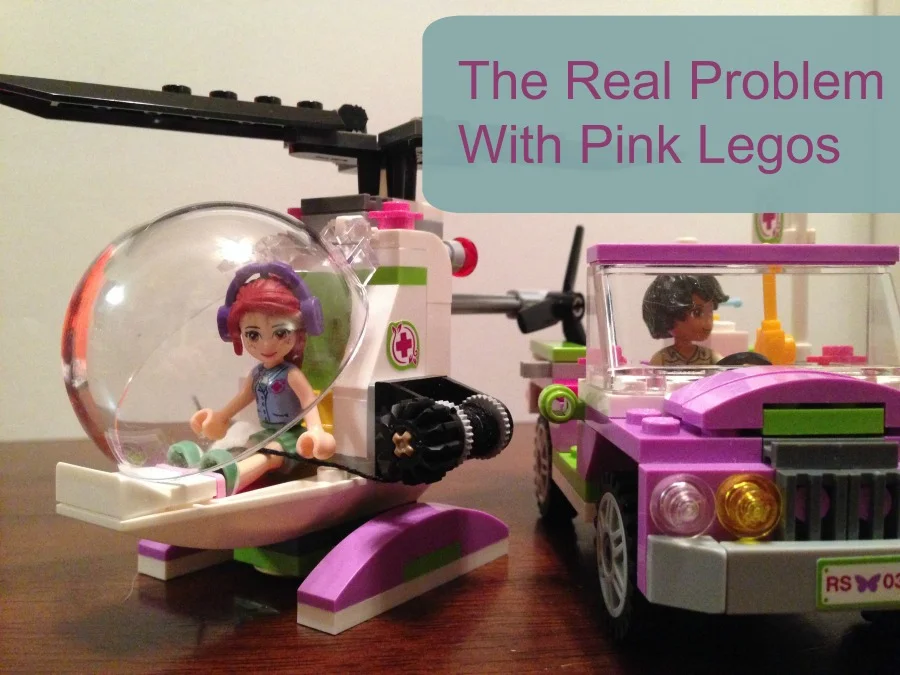
But the sets that come in pink - The Pony Farm, The Beach Trip, The Princess Play Castle - those don’t have any male figures. There are no pink firehouses or police stations with female figures. In the pastel-heavy Friends line, there is a Vet Clinic, a Hair Salon, a Cat Walk (!!), a Juice Bar and a Farm. All of these have female figures, but not male. But they do have animals.
We weren’t the only ones talking about this issue this winter. I saw this cartoon in my Facebook feed at least 3 times in the month of December and it sparked debates in the comments each time. Back in 2013, a letter to Lego from a 7-year-old girl in the UK went viral. She had noticed the male/female figure issue and it bothered her.
“I don’t like that there are more Lego boy people and barely any Lego girls...I want you to make more Lego girl people and let them go on adventures and have fun. OK!??”
I eventually realized that my real issue with Lego sets marketed separately for boys and girls was that it was doing a disservice not just to the girls, but to the boys, too.
Kids learn from what they see. When girls see male figures (but not female) in fire station sets and female figures (but not male) at the hair salon, they are given the message that fire stations are where men belong and the hair salon is where women belong.
And the boys are getting that message, too.
Our girls need to see women in a variety of professional (and strong fantasy character) roles. And so do our boys. It is still a fact of our culture that there are more men in positions of power - politics, management, the courtroom - than there are women. They are the ones making the rules. Things are changing toward more equality, and I’ve seen that shift in my lifetime. But we need our children - the girls, but especially the boys - to see more equality so they will create more equality. Women should keep fighting for those rights, but men also need to stand up for it for it to become a reality.
My ex was a foreman (“fore-PERSON” she would say) in a local sheet metal worker’s union. She installed gutters, flashing, metal siding and metal roofing materials. Most of her day was spent on a roof or a tall ladder. There were one or two other women in her local, but they worked in HVAC, not on the roof. None of them were in leadership positions. Almost every week she would come home with a new story about the subtle but pervasive gender bias she ran into in her job. Job sites with no women’s toilet. Forms where all the pronouns were “he/his.” Jokes about her period or her sexuality. Rumors that she’d lost out on good job calls because the superintendent didn’t think she was strong enough (she was).
Would those superintendents have had a different perspective if they’d played with Lego builder sets with female figures? I don’t know. I hope so. Would there be more female firefighters if kids got play with fire station sets that came with female figures, so little girls had the aspiration to get trained and little boys grew up to hire them, and maybe work for them? I hope so.
The bottom line is that Legos are good toys. They foster engineering skills, creative play, and imagination. They strengthen tiny finger muscles and increase eye-hand coordination. I think Lego is misguided in their current marketing, but I don’t want to boycott their toys entirely for those decisions.
So this is what we did for our daughter. We chose a couple of sets that appealed to our daughter’s general interests. We chose a Lego Junior Fire Emergency set, because she’s very interested in helping people and animals in need, and a Lego Friends Jungle Bridge Rescue set, because it has vehicle like her dad’s Jeep and a helicopter like the one he trained with recently for his search and rescue team. This also happens to be the only Friends set that includes a male figure and the box depicts Mia, the female figure, flying the helicopter. We also got a huge Lego Technic Remote-Controlled Wheel Loader to build over several months with her dad because construction sites fascinate her and because he’s an engineer and can teach her all about those motors.
And we bought some ponytail hair pieces to turn one of those firefighters into a girl.
What do you think of Lego's girl-targeted sets? Would you buy them for your girl?
Great discussion happening on Facebook!

Doña Bumgarner blogs about creative self care and mindful mothering at Nurtured Mama. She lives on the Central Coast of California with her partner, their 4-year-old and a collection of cats and chickens and gender-neutral building blocks.
My podcasts


Subscribe to my weekly email


- August 2017
- March 2017
- January 2017
- November 2016
- October 2016
- September 2016
- August 2016
- June 2016
- May 2016
- April 2016
- March 2016
- February 2016
- January 2016
- December 2015
- November 2015
- October 2015
- September 2015
- August 2015
- July 2015
- June 2015
- May 2015
- April 2015
- March 2015
- February 2015
- January 2015
- December 2014
- November 2014
- October 2014
- September 2014
- August 2014
- July 2014
- June 2014
- May 2014
- April 2014
- March 2014
- February 2014
- January 2014
- December 2013
- November 2013
- October 2013
- September 2013
- August 2013
- July 2013
- June 2013
- May 2013
Last week, we found out the sex of our baby. The only tears shed this time were when the nurse found the heartbeat. After an intense week surrounding the due date of the baby we lost in April, finding out whether or not this baby was a boy or girl seemed so secondary to confirming it was still alive and healthy.
Of course, that was until I saw the “boy parts” on that giant flat screen television.
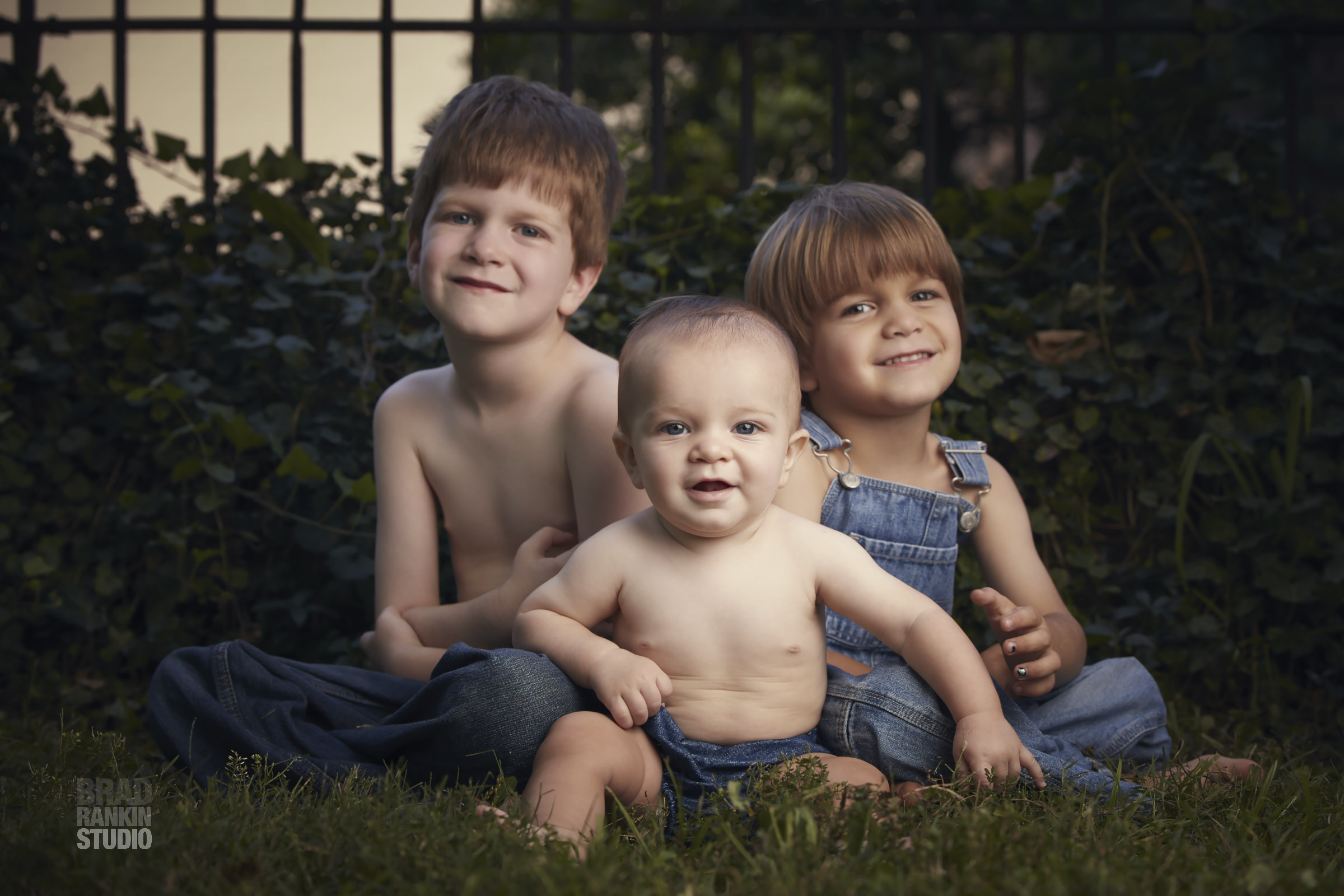
Then, I was facing the reality of THREE sons. All boys. No daughters.