
10 Things I Wish I Knew In The NICU

Lucia then

Amelia then
When I was pregnant with my twins in 2009, my Type-A personality kicked in to overdrive and I became obsessed with preparing our lives for these two little creatures. I carefully researched products, joined my local twins club for advice and support, and took a twins preparation class (“Twiniversity 101”). Being the control freak I am, I chose to deliver at the hospital with the best NICU in New York City and I switched to one of the best high-risk obstetrics practices, whereI insisted on weekly monitoring for any signs of preterm labor. I know that twins often come early and I was prepared for that possibility. Or so I thought. When my water broke suddenly at 30 weeks and my doctor informed me that the babies would be arriving imminently, I could not have felt less prepared. I wasn’t ready. I sobbed over and over that THEY weren’t ready. It wasn’t time yet. I held on for five days and then, at barely 31 weeks, my Baby A, Lucia, came roaring out with a bang, almost in the elevator. Baby B, Amelia, was distinctively less gung-ho to leave the warm, cozy womb (understandably) and she ambled out 5 hours and 12 minutes later. (Seventeen months later, this pretty much still says it all about their personalities.) At birth, Lucia weighed 2 pounds 15 ounces and Amelia weighed 3 pounds 6 ounces. Both girls were so tiny and so fragile, barely moving, and all I could think was that they shouldn’t be here yet. So began our NICU journey, which continued for the longest six weeks and two days of my life.
I am part of a wonderful community of mothers of twins (and a few fathers) here in NYC. Most of us had a long, difficult road to parenthood, and far too many of us endured days, weeks, and even months with our newborns confined to plastic incubators in hospital NICUs instead of at home with us. I naturally turned to my fellow twin moms when compiling a list of advice a few months ago for a friend of a friend’s sister (you know how that goes) who had just had preemie twins. The list that follows reflects my own experience in the NICU, along with the input of many of my fellow warrior moms. (We are indeed a special breed of mothers. The first few months of life with preemie twins feels like intense training to a be some sort of ninja warrior mom. Or a special edition of “Survivor: Twins.”)
1. You may not fall instantly in love with your baby/ies. You always imagine that just after your baby is born, the doctor will lay the baby on your chest, you’ll gaze into each others’ eyes, and you’ll immediately be overcome with a powerful love for your new baby. This is not what happens when you give birth to premature or sick babies. The second that baby emerges, there is an army of doctors, nurses, interns, residents, neonatalogists, and other assorted random people in the room who will whisk your baby/ies away before you even have a chance to realize that you’ve just given birth. I didn’t even get a glimpse of my babies until many hours after they were born, and that was only for a couple of minutes. I was not able to hold Lucia until about a week after she was born. Amelia was less stable, so it was even longer before I was permitted to touch her, and I only held her a handful of times during her first month of life. Our emotions were impossibly complicated during those early weeks: We didn’t feel “love” for our babies so much as an overwhelming sense of responsibility; we were in a state of limbo in which our children were “here” but they weren’t really here yet; we had children but we didn’t feel like we were parents yet. If you had asked me during that time if I had any children, I would have hesitated before answering. It wasn’t until Lucia and Amelia were about 8 weeks old that I was able to say “I love you” to them and that I really felt as though I loved them. But once I started, I couldn’t stop! (I’m pretty sure that by the time they are 13 years old and I am still telling them I love them 56 times a day, they are going to be really annoyed.)
2. Pick a primary nurse to care for your baby/ies. After a few days of getting to know the staff, it’s a good idea to pick a couple of nurses who you particularly like and ask the charge nurse that these nurses be assigned to your baby/ies as much as possible. Each nurse has a different style and different ideas about the best way to care for babies. The conflicting information from all of the different nurses about every little thing from the best swaddling technique to proper pacifier size will drive you nuts. Having one or two nurses you know and trust will help your own peace of mind and ensure continuity of care for your baby/ies.
3. You do not have to spend every waking moment in the NICU. The NICU nurses are the best babysitters you will ever have. Take advantage of this time to go out to dinner, see a movie, or get a massage. This is easier said than done when you have a baby or two in the hospital, but it is important to take a little time for yourself while you can. (Full disclosure: I was never able to put this into practice. I spent every waking minute at the hospital, with the exception of New Year’s Eve when I found myself drunkenly sobbing while pumping and dumping in the bathroom stall of crowded bar. But you should learn from me and not do that.)
4. Having your twins come home together is overrated. Twins rarely are released from the hospital on the same day. Baby A usually is a little stronger and is ready to go home before Baby B, who has a few more issues to overcome. (This is a fact and I asked around at the hospital repeatedly but could not for the life of me come up with a medical explanation as to why this is the case.) In our case, Lucia came home over a week before Amelia. When we were told they would not be ready on the same day, I went into a panic at how we would manage to have one baby in the hospital and one at home. It seemed too overwhelming. But after the fact, I think it worked out for the best because we had a little time to figure out how to incorporate one baby into our home before introducing the second one... at which point the complete chaos began and there was no turning back.
5. You absolutely, no question, without a doubt can breastfeed your baby/ies and you can breastfeed exclusively. Breastfeeding premature twins is the hardest thing I have ever done in my life. It is also the best, most rewarding thing I have ever done in my life. I have heard a lot of women say, “My babies were in the NICU so I couldn’t breastfeed,” but having babies in the NICU does not preclude breastfeeding. Right after my girls were born, I requested that a breast pump be brought to my room and that a lactation consultant stop by to help. From day one, I pumped for 20 minutes every 2-3 hours. At first I used the lactation room in the NICU, then I requested the hospital provide me with a pump to keep in my little corner of the NICU. I rented a hospital-grade pump for my home. (The Medela Classic is the best, most powerful pump, followed closely by the Medela Symphony.) I bought a Medela Pump-in-Style totebag and a handpump for my purse to cover any rare moments when I was not at the hospital or at home. I pumped the bejeezus out of my poor, sore, screaming breasts day and night. I drank gallons of water every day. I ate cheeseburgers as much as possible. I produced enough milk for Lucia, Amelia, and a small country. I kept the NICU freezer stocked with my breastmilk at all times and I made sure that every nurse who got anywhere near my babies knew that they were to get only breastmilk in their feeding tubes. I ended up breastfeeding for nine months, exclusively for six. (Once the feeding tubes were out towards the end of the NICU stay, making the transition to nursing was a monstrous challenge. So much so that it is a topic all its own, one for another day.)

Lucia now

Amelia now
6. Get to know the medical professionals caring for your children and make a point of meeting with them every single day to ask questions, no matter how minor. Introduce yourself to the pediatrician/s assigned to your baby. Introduce yourself to the charge nurse. Get to know the nurses in your area of the NICU. If your NICU is in a teaching hospital, find out what time rounds are and stand next to your baby/ies each day as the interns present to the attending. If you are in a large and crowded NICU, this may be the only way you’ll learn exactly what is going on with your babies and follow their progress. Be ready with questions. Jump in with questions during the presentation if there are words or concepts that you don’t understand. Each morning when you arrive, ask a nurse to notify the pediatrician that you would like to see him/her at some point during the day. If you are not proactive, you may discover that the hospital staff are too busy and overwhelmed with their own work to keep you in the loop.
7. Ask for a tour of the NICU, any materials on premature babies, and to explain all of the instrumentation, monitors and other tubes wires and blinking lights attached to your baby/ies. Days went by before anyone felt the need to explain the 83 different tubes and wires coming out of my babies’ noses and mouths and attached to their little arms, stomachs and feet. Lights would blink and alarms would sound and we had no idea what was going on. About a week after my babies were born, one of the staff members offered to take me on a tour of the NICU. As part of my exit package when we were discharged from the NICU, I was given all sorts of brochures on having premature babies that explained what to expect in the NICU, the terms most commonly used (“ brady,” “apnea,” “desat”... what???), and what all of the different monitors measure and what the numbers all mean. Let me tell you, this would have been helpful BEFORE I was walking out the door of the NICU. I was really irritated.
8. Nurses are the best teachers of newborn care. The one advantage of having babies in the NICU was that by the time they came home from the hospital, we were pros at newborn care and felt totally comfortable taking care of our babies. The NICU nurses have fabulous tips for how to best swaddle, hold, position, comfort, change, burp, bathe, and feed your baby/ies. Learn from them.
9. Do kangaroo care. “Kangaroo care” is when you strip your baby down to its diaper and hold her against your bare chest while resting in a chair or rocker for a couple ofhours or so. Studies have shown that kangaroo care can improve outcomes for premature and sick babies and can shorten the amount of time spent in the NICU. Kangaroo care is trickier than it seems because a nurse has to help you finagle all of the tubes and wires to transfer the baby from the isolette to your chest and then back into the isolette a couple of hours later, and while many nurses will be great advocates for you and happily assist, some nurses just can’t be bothered. I had many more nurses in the “can’t be bothered” camp and I wish I had pushed for more kangaroo care time with my babies.
10. This will all be a distant memory before you know it. I promise.
Allison Harris is a Lawyer Mom with Twins ("LMWT") in New York City and spends an inordinate amount of time corresponding with other twin moms. She recently managed to find the elusive job that offers actual work-life balance, enabling her to put her expensive law school education to good use while also enjoying plenty of time at home with The Ladies, weekend yoga classes, and regular dinners out with other LMWT.
This post originally appeared on Salt & Nectar.





Felix's Birth Story
The word STORY seems a bit of a stretch for something that took less than two hours but nothing about this child's arrival fit the mold so we'll just go with it.
Let's begin at the beginning. Both of my other births began in the morning after a nice full night's rest. Not this one! I woke up around 12:35 am with a hard belly. I thought maybe I just had to pee but knew it was odd because I almost never have Braxton Hicks contractions in the middle of the night. On the walk back from the bathroom, I realized the hard belly was accompanied by the slightest bit of cramping.
So, I laid down and waited to see if I would have another one. Sure enough, a few minutes later the hard belly made another appearance - this time with WAY more cramping. I decided to download a contraction counter app and call my midwife.
"I can't get out of my driveway," she replied when I told her I was in labor.
The word STORY seems a bit of a stretch for something that took less than two hours but nothing about this child's arrival fit the mold so we'll just go with it.
Let's begin at the beginning. Both of my other births began in the morning after a nice full night's rest. Not this one! I woke up around 12:35 am with a hard belly. I thought maybe I just had to pee but knew it was odd because I almost never have Braxton Hicks contractions in the middle of the night. On the walk back from the bathroom, I realized the hard belly was accompanied by the slightest bit of cramping.
So, I laid down and waited to see if I would have another one. Sure enough, a few minutes later the hard belly made another appearance - this time with WAY more cramping. I decided to download a contraction counter app and call my midwife.
"I can't get out of my driveway," she replied when I told her I was in labor.
Oh, right! I forgot to mention. Our entire area had received historic snowfall the day before and looked like this!

I told her that was fine and that we'd just go to the hospital. For a lot of reasons, I really wasn't that upset about not having a third home birth. I love my doctor who took amazing care of me during the loss of our baby. Also, due to that loss, there was a much bigger fear factor going in to this pregnancy - probably bigger than I had even admitted to myself. Not big enough that I would have volunteered for a hospital birth mind you but big enough I hadn't constructed a complete mental block to one either. Plus, with all the snow, I knew it was a real possibility and had been mentally preparing for a trip to labor and delivery.
ACTUALLY preparing, however, was another story.
Once I realized I had absolutely no clue what to do before you go to the hospital to give birth, I called one of my best friends who has had four natural hospital births. Alas, she didn't answer. So, I called my friend Annie, who had planned to come to town for the birth. She DID answer but was snowed in as well.
She asked if she should just text with Nicholas the rest of the time.
"Well, I haven't actually woken him up yet," I responded.
I think I knew once I got up and started moving around things were going to get REAL real fast. (Spoiler: I was right!) So, I laid there a few minutes more and searched Pinterest for hospital bag packing lists. Yes, I'm serious.
Finally, around 1 am, I went into the den where Nicholas was sleeping on the couch and said in a soft voice.
"Nicholas Holland. Guess who has two thumbs and is in labor?!?"
He sat up startled and guessed correctly!
I told him we needed to pack a bag and call my parents. Both of our cars were still snowed in and we would need my stepfather to drive us to the hospital. Luckily, we remembered our other two children sleeping peacefully and called my neighbor (shout out to MVP neighbors Kate and Tish who answered middle of the night calls for help!!!) to come sit with them.
I called my doctor and told her I was in labor. I also politely accused her witchcraft since she had predicted the baby would be born at 39 weeks and 2 days and I woke up at 12:30 am at 39 weeks and 2 days IN LABOR! She told me she'd meet me at the hospital but she had surgery at 7:45 am. I told her not to worry we'd be done by then.
We got our bag packed (After Nicholas exclaimed "I need a list!" and I offered up my previous Pinterest search.) and headed out the door.
By this time, my contractions were basically doubling in intensity and the breaks in between were shortening dramatically. As a result, everyone was getting on my damn nerves. My family chatted in car on the way to the hospital like we were going to a stinking cocktail party.
I finally screamed (lovingly) NO TALKING.
We got to the hospital and went to the wrong entrance (because HELLO! we had no idea where we were going!). They offered me a wheelchair but I walked to labor and delivery, which I'm sure helped things progress even faster than they already were. We walked through the doors and they had me sign a paper. Nicholas told them this was our first time at the hospital but that we had had two home births. Then, I had to go to the room by myself and assure the nurses I was not being domestically abused, using hard drugs, or had suffered any miscarriages.
Once Nicholas and my mom got back in the room, I relaxed a small amount and had the fleeting thought that I could actually get an epidural if I wanted one. I couldn't seem to get in front of the contractions and I couldn't get comfortable and I wasn't sure how long I would last like this.
About that time my water broke and I realized I was going to have this baby in a manner of minutes - not hours as I had originally thought.
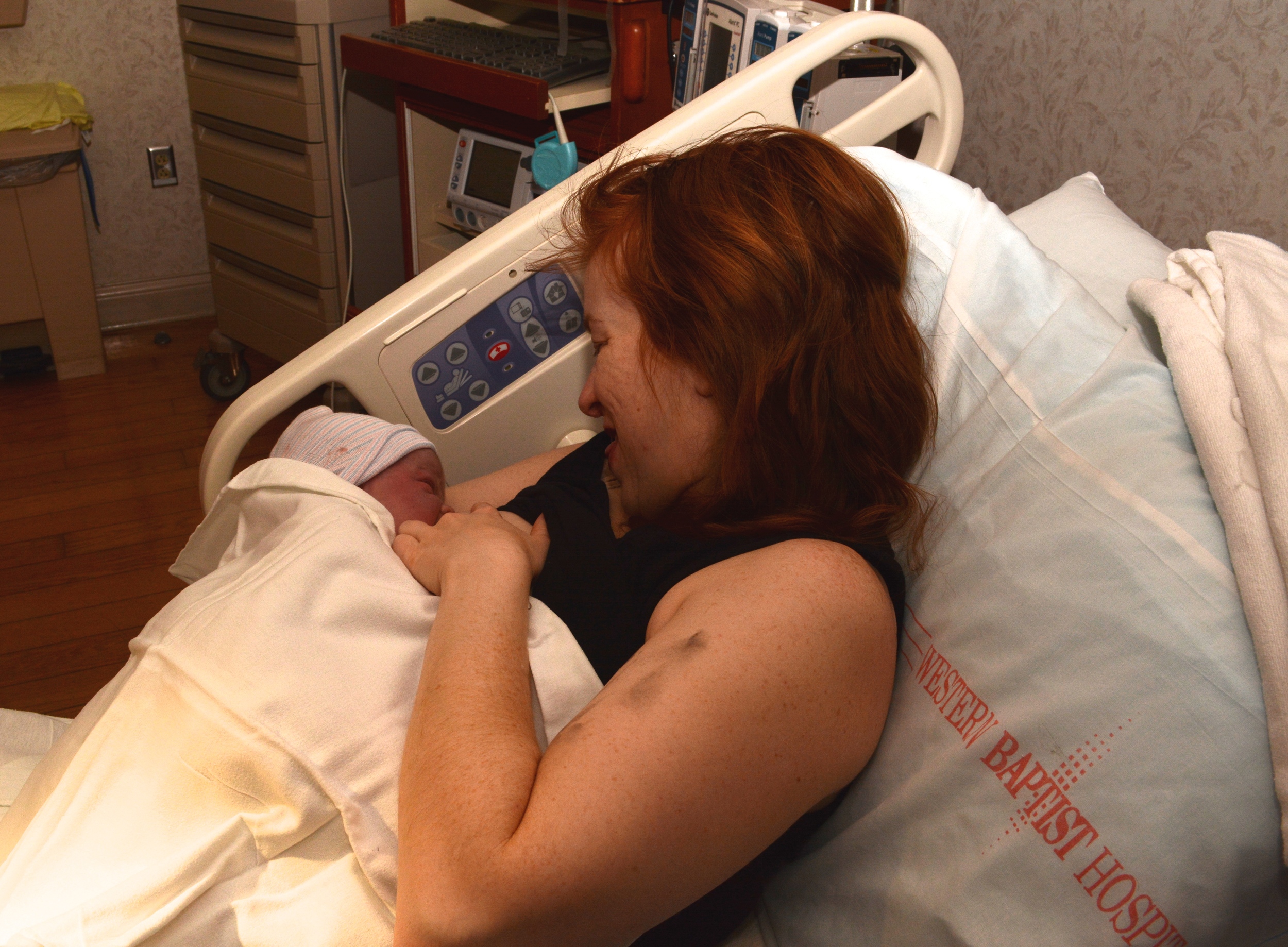
There was meconium in my fluid so they had to call in a NICU team to make sure the baby didn't aspirate any of the fluid. Then, they said they wanted to hook me up to a fetal monitor. I politely declined.
They checked the baby's heart rate and then checked me.
I was 8/9 cm dilated and fully effaced.
For those of you not versed in labor lingo, that translates roughly to PARTY TIME!
The nurses then told me my doctor was still 10 minutes away and to breathe through any desire to push. If I'd had the strength, I would have laughed in their faces. There is no stopping the barreling train that is a 9 pound baby, y'all. It's that simple.
So, I started to push, which is the exact moment I realized that one of the nurses WAS TRYING TO INSERT AN IV IN TO MY ARM AS MY BABY'S HEAD WAS CROWNING.
I started yelling, "Please stop! I cannot handle that right now you have to stop!"
I had the IV (and a lot of bruising) so I can only assume she did not. Fortunately, there's really only one thing you can focus on as your baby is exiting your body and it ain't a pushy nurse with an IV.
Two pushes later and Felix Robert Holland arrived at 3:02 am - approximately 17 minutes after we arrived at the hospital. He weighed 9 lbs and 6 oz and was 21.25 inches long.
They immediately assured us that he didn't aspirate any meconium and was doing great as he cried his little heart out.
My doctor arrived minutes later pointing to her shoes and exclaiming, "I didn't even lace my shoes!"
I delivered my placenta (after refusing help from my doctor and a nurse offering pitocin) and then asked my doctor when I could go home. She said after the baby was cleared by the pediatrician we were free to go and she'd tell the nurses to start prepping all the Against Medical Advice waivers I'd have to sign to bust out of the joint.
My main nurse Emily was really lovely - although thrown a little by many of my requests. First, I refused to let the baby leave the room and asked that his little baby checkups be done while I was holding him.
Then, I asked to take a shower to which she responded, "I don't know if it even works! Most people can't walk because of the epidural!" I told her I felt gross and could walk and needed a shower. She asked a ton of questions about my previous home births and midwife. I also asked for the head nurse who actually delivered Felix to come back so I could thank her. It just felt strange after treating my midwife like part of the family for years to not have had at least a conversation with her.
Around 7 am the pediatrician finally arrived. He is one of the longest practicing pediatricians in our area and has great - if not a bit stern - reputation. He advised me that while he didn't recommend leaving the hospital, the baby looked healthy and it was fine to do so as long as we saw my pediatrician within 24 hours.
So, around 8 am, we loaded up our beautiful baby boy and headed for my mother's house where we spent the next week snowed in (good timing after all, Felix!) and recovering.
11 Pieces of General, Yet Very Important, Advice
My name is Jenny. My internet last name is On The Spot. So, Jenny On The Spot is my full name.
But you can call me Jenny.
I am female. I have aged in the the early part of my 4th decade. I have 3 kids... 9, 12, and, 15. If you do the math I will soon have TWO teenagers, one of whom will be a licensed driver by the beginning of the summer.
Yes, I need a hug. Thank you for asking.

My name is Jenny. My internet last name is On The Spot. So, Jenny On The Spot is my full name.
But you can call me Jenny.
I am female. I have aged in the the early part of my 4th decade. I have 3 kids... 9, 12, and, 15. If you do the math I will soon have TWO teenagers, one of whom will be a licensed driver by the beginning of the summer.
Yes, I need a hug. Thank you for asking.
I am in no condition to run a 5k. But neither is my friend Sarah here, but she actually has a good reason... Related: COME ON LITTLE GUY! WE WANT TO SEE YOUR BABY FACE AND BABY TOES.
And mommy probably wants to SEE her OWN toes.
I just want to thank Sarah for entrusting me with prime real estate on her blog here today.
Inviting someone to share something on your blog is a lot like allowing a someone to throw a party at your house.
As the party thrower in this, Sarah's home... I had some concern.
WHAT IF I TRASH THE PLACE?!
WHAT IF SHE DOESN'T HAVE DISH TOWELS?
There was one time I threw a baby shower at another person's house (an acquaintance). Or was it a wedding shower? In any case... I got there with a whole lot of food to prep. and did you know SOME PEOPLE DON'T USE DISH TOWELS?
I have no idea what the alternative is, but I may or may not have a *thing* about dishtowels...

Especially white ones.
Piece of Advice #1: Always have plenty of dish towels. I recommend white because you can bleach out the shame that certain messes leave on dish towels.
I also have a *thing* about baby wipes.
Piece of Advice #2: Baby wipes aren't just for babies anymore.
That's not really an advice statement.
What I MEANT to write was... Never don't have baby wipes on hand.
That's better.
If you ignore the double negative and whathaveyou.
My babies are no longer babies... but I assert - babies are not needed to keep baby wipes on hand. I keep them in the car, and in the bathroom, and in the kitchen, and in the laundry room... Baby wipes are the rich uncle to the nephew who always has to get bailed out of jail.
In short: You never know when you are going to need a rich uncle/baby wipes.
Piece of Advice #3: Don't do anything that would put you in a place where you will need to get bailed out of jail/call your rich uncle. That should go without saying, but... PEOPLE THESE DAYS.
I'm not trying to mother you, but I am a mom. Don't go to jail. BECAUSE I SAID SO.
Piece of Advice #4: Don't trust anyone who offers advice without solicitation.
Except me.
Piece of Advice #5: Be kind to yourself... like that one friend you have that is way too sweet. Be her (or him), to yourself. I don't actually know how to do that, but I've read we people tend to be quite hard on ourselves and I've always wanted to take that advice.
Piece of Advice #6: Drink plenty of water everyday. That's always good advice. If I do say so myself.

Piece of Advice #7: Make time for friends. I have been really bad about this, so this is just as much a reminder for me as it is for you.
Warning: if you DO end up having to get bailed out of jail, it will probably be because of friends like my friend there on the left.
Totally worth it.
Piece of Advice #8: Don't wait until the day before you are supposed to meet with your tax guy to pull together all your stuff for your personal taxes and 2 small businesses. Just don't. Trust me.
Piece of Advice #9: If you are a dog owner... never give your dogs the benefit of the doubt. They WILL work very hard to consume the roll of tape/lip gloss/leather boots/Converse/paperback book/hardback book you left out... Your daughter's "very special" water bottle you saw sitting on the coffee table as you were running out the door very late and thought, "Oh that'll be fine."
It will not be fine.

#thugs
Piece of Advice #10: If you have children... your kids are smarter than you.
I guess that's not advice. It's a truth statement that you really need to be aware of.
Just because a person can't speak, tie shoes, or eat solid food... doesn't mean they're not smart. OH NO. They may not be able to sit up on their own but they have got you wrapped around their tiny (yet chubby) little finger. ALL OF THEIR FINGERS.
There's really no advice (a.k.a. WARNING) one can give when it comes to children and their cunning. The best I can give: Just beware.
They're worse than dogs.
But also way better.
Even at 9, 12, and 15 they still have me wrapped around their not-so-little fingers.

Piece of Advice #11: Take lots of selfies with your people...
You just have to. It's the very best. That is something you will never regret.
Your teen might regret it, but your teen is still living under your roof, so... SELFIE TIME!
The last thing I would like to add is...
MERRY NEW BABY TO MY FRIEND! I feel all the emotions when my friends add to their numbers. The excitement. The fear. Sometimes jealousy (I don't even know why I miss those sleep-deprived baby days, but golly I sure miss those days sometimes!). The joy... that new baby head smell!
There really is no new advice under the sun. Just the reminder to sleep when you can (I regret not heeding that advice), soak in all the baby goodness... revel in the beauty of new sibling love. It will never be more sweet than in the beginning. Because sibling rivalry kicks in and... I'm sorry. I am digressing...
Kiss those cheeks, take lots of pictures (SELFIES TOO, MAMA!), let that little guy melt into your chest for long naps. It goes so fast. As you know. Those moments are THE moments. And you just can't jump back in time to do it again.
At least I don't think we can time travel just yet...



Ashley Martin and "Picture Perfect Births"
Home birth is back in the news. In early December, the British health service released new statistics on the use of midwives at home and in birthing centers. Based on these findings, they concluded healthy women were safer delivering with a midwife at home or in a birthing center than in a hospital. These findings prompted the New York Times Editorial Board to officially recommend a more welcoming approach to midwifery and home births here in the United States.
On one of her recent shows highlighting these findings, Diane Rehm noted that there seemed to be consensus among her guests and the medical community - midwives offer a better standard of care and real lessons for the medical community on how the patient experience.
Unfortunately, despite the growing evidence that midwives and home births can be a safe options for mothers, my most recent discussions involving home birth have centered around a viral post on PopSugar entitled "What A Home Birth Is Like: My True Feelings Regarding My Home Birth Experience" by Ashley Martin.

Home birth is back in the news. In early December, the British health service released new statistics on the use of midwives at home and in birthing centers. Based on these findings, they concluded healthy women were safer delivering with a midwife at home or in a birthing center than in a hospital. These findings prompted the New York Times Editorial Board to officially recommend a more welcoming approach to midwifery and home births here in the United States.
On one of her recent shows highlighting these findings, Diane Rehm noted that there seemed to be a consensus among her guests and the medical community - midwives offer a better standard of care and real lessons on how to improve the patient experience.
Unfortunately, despite the growing evidence that midwives and home births can be a safe option for mothers, my most recent discussions involving home birth have centered around a viral post on PopSugar entitled "What A Home Birth Is Like: My True Feelings Regarding My Home Birth Experience" by Ashley Martin.
In the post, Ashley shares her traumatic home birth experience that led to both her and her son being transferred to the hospital. Ashley is obviously still feeling the effects of this traumatic experience and I am so, so sorry for that.
“I have nightmares about my birth. I think about it constantly. It consumes me. It has changed who I am as a person.”
However, I am honestly troubled by the way in which she describes her journey to home birth and I think - as valid as her story is - using it to represent the dangers of home birth is incredibly problematic.
Ashley spends a lot of time describing the home birth experience she was expecting.
“I went into my home birth wanting that picture perfect birth — just like all the other home birth photos showed... I wanted a fairy tale — picture perfect birth. ”
In fact, Ashley admits to investing hundreds of dollars in birth photography. The post itself is in response to the release of these photos on the internet. PopSugar even describes the previous post as a "beautiful photographed" home birth.
I full admit to being swept up into this newest trend. When Griffin was born, having your home birth photographed was not a thing. Not to mention, due to the legal implications of our birth, photographs didn't seem like such a great idea. Amos's birth was documented but not by a professional. However, as I saw more photos and videos of home births, it seemed like such a wonderful idea.
No one loves to document more than me! Plus, these images seemed to undo all the negative stereotypes surrounding home birth and paint a VERY different visual than the imagery surrounding hospital births. Surely, that was a good thing?
Of course, after reading Ashley's story, I see the downside of "beautifully photographed" home births, especially if they perpetuate the myth of a "picture perfect birth."
Y'all, let me be VERY clear, there is no such thing as a perfect birth. The word perfect should not ever be used to describe an event during which one can poop oneself. Period.
My births were really wonderful. I gave birth to BIG babies without a ton of hard labor and with minimal pushing. I had zero intervention and great recoveries. However, there was nothing "pretty" or "glamorous" about it. I threw up. I screamed. I cried. I was unkind to my family members. I even had a few moments of panic.
Birth is WORK. In my opinion, it's the best kind of work - work where your mental and physical and spiritual selves align. I realized recently when reading about Mihaly Csikszentmihalyi and the concept of flow (what he considers to be the secret to happiness) that that is what I experience during birth - full immersion in the process and a feeling of total focus and enjoyment.
And that's where else I take issue with Ashley's description of birth.
“We shouldn’t trust birth, we should respect it.... Birth is just about luck — making sure all the stars align perfectly.”
I couldn't disagree more.
Birth is not about luck and implying that it is involves a passive acceptance of the process that too often leads to victimization and trauma. It is also not about blind trust in either your body or your caregiver - be they a doctor or a midwife.
There are million factors - many we understand and many we don't - that contribute to birth. Not to mention, every mother, every baby, every birth is special and unique and no approach - be it a midwife's or a doctor's - holds the answer to every single scenario.
There IS some trust involved and from Ashley's description it seems like her's was misplaced.
“I was misled, lied too, and manipulated. Informed consent? Hah. I wish.
I left my birth feeling broken, beaten down, cheated. I felt like no one there really cared about the most important thing: my child’s safety and well-being.”
Unfortunately, I've heard people describe hospital births in exactly the same way - people who left a health care experience feeling surprised and traumatized that what they considered to be their best interests were not being met. I've recently had this discussion with many of my close friends regarding not just birth but birth control options, infertility, and general hormonal issues.
You cannot simply hand over the decision making for your health to a provider - be it a doctor or a midwife. No one has the same values and priorities as you do. No one knows your body the way you do. No one is invested in the outcome as much as you are.
None of this is to say what happened to Ashley Martin is her fault. If she was lied to or her concerns were brushed off, then there are some real problems with her midwife and care providers that need to be addressed. Not to mention, she states that "No one was monitoring my vitals or his. No one was trained for this type of emergency." which obviously is a massive danger.
However, there are no perfect home births and we don't need perfect outcomes to decide on the safety of home birth either. Anecdotal evidence - like what happened to Ashley Martin - is not how we should assess the future of home birth in this country.
As I often say, the presence of ANY risk does not define a behavior as unsafe.
There are risks involved with ALL birth and they are not erased once one crosses the threshold of a hospital. My favorite question I get when I tell people I am planning a home birth is, "What if something goes wrong?"
The implication being nothing goes wrong at a hospital.
There are risks unique to a hospital birth. There are risks unique to a home birth. Believe me, as I plan my third home birth after a pregnancy loss due to cord injury, I have thought A LOT about these risks.
However, I cannot let the emotional and fearful voices in my head run my life. If I did, I would never have gotten pregnant again in the first place. I can't even rely solely on my previous home birth experiences - which are no less anecdotal than Ashley Martin's.
I have to look at the mounting evidence that states home birth is safe and complications rare. I have to look at the incredible experience of my midwife who has delivered over 700 babies and has encountered almost every complication imaginable. I have to look at my amazing obstetrician who supports my decision and is there in an emergency should I need her. And, yes, I have to look to my own body and build back a trust that was lost after the death of our baby.
The one thing I'm not looking for is perfection.
You'll never believe that THIS is a crime.
Today is International Day of the Midwife. Began by the International Conference of Midwives, this year's theme is "Midwives changing the world one family at a time."
Obviously, I feel passionately about the cause of midwifery. My midwife is like a member of my family. She gave me the births I always wanted. She supported me. She encouraged me. She brought my two boys into the world safely, which is a gift I can never repay.
She also committed a crime.

Today is International Day of the Midwife. Began by the International Conference of Midwives, this year's theme is "Midwives changing the world one family at a time."
Obviously, I feel passionately about the cause of midwifery. My midwife is like a member of my family. She gave me the births I always wanted. She supported me. She encouraged me. She brought my two boys into the world safely, which is a gift I can never repay.
She also committed a crime.

Currently, the state of Kentucky does not provide a legal path to licensure for midwives. As a result, any midwife helping a woman deliver at home is practicing medicine without a license, which is a felony. Despite the fact that the number of women giving birth at home is growing (especially in this state), midwives in Kentucky must accept great personal risk to provide care for these women.
The Kentucky Home Birth Coalition is a grass-roots organization working to change the law and provide a legal path to licensure for direct entry midwives using the Certified Professional Midwives (CPM) credential in Kentucky.
Regulating home births that are GOING TO HAPPEN ANYWAY increases the safety of birth. Home births in this state are growing, including a huge Amish population that is not going to a hospital. Instead of pushing this process underground where people not properly trained can practice midwifery, it is in everyone's best interest to regulate and assure that any midwife practicing is properly trained and licensed.
To celebrate the International Day of the Midwife, I'm asking you to give just $5 to support the Kentucky Home Birth Coalition in their mission. Give $5 if you've been affected by my story, if you think women should have the births they want without breaking the law, or if you love the two little boys I delivered at home!

Emily Oster's Expecting Better

I should have been in an economist. All my favorite books are written by economists. I love the data driven approach to problem solving and I generally find them a funny, personable group.
I'm now adding Emily Oster to my list of favorite economists and Expecting Better: Why the Conventional Pregnancy Wisdom is Wrong - and What You Really Need to Know to my list of favorite pregnancy books.
Pregnancy advice - both that found within books and in the doctor's office - often seems based on little more conjecture and anecdotal guessing. And that's assuming it stays the same, which it often doesn't. One day coffee is ok. The next it isn't. One day home birth will kill your baby. The next day not so much.
Oster approaches each recommendation and pregnancy decision with deliberation and data. However, as a mom herself, she also brings a particularly personal approach as she shares her own decision-making process and tells the story of her first pregnancy.
I learned so much while reading her book, despite going through two pregnancies and considering myself a bit of an expert. For once and for all, runny eggs and sushi are ok! YIPEE! There is ZERO evidence bed rest is helpful. (!?!?) Any toxins you encounter during the two weeks between conception and your missed period have no effect if your pregnancy goes to term. THAT information would have saved me a lot of anxiety with my first two pregnancies.
Oster also addresses the process of labor and delivery. As a passionate advocate for natural birth, I was happy to see Oster ultimately decided on natural birth after assessing the data. Although, I was disappointed that she neglected to address water as a natural pain remedy because I found it to be an incredibly effective pain relief method in my first birth (especially as compared to my second birth outside the water).
I was also happy with Oster's analysis of home birth risks. She seems to do a fair and reasonable assessment of the studies and concludes the risks are low. One small issue I had is she seems to make the same mistake many people do when assessing the risk of serious complications during a home birth, which is ignoring the fact that serious complications could also arise in a hospital. Medical errors are real. Antibiotic resistant infections are real. The risks of these complications are small but so are the risks of having a life-threatening complication at home and not getting to the hospital in time.
My last small criticism also (not surprisingly) has to do with my own experience. Oster puts a great deal of emphasis on the training of one's midwife, eventually concluding that a certified nurse midwife is the best choice over a direct entry midwife due to training. I would argue one should not completely ignore experience. A direct entry midwife that has successfully attended 300 births is an infinitely better choice than a certified nurse midwife with fewer than 50 births under her belt. The training is absolutely an asset but experience should be an important factor to consider.
My small criticisms aside I found Oster's book to be empowering. Far from the condescending tone taken in most pregnancy books, she offers up the facts and encourages women to make up their own minds. Good advice, indeed.
What's your favorite pregnancy book? Any pregnancy advice you'd loved to have debunked!?!
The Cost of a Home Birth
Yesterday, the New York Times published an excellent piece entitled American Way of Birth, Costliest in the World. Following the struggles of several families without maternity coverage, Elizabeth Rosenthal examines the way maternity care is priced and the impact of high costs on care.
This about sums it up:
“We’ve created incentives that encourage more expensive care, rather than care that is good for the mother,” said Maureen Corry, the executive director of Childbirth Connection.
I truly wish I could say I’m surprised. I am not.
As I’ve said before, our system is broken. We spend more money on birth and get worse outcomes than any other industrialized nation. I saw the uphill battle I would face inside that system and decided to opt out.
I chose to have a home birth. Let me tell you what it cost me.

Yesterday, the New York Times published an excellent piece entitled American Way of Birth, Costliest in the World. Following the struggles of several families without maternity coverage, Elizabeth Rosenthal examines the way maternity care is priced and the impact of high costs on care.
This about sums it up:
“We’ve created incentives that encourage more expensive care, rather than care that is good for the mother,” said Maureen Corry, the executive director of Childbirth Connection.
I truly wish I could say I’m surprised. I am not.
As I’ve said before, our system is broken. We spend more money on birth and get worse outcomes than any other industrialized nation. I saw the uphill battle I would face inside that system and decided to opt out.
I chose to have a home birth. Let me tell you what it cost me.
My midwife charges a flat fee for her services. The fee includes all of my prenatal visits, including doppler monitoring, blood pressure tests, glucose screening, and urine tests. I see my midwife monthly in the first two trimesters and then bi-weekly in the last few weeks. My visits usually last from one to two hours. There is no waiting room or long waits in the exam room. I go to her house or she comes to mine. I have her complete and undivided attention the entire visit. She asks about my diet, my stress level, and my family. She answers as many questions as I have.
The fee also includes the birth. I purchase my own birthing pool and some of my own supplies. My midwife comes with an assistant the moment my contractions begin and stays with me until hours after the birth. She continuously monitors me and the baby, coaches and supports me through contractions, and is prepared in the case of emergencies. She stays for three to four hours after the birth and helps me shower, get settled, and establish breastfeeding.
The fee also includes my postnatal care. My midwife comes to my house the following two days after I give birth and once a week for two weeks after that. She checks me and the baby and again usually spends at least an hour checking in on my mental state.
The level of care my midwife provides is priceless. I feel completely and totally safe in her care. I trust her to the core of my being and she is considered a member of my family.
But how much do I actually pay her?
$1600.
That’s it.
I pay her directly because she does not accept insurance. My insurance company would technically reimburse a percentage of my expenses but in order to do that I'd have to submit a bill with all the official billing codes, which my midwife doesn't do.
Now, my midwife cannot provide ultrasounds or do Group B strep tests. Therefore, I went to my OB-GYN’s office for those tests. I was very luck that my doctor during my second pregnancy was very supportive of my home birth (my first pregnancy is another story) and generally let me control my treatment. I had one ultrasound and the recommended screenings - nothing more.
Luckily, I had maternity coverage with both pregnancies so my out-of-pocket expense was minimum. I would estimate I paid approximately $200 to $300 dollars.
So, with supplies and additional doctor’s visits, that puts the total cost for each of my birth at about $2,000.
I paid less than almost any other pregnant person I know and got the births I had always wanted. (Well, I didn’t necessarily WANT nine pound babies but you get my point.)
I wouldn’t recommend a home birth to someone whose main motivation is to save money. However, I would argue that the cost structure of my home birth - much less the care itself - offers a very simple lesson for the health care community.
Expensive care is not better care. (Click to tweet.)
If you've given birth or had a partner that has given birth, how much did it cost? Were you surprised by the total? Was expense even something you considered?

Amos's Birth Story

The contractions started at around 10:30am. The night before I was convinced I was about to go into labor. I could feel Amos dropping down into my pelvis. I went for a long walk, relaxing into every Braxton Hicks contraction. I tried other suggested activities (insert throat clearing here) to bring on labor. Finally, I went to bed.
I woke up still pregnant...and cranky as hell.
I tried to go about my day. I took Griffin to the park. My grandmother came over for a visit. Around 11am, I noticed the nonstop Braxton Hicks contractions had taken on the more distinctive characteristics of menstrual cramps. I called my midwife — at first, suggesting that she stop at another visit before coming to my house. Two contractions later, I called her back and said, “Scratch that. Come here first.”
My grandmother stayed with Griffin, while I went to pick up Nicholas from work. He dropped me off my mother’s, where I laid on my left side to slow the contractions until my midwife’s arrival. They were still completely manageable at this point. I had on Oprah’s Master Class in the background, which was sort of amazing. It was like Oprah was in the room coaching me. (Y’all KNEW I wouldn’t give birth without at least one Oprah reference!)
About an hour and a half later, my midwife and her assistant arrived. She checked me and said I was between 2-3 centimeters. I spent the next hour walking around and squatting into the contractions. Working very hard to move things along, I knew I could get in the pool once I was at about 6 centimeters — anything short of that there was a chance the pool would actually slow down my labor.
Another hour or so later, my midwife checked me again. This time I was a solid three centimeters and much more effaced. More walking. More squatting. I was finding it difficult to get in a relaxing position. Finally, I got on exercise ball and braced myself on the side of couch. My midwife’s assistant would push hard on my lower back during every contraction. That pressure and my breath was all I had to get me through and things were starting to get intense.
I started to complain. I didn’t remember it hurting this much last time I said. This baby’s head must be huge I said. I wasn't getting time to rest because they were coming two at a time. The complaining turned to moaning turned to more than a couple of screams.
I kept waiting for my midwife to say it was time to check me again. Finally, I was at the end of my rope. I wanted to get in the pool. I didn’t care if I was 3.5 centimeters and my labor came to a screeching halt.
Pool. Now.
I made the long walk back to the bedroom for my midwife to check me.
9 centimeters! HOLLA!
And this is where things get exciting. My midwife yells out, “Anyone who wants to see this baby be born, better come now!” I walk back into the foyer where the pool is. Inexplicably, Griffin is in the next room doing a puzzle. (He had been taking a nap up until this point.) After some pretty serious rushing, he and my stepfather leave.
I get in the pool. At my next contraction, I feel the urge to push and my water breaks. I start pushing and screaming. Minutes later, Amos is crowning. I’m leaning over the side of the pool when his head emerges. My midwife has me get on my back (and by that I mean she and her assistant pick me up and flip me like a pancake). One more push and Amos Edward Holland was born.
Despite being in an enormous amount of pain, I felt that instant sky-clearing-ray-of-light-shining-down moment of pure love for this baby in my arms. I would describe Griffin’s labor and delivery as easier but I didn’t really have that intense bond with him the moment he was placed in my arms.
It was completely and totally mind-blowing.
Maybe it was because the labor went so fast — a mere six hours from first cramp to his birth. Maybe it was because the labor had been so hard. Let me tell you — going from 3 centimeters to 9 centimeters in a little over an hour AIN’T EASY. My first birth was a lesson in trusting my body. My second birth was a lesson in trusting my gut, which was screaming, “Get in the pool! This bloody hurts!”
Either way that moment was worth it all.
My podcasts


Subscribe to my weekly email


- August 2017
- March 2017
- January 2017
- November 2016
- October 2016
- September 2016
- August 2016
- June 2016
- May 2016
- April 2016
- March 2016
- February 2016
- January 2016
- December 2015
- November 2015
- October 2015
- September 2015
- August 2015
- July 2015
- June 2015
- May 2015
- April 2015
- March 2015
- February 2015
- January 2015
- December 2014
- November 2014
- October 2014
- September 2014
- August 2014
- July 2014
- June 2014
- May 2014
- April 2014
- March 2014
- February 2014
- January 2014
- December 2013
- November 2013
- October 2013
- September 2013
- August 2013
- July 2013
- June 2013
- May 2013
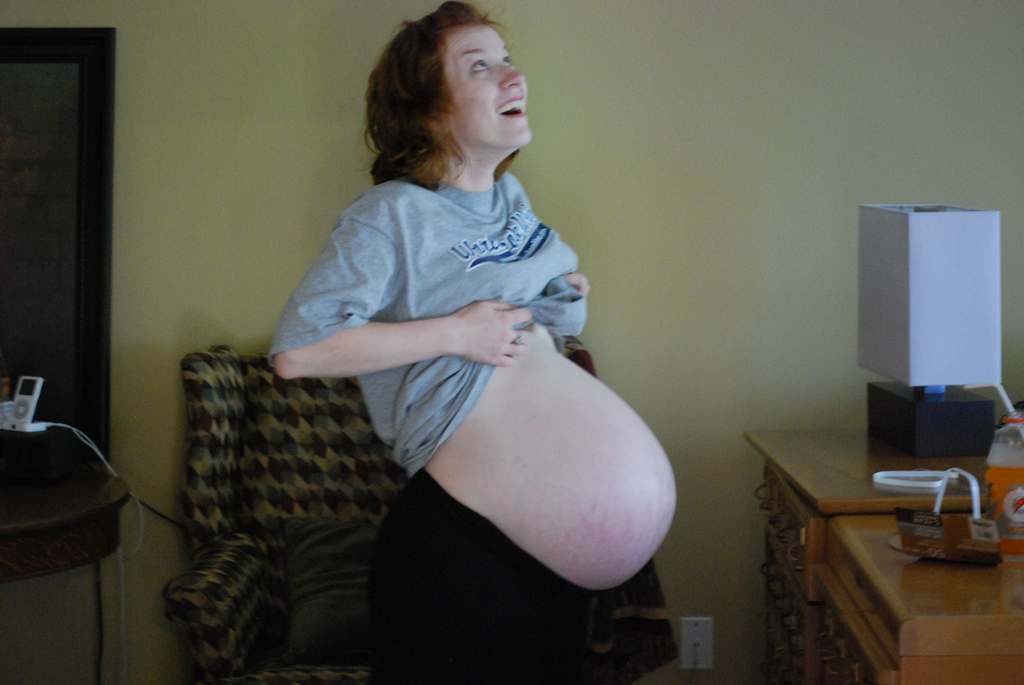
Since I’m at the peak of my reproductive years, I always have about nine friends who are pregnant at any given time. No matter where I am, one of them is there. With her swollen belly, she insists she is the biggest pregnant woman to walk the earth. I smile. I promise her I was bigger…MUCH bigger. She smiles—sure I’m just trying to make her feel better.
Then, I pull up this picture on my phone.