
Are people doing the best they can?
This weekend I finished the audio version of Brené Brown's new book Rising Strong.
Y'all. This book broke my brain.
If you are unfamiliar with Brené's work, stop what you are doing and watch this Ted Talk.
This weekend I finished the audio version of Brené Brown's new book Rising Strong.
Y'all. This book broke my brain.
If you are unfamiliar with Brené's work, stop what you are doing and watch this Ted Talk.
She is AMAZING. Her teachings on shame and vulnerability, including her books The Gifts of Imperfection: Let Go of Who You Think You're Supposed to Be and Embrace Who You Are and Daring Greatly, instruct everything I do. Her insights have helped me re-evaluate my relationships, my work, my creative process, my parenting.
In Rising Strong, she advocates "getting curious" about our emotions... in particular, when we are feeling self-righteous.
Not going to lie. I'm REAL good at feeling self-righteous. It's my go-to emotion when I'm feeling hurt or angry or unappreciated. During one of Brené's own bouts of self-righteousness, her therapist asks her a powerful question.
"Do you think people are doing the best they can?"
Brené answers with a resounding, "NO!" And as she goes on to explain why the "sewer rats and scofflaws" are keeping us all from living big, I found myself yelling along with the radio.
"EXACTLY! You tell them Brené!"
It's SO HARD to assume the best of people when they are hurting us or shaming us or even ignoring us. I don't want to assume the passive agressive woman at church is really doing the best she can. I don't even want to assume the best of people I dearly love - like my own husband - when I'm in the midst of feeling resentful and angry.
However, we've all been on the other side of judgment and pain. We've all been someone else's "sewer rat and scofflaw" and we all know that - at that time - we were doing the best we could.
Now hear me, that doesn't mean we were doing THE BEST THERE WAS TO DO.
When I yell at my four-year-old, I know it's not the best I'm capable of - objectively speaking. However, in that moment, considering my stress level, my energy level, and God knows what else I am doing the best I can with the tools available to me. I don't love him any less in that moment then when I am patient and calm. I'm just doing the best I can.
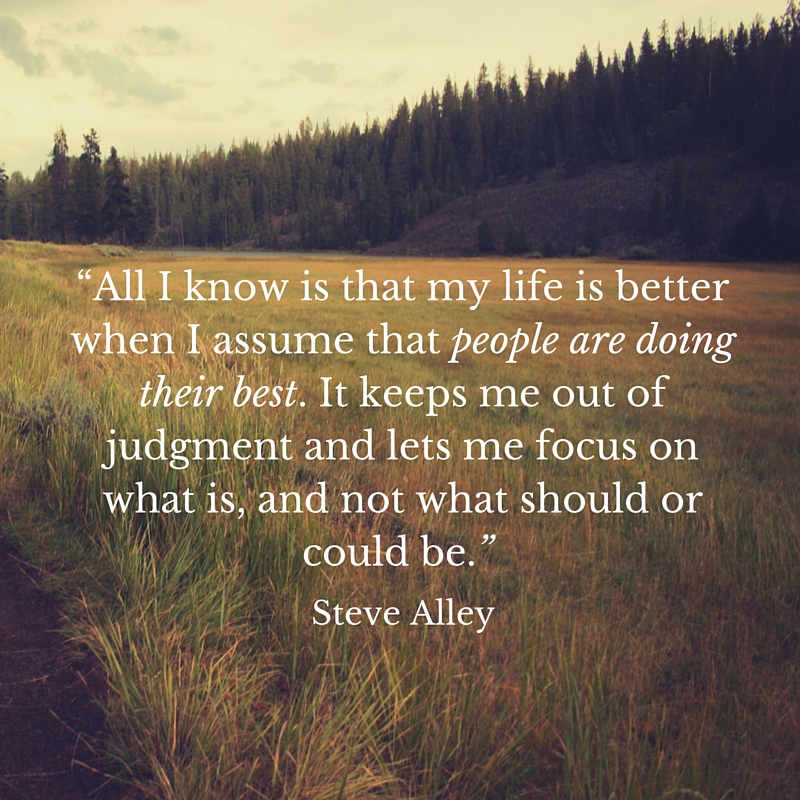
It's Brené's husband Steve who eventually states what feels like trurth to me. When she asks him if people are doing the best they can, he answers, “I don’t know. I really don’t. All I know is that my life is better when I assume that people are doing their best. It keeps me out of judgment and lets me focus on what is, and not what should or could be.”
She then quickly addresses the "murderers, assassins, and terrorists" question we all have.
Are murderer really doing the best they can?
Her answer?
Yes, but their best is DANGEROUS.
And that's when my brain broke. I've been struggling recently with the concept of choice and personal responsibility, when it comes to my kids and when it comes to society as a whole. As we learn more and more about how the brain responds under stress, how can we really ascribe choice and then punishment to people who are suffering under incredibly difficult situations - from poverty to addiction to trauma? With regards to the little terrorists I live with on a daily basis, how can we punish a four-year-old who literally can't act differently?
The brilliance of her answer is it separates EFFORT FROM RESULT.
Yes, you are doing the best you can and we acknowledge your humanity and suffering. However, the result of your actions are important as well. Whether you are hitting your brother or committing murder, why you did what you did is separate from why we can't allow you to do that again.
So, what do y'all think? Are people doing the best they can?
POLL TIME: Are people doing the best they can?
Posted by Sarah Stewart Holland on Wednesday, October 14, 2015


Forgiveness

We’ve been at the beach for four days now. More times than I can count I’ve dove in the ocean or the pool only to kick my way to the surface seconds later. The moment I break the surface of the water and take a breath always feel a little magical.
It’s how I feel right now. I feel like I’m breaking the surface of this funk. I’m coming up for air.
It feels so, so good.
It feels like I’m letting things go. It feels like I’m moving on. It feels like I’m finding my balance.
Of course, JUST when you get your balance life has a way of shoving you off your feet. Yesterday, at the pool, I had pulled Amos with me into the deep end to practice his swimming. He has been fighting us tooth and nail all summer, but we’d forgotten his floaties and I decided now was my chance.
He cried and hollered. I told him he knew how to blow bubbles and hold his breath that I’ve seen him do it all summer. I dropped his underwater a few times and sure enough he did exactly what I thought he would do. He held his breath and blew his bubbles.
Still, he’s a stubborn kid and he kept fighting me. I stayed calm. I told him I could stand here all day and that his friends were having fun and he could join them if he tried. I told him he was a big strong boy and I knew he could do it.
He calmed down a little but the second he’d go underwater he’d freak out again and grasp for me. I never let him go. He never choked, but he still kept fighting me.
Finally, a lady came over and said, “If you dunk him one more time, I’m going to report you. I’m a licensed reporter. That is not the way to do it and everyone is watching. I’m DISGUSTED.”
I just stood there. Speechless. Amos in my arms. Then, I went to the steps and kept practicing with Amos, who finally agreed to go under water if I went with him.
Meanwhile, I was in a full blown shame spiral. I felt terrible. Maybe I was pushing Amos too hard? Maybe I was going about it the wrong way?
I wanted it to be simple. She was a bitch and I was doing nothing wrong and that was the end of it.
I’ve had a lot of confrontations with friends and some strangers over the past few years. Confrontations that still haunt me when – like now – I’m feeling vulnerable. They’re old wounds I like to reopen when I’m feeling sorry for myself. Broken friendships. Hurtful comments. Tokens of my failings I spread out on the table to prove I’m actually as terrible as I feel.
I want my own personal brand of closure for each one. I want the person to sit down and apologize for hurting me and it has taken me so, so long to realize that is not EVER going to happen.
It wouldn’t matter if it did. It’s almost never as simple as they were wrong and I was right. I wish it was.
In an interesting twist, it was a book on organizing that finally helped me see the light. In The Life-Changing Magic of Tidying Up, Marie Kondo states simply,
Not every person you meet in life will become a close friend or lover. Some you will find hard to get along with or impossible to like. But these people, too, teach you the precious lesson of who you do like, so that you will appreciate those special people even more.
I want every friend to be my best friend. I want every stranger – including the lady at the pool - to see my parenting and think I’m the BEST.
Alas, it doesn’t work like that. Some people are only around for seasons. Some are meant to teach you valuable lessons.
The biggest lesson I need to learn is forgiveness - whether I get my cathartic closure or not. The first thing Annie says every time I come to her complaining about the latest insult or insensitivity is "Have you forgiven them?" I know she's right and I know it will be a struggle.
Forgiveness is so hard because I'm unforgiving of myself. I've beat myself up all day about the pool fiasco. Telling myself I was wrong. Telling myself I traumatized Amos.
Instead, I should acknowledge the complexity of the situation. I was not at my best and neither was she I'm guessing. I'm still a good mother and she's probably a good person.
I can't control anything about that woman or anyone else who has hurt me in the past. All I can do is choose to learn a lesson, practice forgiveness, and move. on.
Until tomorrow,
Sarah


What to do when your child fails
I became a mother six years ago and I'll always remember one of the first truths my own mother told me about raising a child.
The second you figure your child and a particular phase out - the second you think "I got this!" - they change.
I should have known kindergarten was going a little too smoothly. Despite my own misgivings about the beginning of elementary school, Griffin handled it well. We quickly established a morning routine that worked well for our family. Except for the occasional hunt for a rogue shoe, we have breakfast without too much yelling or prompting. There were never any tears or separation anxiety at drop off. We tackled homework easily and only had one day where Griffin went beyond "yellow" or a single warning for bad behavior. Most days he was on "green" for good behavior and seemed to sincerely enjoy going to school.
In full disclosure, Griffin's kindergarten teacher is one of the best. She is warm, fun, and stays cool and calm at every turn. She also happens to be one of my dearest friends so we were more than a little bit spoiled on that front.
Between the great teacher and drama-free days, I had JUST started to pat myself on the back for a successful year.
That was stupid.

I became a mother six years ago and I'll always remember one of the first truths my own mother told me about raising a child.
The second you figure your child and a particular phase out - the second you think "I got this!" - they change.
I should have known kindergarten was going a little too smoothly. Despite my own misgivings about the beginning of elementary school, Griffin handled it well. We quickly established a morning routine that worked well for our family. Except for the occasional hunt for a rogue shoe, we have breakfast without too much yelling or prompting. There were never any tears or separation anxiety at drop off. We tackled homework easily and only had one day where Griffin went beyond "yellow" or a single warning for bad behavior. Most days he was on "green" for good behavior and seemed to sincerely enjoy going to school.
In full disclosure, Griffin's kindergarten teacher is one of the best. She is warm, fun, and stays cool and calm at every turn. She also happens to be one of my dearest friends so we were more than a little bit spoiled on that front.
Between the great teacher and drama-free days, I had JUST started to pat myself on the back for a successful year.
That was stupid.
In my smugness, I had forgotten that about 40% of the drama-inducing events in elementary school are packed into the final few weeks of kindergarten. This month alone we have had a field trip to Land Between the Lakes, spring sports day, and the talent show.
The field trip was organizationally stressful but went great. Spring Sports Day was a bigger ask because my eldest child isn't exactly athletic. He basically woke up crying and I had to get my ribbons from my own elementary school days to show him that happiness could come in life without being good at potato sack races.
I actually wore one of my participation ribbons that day, which kept him smiling and giggling when he only got one ribbon himself.
Then came the talent show.
At first, Griffin was a firm no. He did not want to participate. He did not want to sing.
Fine. No skin off my back.
Then, the form came back and "storytelling" was mentioned as a talent. Now, my son is not athletic and he is not a musician but my son IS a storyteller. Since he was old enough to say the word story, he has either been asking for stories or telling them himself. I mentioned that he could tell a Harry Potter story as his talent.
He was psyched.
I thought we would need to spend some time formulating the story but one day on the way home from school he basically told the entire story in one try.
"Every wizard has a wand. Every want has a story..."
I swelled with pride. I couldn't believe it. I suggested he add a small part explaining phoenixes but that was it. Over the next week or so, I would make him practice in front of different groups of adults and he always did great.
We even asked our library storyteller (and local legend) Ms. Retta for advice. She told him not to worry too much about everyone in the audience because he was giving them a gift. He was giving them a story.
I cried.
At Griffin's school, the talent show has several rounds. You perform in music class to advance to the semi-finals. Then, you perform for all the specials teachers and your own grade to advance to the finals. I asked my mommy advisors who reported that almost all kindergarteners make it through, as long as they are prepared.
Well, we were prepared!
Griffin made it through to the semifinals and we came to watch. Erma Bombeck once famously said that having children is making the decision to let your heart walk around outside your body and I have never felt the truth of that statement more profoundly than when I watched my son tell his story on stage.
He was nervous and made a few missteps but every time took a deep breath and continued on. He was wonderful. His classmates cheered. I cried (again). His face beamed with pride.
Honestly, I never even considered that he wouldn't make it through.
To my mind, he was a kindergartener who wrote an original story and then recited it on stage. His talent was unique and difficult for his age. I couldn't imagine that he wouldn't be rewarded. Plus, there were only a handful of kindergartners and I assumed they would all go on to the finals.
Well, I was wrong. I found out later that evening - despite his assurances that he had made it through - that was he not selected for the finals.
I was absolutely heartbroken. I cried (noticing a theme here) and went more than a little momma bear. Why did we need to reject kindergarteners!?!? Wasn't there enough losing at Spring Sports Day? We had to tack on some more!
I even emailed the teacher in charge of the talent show and seriously considered emailing the principal.
I'm not exactly proud of these instincts. In that moment, I felt like I had failed my child by encouraging him to sign up for an experience for which I don't think he was (or needs to be) emotionally prepared. It's easy to say kids need to learn to lose and learn to deal with rejection but DANG! when it's your six-year-old in tears NEXT year seems like a fine time to sign up for that lesson.
We told him and he cried and I cried (yes, again). The universal advice was to stay calm and not get upset in front of him. However, my gut told me to be honest with my child because that's all I really can be. So, I told him I was just as upset as he was and that I thought the teachers made a really bad decision. I told him that the talent show seemed to be more about music and that maybe they didn't really appreciate storytelling.
My favorite moment was when Nicholas looked at our son and joined me in throwing the parenting rulebook out the window.
"I'm not going to tell you you can do a better job next year because I think you did a great job this year."
Griffin immediately calmed down. Instead of trying to talk him out of being upset, we sat with him and told him we were upset, too. We didn't try to fix it and I honestly think that helped more than anything else. We talked about how J.K. Rowling was rejected 12 times before a publisher accepted Harry Potter. We talked about that creating art is the most important thing you can do and that you can't let people stand in your way.
We talked about how he had given the gift of his story and that's what mattered.
He is fine. His best friend at school (who made it to the finals to which Griffin responded, "I'm glad he made it. He's the best kindergarten singer.") reported that Griffin was handling his rejecting like "a champ."
In other words, he's handling the next stage of childhood just fine. He learned that unfair things happen. He learned that moms and dads get upset. He learned that you can face rejection and come through the other side.
I wish the same could be said for me.
I put my heart up on that stage and it took a serious beating. Recently, I told a friend that I think my strong personality gives the impression that I'm tough and, in certain situations, I suppose I am. However, I have an incredibly thin skin when it comes to rejection and - I've learned - basically no skin at all when it comes to my KIDS and rejection.
Tackling your kid's next phase when it only involves sleep regression or teething is a cinch. Tackling the next phase when it involves facing your own personal insecurities and emotional minefields is another thing altogether.
I had always assumed that it would be me shepherding my kids through each new and exciting phase of growing up. Turns out Griffin gave me more than the gift of a story up on that stage.
He taught me that sometimes my heart will be limping behind while he shows me the way.




The science of parenting: Is it safe to play outside?
In this series, I’m examining the science of parenting. In Part One, we discussed the the importance of the quality - not quantity - of time we spend with our kids. In Part Two, we looked at the science on what types of activities can be considered quality family time. In Part Three, I look at how our children spend their time, our perception of those activities, and what the science actually says.
Last week, I took the boys to our local park after school. I had just read an editorial making a strong case for free-range parenting. This quote in particular left me wondering if I give my own children enough opportunities to explore.

In this series, I’m examining the science of parenting. In Part One, we discussed the the importance of the quality - not quantity - of time we spend with our kids. In Part Two, we looked at the science on what types of activities can be considered quality family time. In Part Three, I look at how our children spend their time, our perception of those activities, and what the science actually says.
Last week, I took the boys to our local park after school. I had just read an editorial making a strong case for free-range parenting. This quote in particular left me wondering if I give my own children enough opportunities to explore.
“ ‘We are depriving them of opportunities to learn how to take control of their own lives,’ writes Peter Gray, a research professor at Boston College. He argues that this increases ‘the chance that they will suffer from anxiety, depression, and various other mental disorders,’ which have gone up dramatically in recent decades. He sees risky, outside play of children among themselves without adult supervision as a way of learning to control strong emotions like anger and fear.”
So, I decided on that day to let Griffin cross the street from our local neighborhood park and go to the market to buy juice for him and his brother. I gave him $10 and instructed him to watch carefully for cars, be polite and respectful to the cashier, and come back to the park as soon as he was done.
I watched him cross the street with a lump in my throat and loud voices in my head screaming about all the things that could go wrong. He could get hit by a car. He could be approached by a stranger or a predator. He could break something or otherwise wreak havoc in the store.
The two friends at the park (and even my own husband) were shocked I had let him go. They voiced the fears already marching through my head.
However, I took a deep breath and reminded them (and myself) that he was mere yards away, that he would be fine, and - most importantly - I try not to make decisions out of fear and teach my children to do the same.
The pride on that child's face upon his return was a sight to behold and all the confirmation I needed that I had done the right thing. Being trusted with money, helping out his little brother, and showing his mom he could do it was such a big deal to this little kindergartener.
In fact, he did such a good job. He's also been allowed to play outside alone in our cul-de-sac with two older neighbor boys.
The debate surrounding this type of “free-range” parenting is particularly relevant to the discussions regarding the recent study concluding that quality time with our kids is more important than quantity. Yes, we need time together as a family.
However, our kids also need time alone - away from parental influence and supervision - to explore, to problem-solve, to learn to control their own lives and emotions.
Unfortunately, OUR emotions are getting in the way.
But what’s the real reason?
“There appears to be no link between play patterns and play provision; children are no more likely to play outdoors, or play further away from home if there are adequate opportunities provided within their neighbourhood. Rather, the evidence of this paper is that the most significant influence on children’s access to independent play is not the level of public provision of play facilities but parental anxieties about children’s safety and the changing nature of childhood”
We are AFRAID. Plain and simple.
What exactly are we afraid of?
Recently, I was discussing letting Griffin walk home alone from the bus stop. This is literally .1 miles from my home and that’s if he doesn’t cut through my neighbor's yard. My stepfather exclaimed I couldn’t do that because someone could stake out his schedule and snatch him.
Y’all. That is insane.
The chances of that happening are about the same as Griffin inventing a hovercraft to fly that .1 mile home and achieving this technological marvel before the end of the school year.
The fact is that this is the safest time to be a child in all of human history.
Child victimization has been in a steady decline for forty years. Based on the crime statistics kept since the 1970s: child sexual abuse is down 53 percent; physical abuse is down 52 percent; aggravated assault is down 69 percent; robbery is down 62 percent; larceny is down 54 percent.
Thanks to anti-bullying and public education campaigns, bullying has dropped by a third in the last five years.
The odds of your child actually being kidnapped and murdered stand at about 1.5 million to one.
1.5 million to one.
So, the actual risk of letting your children play outside alone is incredibly low. The irony is the actual BENEFIT of letting your children play outside alone is incredibly HIGH.
Children who play outside have lower rates of obesity. Children exposed to dirt and germs have healthier immune systems. Studies have shown children learn important social skills on the playground and that outside play can reduce stress and the symptoms of ADHD.
What is actually dangerous to children?
Cars.
In other words, driving your children all over town for carefully monitored and adult-directed play is MORE DANGEROUS than opening your front door and telling them to “Go outside and play!”
This is something I've written about before. The presence of any risk doesn't define a situations as dangerous for kids OR adults.
In an article entitled "Why Parents Should Stop Overprotecting Kids and Let Then Play," editor at large for Psychology Today Hara Estroff Marano best captures the situation.
"Risk is an inherent part of life. Success and happiness hinge not on the elimination of risk but on the reasonable management of risk."
I think this might be about more than risk.
I've recently learned through my own struggles with anxiety that the presence of anxiety often means we feel a lack of control. We want to control every aspect of our children's lives. I know I do. The less rational part of my brain tells me if I'm there controlling every aspect of their lives I can keep bad things from happening.
But you know - and I know - that's absurd.
Bad things happen and they will happen to our kids - despite our best efforts. All we can hope for is that we will have prepared them as best we can. We have to TRUST that they can make good decisions and give them the opportunity to try within reasonable boundaries. We have to say, "I know it's scary but I know you can do it."
We have to open the door wide and let them go outside and play.
Do you let your children play outside alone? Did you play outside alone as a kid?
Choosing to Love
Recently, I was listening to This American Life. For those of you who don’t listen to This American Life (no judgment but what is WRONG with you!??), every week they choose a theme and put together different stories on that theme. This episode’s theme was break ups. The first story revolved around the particular perfection that are breakup songs. It involved Phil Collins and was really everything that is wonderful about the type of storytelling on This American Life.
Specifically, I learned the story behind one of my favorite songs – breakup or otherwise – of all time Bonnie Raitt’s I Can’t Make You Love Me.

Recently, I was listening to This American Life. For those of you who don’t listen to This American Life (no judgment but what is WRONG with you!??), every week they choose a theme and put together different stories on that theme. This episode’s theme was break ups. The first story revolved around the particular perfection that are breakup songs. It involved Phil Collins and was really everything that is wonderful about the type of storytelling on This American Life.
Specifically, I learned the story behind one of my favorite songs – breakup or otherwise – of all time Bonnie Raitt’s I Can’t Make You Love Me.
Written by Mike Reid and Allen Shamblin, the idea from the song came after Reid read a newspaper story about a man who had shot up his ex-girlfriend’s car. At his sentencing, the judge asked the man if he had learned anything to which the man responded, "I learned, Your Honor, that you can't make a woman love you if she don't.”
Hearing that story with Bonnie Raitt’s mournful voice in the background, I burst into tears.
Now, I haven’t experienced a breakup in almost 15 years. Don’t get me wrong. It was a bad breakup. It involved betrayal on a scale my 19-year-old heart could barely comprehend. I still remember the pain of wanting someone to love you when THEY JUST DON’T.
However, that was not why I was crying.
I was crying because I wake up every morning to a man who does chose to love me. This is a man who is legally obligated to me and my children but whose heart holds no obligation at all. I forget that sometimes. I take it for granted.
As a mother, the love I feel for my children can outshine everything else. It’s so raw and instinctual and powerful, and yet, in a way, a little less special. I don’t choose to love my children. I just do. I have no control over it.
But I choose to love this man and he chooses to love me and when the reality of that hits me sometimes, it feels like the biggest damn miracle I’ve ever witnessed.
When Nicholas and I lost our baby, I expected my girlfriends to provide the most solace. Not because I expected less from Nicholas but because I just thought as mothers they might understand my pain in a way he couldn’t. And they did provide a huge amount of emotional support but over and over again it was Nicholas that kept me moving forward.
It feels unfair. It just so happens that the same 19-year-old heart that had been shattered by betrayal lucked into Nicholas’s possession only a few months later. I knew at that point what love wasn’t but really had no idea what love or marriage or companionship really WAS. I have friends that are still looking. I have friends that trust their hearts to people who chose someone else.
But here I am with a man who does choose to love me.
I know that could change. Life is hard and marriage is harder but for now I’m going to be grateful for my little miracle.
I can’t make him love me, he just does.




Why I'm Afraid to KEEP Having Babies
I love being a mother. I've been mothering since I was a small girl. I was always much older than my cousins so I grew up around babies. My twin half-brothers were born when I was ten years old. I remember coming home from summers in California with our father - summers spent caring for these tiny twin babies - and literally praying to God someone would leave a baby on my front porch.
I was positively phobic about being infertile. While I did postpone children long enough to go to law school, I remember the constant temptation to have a child. As I struggled with career choices and job searches, there was a huge part of me that wanted to bypass it all and start having children. I KNEW there would be none of the uncertainty and self-doubt when when it came time to be a mother.
I knew the job of mothering would be fulfilling. I knew I would be good at it.
And I was right. It is fulfilling. I am (for the most part) good at it. So, I understand where Chaunie Brusie is coming from in her post I'm Afraid to Stop Having Babies.
I love being a mother. I've been mothering since I was a small girl. I was always much older than my cousins so I grew up around babies. My twin half-brothers were born when I was ten years old. I remember coming home from summers in California with our father - summers spent caring for these tiny twin babies - and literally praying to God someone would leave a baby on my front porch.
I was positively phobic about being infertile. While I did postpone children long enough to go to law school, I remember the constant temptation to have a child. As I struggled with career choices and job searches, there was a huge part of me that wanted to bypass it all and start having children. I KNEW there would be none of the uncertainty and self-doubt when when it came time to be a mother.
I knew the job of mothering would be fulfilling. I knew I would be good at it.
And I was right. It is fulfilling. I am (for the most part) good at it. So, I understand where Chaunie Brusie is coming from in her post I'm Afraid to Stop Having Babies.
“Which is precisely why I am now terrified to ever move past the baby stage in my life.
There’s no pressing physical reason that I have to stop having babies, but I know very well that my husband and I are at a crossroads of sorts. We have lived in the trenches of parenting very young kids for the past six years and while it’s been so amazing in ways hard to explain, it’s also been stifling in many ways. Our marriage has been tested and I can feel my husband struggling to come up for air, wanting — and needing — to spread his wings in pursuing his dream job.”
Chaunie goes on to explain - despite all this she's still terrified to leave the baby stage behind. She hates thinking that this baby is her last baby.
“Because the honest truth is I’m afraid of what comes next...
As moms, we hear the plea from parents who have lived through the baby stages to enjoy it, soak it all in, count every last minute as the blessing that it is. Every time I close my eyes I see my husband’s grandma’s face, telling me with eyes full of sweet sadness, that right now, this time of babies nestled in my arms, days spent around naptimes and stories and coloring and play time, safe in our cocoon at home, is the best time of our lives.
And I fully believe that with all of my heart.
But the problem is, if this is the best time of my life …
How do I ever leave it behind?”
I've had this EXACT thought so many times. Every time a sweet older relative or perfect stranger tells me to "soak it up" I can feel my chest tighten.
"I AM!" I want to exclaim in a panic. "But they keep growing up on me and I can't seem to slow it down no matter how much cherishing and soaking and enjoying I do!"
It feels like trying to grasp sand. The tighter I clench my fist the faster it all runs through my finger. After all, no one wants to lose their job - especially one they're good at and truly enjoy.
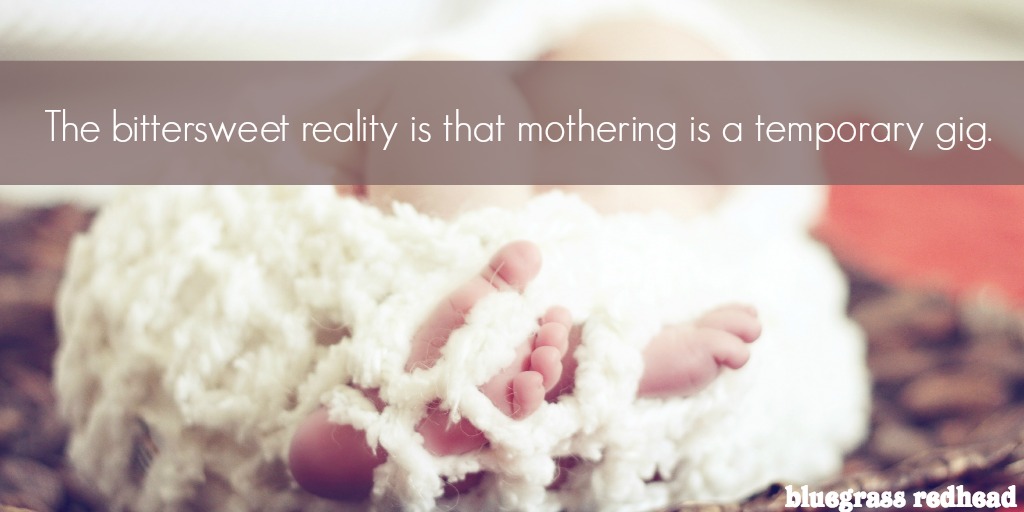
However, the bittersweet reality is that mothering is a temporary gig.
Now, don't misunderstand me. BEING a mother is forever. I think there's a reason there is no English word for a parent who loses a child, because you never STOP being their parent. I will be a mother until the day I die - no matter what.
However, the actual job of mothering is not forever - even Michelle Duggar will eventually have an empty nest. The intense poignancy of this thing - this MOTHERING - is precisely how fragile and fleeting it is. Every day they grow. Every day is one day closer to the day they leave you.
And THAT'S THE POINT.
We want our children to grow and become happy, healthy, independent adults - no matter how much it breaks our heart in the process. We all know parents whose children don't reach independent adulthood for a million different reasons and I know each of us who walks an easier path are grateful. Still, there is a type of sadness linked to that gratitude. I am always reminded of my favorite parenting quote from J.K. Rowling's A Casual Vacancy:
“How awful it was, thought Tessa, remembering Fats the toddler, the way tiny ghosts of your living children haunted your heart; they could never know, and would hate it if they did, how their growing was a constant bereavement.”
In the midst of grieving, I try to remind myself that, even though mothering is a very special job, I believe there is real and true fulfillment found outside parenting. Oprah seems to be doing just fine. I don't think anyone would argue Gloria Steinem hasn't lived a fulfilling life. I think of my role models - women like Sandra Day O'Connor and Nancy Pelosi. These women were amazing mothers. They raised amazing children. Then, they went out after their children were grown and CHANGED THE DAMN WORLD.
I want to do that. I want a second act and my ability to do that is limited every time I have another baby. Every baby means less time, less energy, less money to pursue goals that are important to me.
And, as seriously as I take mothering and as much of myself that I pour into the raising of my children, I want more from my life then being their mother. I want my legacy to reach beyond what my children accomplished. I want to accomplish things in my own right. I want to leave my OWN mark.
And that's why even though I'm scared to stop having babies... I'm even more scared to keep going.
When did you realize you were done having kids?
An Open Letter of Apology to my Firstborn
I feel like every month another open letter of apology makes the rounds on Facebook. The letter is written to the second or third child and is a tongue-in-cheek apology by an overwhelmed momma for all the things she DIDN'T do this time around.
There were no prenatal yoga classes or germaphobic protections taken. There are no baby books filled with mementos or perfectly planned outfits. Instead, the "poor" second or third child is subjected to boisterous siblings and lack of 100% supervision.
I hate these letters.

I feel like every month another open letter of apology makes the rounds on Facebook. The letter is written to the second or third child and is a tongue-in-cheek apology by an overwhelmed momma for all the things she DIDN'T do this time around.
There were no prenatal yoga classes or germaphobic protections taken. There are no baby books filled with mementos or perfectly planned outfits. Instead, the "poor" second or third child is subjected to boisterous siblings and lack of 100% supervision.
I hate these letters.
I hate the implication that the "good" moms are the first-time moms who can bend over backwards to meet every unrealistic expectation of motherhood we place on ourselves from the moment we pee on a stick.
I call shenanigans.
I will not apologize to my second (or soon-to-arrive third) child. They are not worse off because I don't obsess about their clothes or every germ they encounter. They are not worse off because I don't focus 100% of my attention on them. I am a better mother now then I was five years ago. Period.
However, I WILL unapologetically proclaim I am a MUCH better mom than I was the first time around - precisely because of the stuff I no longer do. I've let go of perfectionism (which is apparently the key to parental happiness). I'm more spontaneous and have more fun with my kids. I have learned more about child development and positive parenting. I've learned a lot in the past five years and it shows and I'm not embarrassed to say so.
If anyone deserves an apology, it's my firstborn who still suffers the steep learning curve his father and I encounter at every major milestone.
My dearest firstborn son,
Your babyhood is seared into my memory. It was transformative in a way I could never imagine. We spent so much time together you began to feel like an extension of my body and I can't imagine starting this journey with anyone but you. However, the journey wasn't always easy and I think I owe you an apology.
I'm sorry I focused so much on your stupid sleep schedule. Some of my worst moments as a mother were trying to get you to take a nap that first (and second... and third year). I yelled. I cursed. I cried. Or I left you crying. It seemed so important at the time. You NEEDED sleep. What you didn't need was a crazed lady screaming at you to sleep. I'm really, really sorry about that.
I'm sorry you spent so much time with adults. I'm an only child and daddy's family lived far away so there weren't a lot of cousins. Plus, I hadn't perfected the art of mommy friends yet so you spent a lot of time as the center of adult attention. I wonder now if that's why you're such a serious kid. I suppose the world needs all those responsible firstborns to keep things running smoothly but I worry sometimes I robbed you of some of the silliness of childhood.
I'm sorry I fed you all that bland baby food - even if it was homemade. Your little brother ate what we ate from the get-go and, as a result, he seems to have a much more adventurous palate. For months, you ate nothing but unseasoned sweet potatoes and carrots and peas and any other vegetable I could fit in my Beaba Cooker. I'm really sorry for that. I'm hoping one day you overcome your fear of spice and learn to embrace your culinary wild side.
I'm sorry for dragging you to every stupid baby activity I could find before you could even sit up. Truth be told, I was desperate for adult interaction and you were an easy excuse.
I'm sorry for all the over-zealous discipline. We spanked. We yelled. We doled out way more than our fair share of time outs. Daddy and I were rookies. That's the truth. We hadn't yet learned the subtle art of choosing our battles and adjusting our expectations. You took the brunt of that and I'm so so sorry.
I'm sorry that you still carry the burden of our learning curve. You'll be the one we figure out how to manage homework with ... and curfews.... and college applications. I have loosened my grip on being the "perfect" mother but I still feel the pressure of all those firsts with you.
You see I want to get it RIGHT precisely because I've messed up so much in the past with you. I feel like I owe it to you. You gave me the greatest gift possible. You made me a mom. In the most intense way possible, YOU are my baby.
That's a lot for one kid. I know that. I'm sorry.
Thank God for your siblings.
Love,
Mom
My podcasts


Subscribe to my weekly email


- August 2017
- March 2017
- January 2017
- November 2016
- October 2016
- September 2016
- August 2016
- June 2016
- May 2016
- April 2016
- March 2016
- February 2016
- January 2016
- December 2015
- November 2015
- October 2015
- September 2015
- August 2015
- July 2015
- June 2015
- May 2015
- April 2015
- March 2015
- February 2015
- January 2015
- December 2014
- November 2014
- October 2014
- September 2014
- August 2014
- July 2014
- June 2014
- May 2014
- April 2014
- March 2014
- February 2014
- January 2014
- December 2013
- November 2013
- October 2013
- September 2013
- August 2013
- July 2013
- June 2013
- May 2013