
Brittany Maynard, Kara Tippetts, and the Right to Die
By now, most of you have read the story of Brittany Maynard. At 29 years old, Brittany was diagnosed with terminal brain cancer only a year after getting married. After brain surgery, she was told she had six months to live and decided to move to Oregon to take advantage of that state's Death with Dignity Law. After receiving a prescription for medication that will end her life, Brittany has chosen her last few weeks to advocate for the right to die.

By now, most of you have read the story of Brittany Maynard. At 29 years old, Brittany was diagnosed with terminal brain cancer only a year after getting married. After brain surgery, she was told she had six months to live and decided to move to Oregon to take advantage of that state's Death with Dignity Law. After receiving a prescription for medication that will end her life, Brittany has chosen her last few weeks to advocate for the right to die.
“Right now it’s a choice that’s only available to some Americans, which is really unethical,” she says.
”The amount of sacrifice and change my family had to go through in order to get me to legal access to death with dignity – changing our residency, establishing a team of doctors, having a place to live – was profound,” she says.
”There’s tons of Americans who don’t have time or the ability or finances,” she says, “and I don’t think that’s right or fair.”
I agree with Brittany Maynard wholeheartedly and, to be honest, I assumed most everyone else did, too. That was until a blog post started appearing in my Facebook feed. It's a guest post by Kara Tippetts on the blog A Holy Experience and is an open letter to Brittany Maynard. Entitled Dear Brittany: Why We Don’t Have To Be So Afraid of Dying & Suffering that We Choose Suicide, the post is a heartfelt and passionate plea from Tippetts to Maynard to reconsider her choice.
Tragically, Tippetts is uniquely situated to comment on Maynard's choice because she herself is battling terminal cancer. She speaks sincerely and eloquently about her own struggle and what she sees as the blessings and grace found within the journey of the dying and the struggle of suffering.
“Suffering is not the absence of goodness, it is not the absence of beauty, but perhaps it can be the place where true beauty can be known.”
I also agree with Tippetts to an extent. I also believe there can be beauty and grace in the midst of great suffering. I think running from death and grief is a fool's errand and the most profound moments of our human existence are when we allow space for vulnerability to experience the epic mix of joy and pain that is life itself.
However, I strongly disagree with Tippetts on two points. She argues that doctors assisting Maynard in her journey are breaking their Hippocratic oath to do no harm and uses the "beautiful partnership" she's built with her own doctors as evidence.
“Today my oncologist and I spoke of your dying, of my dying, and of the beautiful partnership I have with my doctors in carrying me to my last moments with gentle care. For two thousand years doctors have lived beside the beautiful stream of protecting life and lovingly meeting patients in their dying with grace.
The doctor that prescribed you that pill you carry with you that will hasten your last breath has walked away from the hippocratic oath that says, “first, do no harm.” He or she has walked away from the oath that has protected life and the beautiful dying we are granted. The doctors agreeing to such medicine are walking away from the beautiful protection of the hippocratic oath.”
Tippetts is extraordinarily lucky to have found such a partnership with her health care providers but the sad reality is that for millions of Americans "dying with grace" is not a choice they are given.
Earlier this year, a 21-member nonpartisan committee, appointed by the Institute of Medicine, the independent research arm of the National Academy of Sciences, released a report called Dying in America. The conclusion of the report was clear.
“The bottom line is the health care system is poorly designed to meet the needs of patients near the end of life,” said David M. Walker, a Republican and a former United States comptroller general, who was a chairman of the panel. “The current system is geared towards doing more, more, more, and that system by definition is not necessarily consistent with what patients want, and is also more costly.”
This report doesn't even include a discussion of death with dignity. The conclusion was, even for patients who want to face death as Tippetts has, the system does not work to their benefit. They are over-treated, over-medicated, and left with little choice in one of the most exquisitely personal decisions a human being can make - how to face death.
The personal manner of this choice is the second point in which I greatly disagree with Tippetts. She makes an impassioned plea based on her religious beliefs that only God should decide when we take our last breath and that a personal relationship with Jesus Christ is what Maynard needs in her life.
“He died and He overcame death three days later, and in that overcoming of death He overcame the death you and I are facing in our cancer. He longs to know you, to shepherd you in your dying, and to give you life and give you life abundant- eternal life.”
I'm not here to debate who should decide when I take my last breath. Kara Tippetts has every right in the world to believe that death with dignity is suicide and every right in the world to battle death on her own personal, spiritual, and emotional terms.
However, so does Brittany Maynard.
It is not the purpose of law to determine which philosophy is correct. A Death with Dignity law in all 50 states should exist so that no matter which road an American chooses to take when faced with the impossible journey of terminal illness that road is available to them.
Now, no one is arguing that crafting a law that allows someone to exercise his or her right to die would be easy. However, merely because a legislative task would be procedurally difficult or ethically complex does not mean we shouldn't try.
Oregon has had a death with dignity law for 17 years and has not been faced with a "slippery slope" situation in which depressed people or exploited elders are taken advantage of under the law. The numbers speak to the reality of the situation. Since its passage in 1997, 1,173 people have had prescriptions written under the act, and 752 have used them to die.
So, while I have nothing but the utmost respect for Kara Tippetts's journey and her plea to Brittany Maynard, I believe her intensely personal experience and religious beliefs are not enough to restrict those of any other American walking that difficult road.
We all must face death but we all deserve the right to face it on our own terms.
What are your thoughts on Brittany Maynard and death with dignity?
P.S. My further thoughts on Grief and the Choices We Make.




5 Things That Make Me Smile
Happy World Smile Day! What in the heck is World Smile Day? I'm so glad you asked!

Happy World Smile Day! What in the heck is World Smile Day? I'm so glad you asked!
“As is well known by now throughout the world Harvey Ball, a commercial artist from Worcester, Massachusetts created the smiley face in 1963. That image went on to become the most recognizable symbol of good will and good cheer on the planet.
As the years passed Harvey Ball became concerned about the over-commercialization of his symbol, and how its original meaning and intent had become lost in the constant repetition of the marketplace. Out of that concern came his idea for World Smile Day®. He thought that we, all of us, should devote one day each year to smiles and kind acts throughout the world. The smiley face knows no politics, no geography and no religion. Harvey’s idea was that for at least one day each year, neither should we. He declared that the first Friday in October each year would henceforth be World Smile Day®. Ever since that first World Smile Day® held in 1999, it has continued every year in Smiley’s hometown of Worcester, MA and around the world.”
What a beautiful idea that deserves to be celebrated! So, here are five things that make me smile.
1. This Song
"I care a lot, use an analog clock
And never know when to stop"
2. This Show
Y'all. THIS SHOW. Ok, it also makes me cry but so, so, so much beautiful smiling. It is the most vulnerable, intimate, fantastic show about family I've ever seen and I've seen A LOT of television.
3. Fall

Everything is still mostly green but there's the teeniest, tiniest bit of fall colors peaking out if you look closely.
4. Moment of Happiness email from Gretchen Rubin

My love of Gretchen Rubin is well-documented but I just recently subscribed to her daily Moment of Happiness email and I absolutely love it. Everyone morning I smile from the humor, intelligence, or wit of her daily quotation selection. Subscribe. You will not regret it.
5. Y'all
Seriously, I love all of you so much and I wanted to my World Smile Day act of kindness to include you somehow! SO, I'm going to giveaway 5 $5 Starbucks gift cards to 5 lucky readers.
All you have to do to enter is leave a comment telling everyone something that makes you smile! Giveaway ends at midnight CST TONIGHT (10/3/2014).
Best and Worst Dressed at the 2014 Emmys

From left, Christina Hendricks in Marchesa; Kaley Cuoco-Sweeting in Monique Lhuillier; January Jones in Prabal Gurung; and Claire Danes in Givenchy couture.
From left: Jordan Strauss/Invision, via Associate dPress; Frazer Harrison/Getty Images; Jason Merritt/Getty Images; Frazer Harrison/ Getty Images
So. Much. Red. It got to be a little overwhelming by the end.
At least it was exciting. Sometimes everyone plays it so safe watching the red carpet can be a little boring but you can't say last night's fashion at the Emmy Awards wasn't interesting.
(Say a word about Lena Dunham and I'll cut you. She can do no wrong.)
I found myself drawn to the more understated pieces however. I loved Lucy Lui's beautiful draping and Michelle Dockery was flawless as ever. She did however sport the dominant middle part that I found wildly unflattering on most of the stars. (I'm looking at you Christina Hendricks).
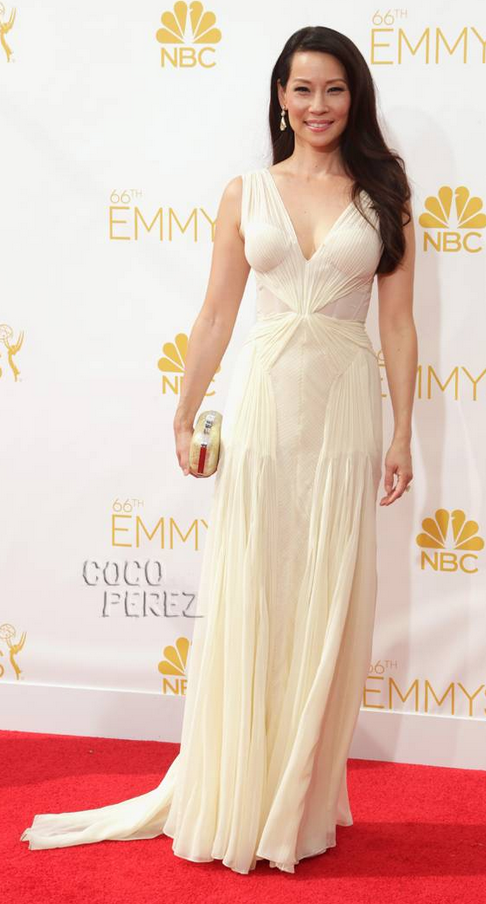
Lucy Lui in Zac Posen. Image via Just Jared.
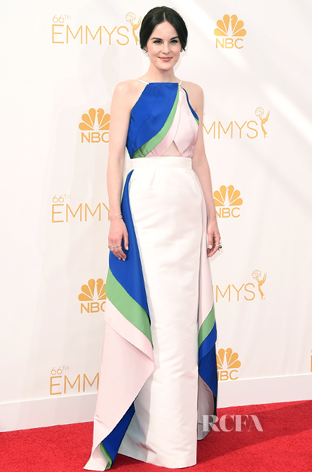
Michelle Dockery in Rosie Assoulin. Image via Tom + Lorenzo.
I also really loved Anna Gunn in Jenny Packham.
Now, who got it wrong? A couple who also went for understated and fell flat. I did NOT like Kate Mara's dress which looked like a Project Runway experiment in draping gone wrong. I also thought Katherine Heigl (who unlike most of America I do not hate) looked WAY too mature in her satin dressing coat.

Katherine Heigl. Image via GossipReporter.com

Kate Mara. Image via Daily Herald..
What did y'all think? Who was your best and worst dressed?
Hobby Lobby: Contraception and Corporations
First, based on my own personal history, I have a passion for the specific methods of contraception being discussed in this case and the persistent myths surrounding them. After graduating from college, I spent a year running an emergency contraception (EC) hotline. At the time, EC was available only by prescription. When a woman would call, I would collect her information, ask her several medical questions, and have a prescription called in. I dealt exclusively with the hormonal EC levonorgestrel.
I like to tell people I prevented more abortions in that year than most people do in their entire life.

Yesterday, the Supreme Court ruled that requiring closely held corporations, in this case Hobby Lobby and Mennonite cabinet makers Conestoga Wood, to provide health insurance coverage for methods of contraception that violates the companies owners’ sincerely held religious beliefs was not permitted under the Religion Freedom Restoration Act.
First, based on my own personal history, I have a passion for the specific methods of contraception being discussed in this case and the persistent myths surrounding them. After graduating from college, I spent a year running an emergency contraception (EC) hotline. At the time, EC was available only by prescription. When a woman would call, I would collect her information, ask her several medical questions, and have a prescription called in. I dealt exclusively with the hormonal EC levonorgestrel.
I like to tell people I prevented more abortions in that year than most people do in their entire life.
Now, some people – including the family that owns Hobby Lobby – would disagree with me because some people believe that EC is an abortifacient. Why do they believe that? Well, some people believe that life begins at fertilization and any drug that could prevent implantation of fertilized egg into the uterus (which is when the medical community defines the beginning of life) is an abortifacient not a contraceptive.
Any EC package you pick up clearly states the drug could prevent implantation.
So, are these people right?
No. Here’s why. Scientists get REAL finicky about statements of fact. They also get REAL finicky about proving said facts. Think back. How often does your doctor use the term “never” or “always.” Probably not very often. They don’t talk like that because scientific evidence deals in probability.
You can’t prove “always” because who the hell knows. You also can’t prove a negative. You can’t prove that something will NEVER happen. You can’t prove that EC will NEVER disrupt implantation because you can’t plant camera in every uterus that takes the drug (although give them time!) and make sure that never happens.
But guess what? I’m not scientist! I don’t have to follow their rules so listen up.
EC NEVER DISRUPTS IMPLANTATION. Period
It just doesn’t.
Here’s the best explanation I’ve found from the team at Science Friday (and if you can’t trust Ira Flatow who can you trust?!?)
“In addition to the available biological evidence, clinical research provides important insights about how EC works. The newest and most reliable evidence comes from two recent studies (published in 2007 and 2011) in which women who came to clinics for EC were monitored to assess each woman’s menstrual cycle day. Among women who took EC before ovulation, none became pregnant. The women who took EC on the day of ovulation or after became pregnant at the rate that would be expected if they hadn’t used any contraception. This provides compelling evidence that levonorgestrel EC works by inhibiting or delaying ovulation, but is ineffective after ovulation has already occurred (and therefore would not be effective in preventing the implantation of a fertilized egg).”
Did you catch that? If you take EC after ovulation when you be mostly likely be disrupting implantation and not fertilization, your chance of pregnancy is the same as if you took nothing at all. You know why? Because EC doesn’t disrupt implantation and if you’re putting all your eggs (pun intended) in the one basket of hoping that it does, you are shit out of luck.
Now, there is a second form of EC containing ulipristal acetate and mifepristone and there are no studies on that class of drug. However, the failure rate of this drug isn’t significantly lower than levonorgestrel EC and neither drug has a failure rate low enough to indicate they disrupt implantation.
Can we prove they NEVER disrupt implantation?
Nope, but they DON’T because if they did they’d work a hell of a lot better than they do at preventing pregnancy.
Now, Hobby Lobby has a problem with two of other forms of contraception that they define as an abortifacient – intrauterine devices (IUDs). IUDs can also be used as a form of emergency contraception if they are placed in the uterus within days after unprotected sex. Now, mind you, I have never known anyone to do this nor even HEARD about this approach during my time at Planned Parenthood. First of all, that is one dang expensive – not to mention invasive - form of emergency contraception.
But, I’m willing to cede that someone somewhere has probably done it. I’m also willing to cede the point that IUDs could prevent implantation precisely because they are so much more effective than hormonal EC. Of course, in taking IUDs off the table as a covered contraception choice, these companies are removing the most cost-effective and efficient form of birth control out there.
When I worked at Planned Parenthood, it was the most used form of contraception among providers aka doctors. IUDs are a particularly good choice is you don’t plan on having children for a while and are sensitive to hormones as the copper IUD is one of the few long-term contraceptives available that is hormone free. Choosing which contraception is right for you is a complicated decision and one that is now made more difficult for thousands of women who will have to decide if they want to bare the financial burden of that choice all on their own.
So, IUDs mostly likely prevent or disrupt implantation. The question then becomes should Hobby Lobby be required to cover a contraception they believe to be abortifacient based on the owners’ religious belief that life begins at fertilization?
For the Supreme Court, that question hinges in large part on whether these closely held corporations are legal “persons” under the Religious Freedom Restoration Act which prohibits the “government [from] substantially burden[ing] a person’s exercise of religion even if the burden results from a rule of general applicability.”
Now, the idea of corporations as legal persons is not new. Justice Alito has a lovely little paragraph about how this legal fiction is meant “to provide protection for human beings.”
“A corporation is simply a form of organization used by human beings to achieve desired ends. An established body of law specifies the rights and obligations of the people (including shareholders, officers, and employees) who are associated with a corporation in one way or another. When rights, whether constitutional or statutory, are extended to corporations, the purpose is to protect the rights of these people.”
Doesn’t that sound nice?
Here’s the problem. Corporate culture in its current form places a strong duty on directors and management to maximize profits for the corporation's shareholders. People make complicated decisions based on many factors. However, the management of a corporation makes decisions that keep shareholders happy so they don’t get fired.
Could the shareholders of a company come together and decide that they want to prioritize environmental sustainability over profits? I guess so. Does that happen very often? No.
That’s why you don’t hear much from Chick-fil-A’s Dan Cathy about gay marriage anymore. Chick-fil-A’s current profits maximization is built on expanding into college campuses, where a younger and less conservative demographic didn’t have the stomach for the Cathy family’s Christian politics. That’s why Hobby Lobby still buys products from China where there is state-mandated abortion because selling only American made products would eat into their products. It’s also why the company invested companies that manufactured emergency contraception. There was money to be made.
Look I'm not saying Hobby Lobby is some money-grubbing monster. They pay their employees far above the minimum wage. They work hard to assure the quality of workplace conditions for the workers who make their products in China. But still. Profit plays a role and it plays a big role and to act otherwise is foolish.
For example, limiting an employee’s contraceptive choice doesn’t affect profits so the calculus becomes a bit different.
So, “sincerely held” religious beliefs? I’m not so sure. Why I would never question the Green family’s individual faith? I do believe that ascribing a faith to a corporation whose motivations are much less complicated is problematic.
But let's not pretend Ruth Bader Ginsburg doesn't say it than I ever could.
“The Court, I fear has ventured into a minefield, by its immoderate reading of RFRA. I would confine religious exemptions under that Act to organizations formed ‘for a religious purpose,’ ‘engage[d] primarily in carrying out that religious purpose,’ and not ‘engaged. . . substantially in the exchange of goods or services for money beyond nominal amounts.’”


It's not really about the boobs
My response to the viral post "My Husband Doesn't Need To See Your Boobs" and why it's not REALLY about the boobs at all.
Last week, my cousin Taylor texted me a link to a blog post. Written by Lauren from Apples & Band-Aids blog, the post was entitled “My husband doesn’t need to see your boobs.”
In the post, Lauren goes out of her way to say she is not judging any woman who posts her bikini-clad self on social media but does ask if any and all bikini-clad women could just NOT. The photos were a “stumbling block” in her marriage and everything would be so much better if the photos weren’t there.
Taylor’s commentary was simple. “This bothers me.”
It bothers me, too.
It bothers a lot of you if this Facebook conversation is any indication. It also CLEARLY bothered a lot of other people too because Lauren shut down the comments section because it had come a place of attack and “hatred.”

My response to the viral post "My Husband Doesn't Need To See Your Boobs" and why it's not REALLY about the boobs at all.
Last week, my cousin Taylor texted me a link to a blog post. Written by Lauren from Apples & Band-Aids blog, the post was entitled “My husband doesn’t need to see your boobs.”
In the post, Lauren goes out of her way to say she is not judging any woman who posts her bikini-clad self on social media but does ask if any and all bikini-clad women could just NOT. The photos were a “stumbling block” in her marriage and everything would be so much better if the photos weren’t there.
Taylor’s commentary was simple. “This bothers me.”
It bothers me, too.
It bothers a lot of you if the above Facebook conversation is any indication. It also CLEARLY bothered a lot of other people too because Lauren shut down the comments section because it had come a place of attack and “hatred.”
So, here’s the thing. I’m not here to shame this woman. If the post is any indication, she carries around enough shame already.
And the truth is I don’t know her and I don’t know her marriage. She admits to a certain amount of insecurity, which is something from which none of us are immune. We all worry - even a little bit - our spouse might find someone else (maybe Dean Cain… KIDDING) more attractive than us. We all worry that other people are focusing in on the bits we’d rather keep hidden. We all hear the societal message that we can do more, be more - or less in the case of weight.
To me, what seems to make Lauren different is that she feels like this normal human emotion is a part of some bigger battle - a battle she feels justified in asking perfect strangers help her fight.
She is a woman “fighting for her marriage.” She is “protecting his eyes, protecting his heart.” She is clearly a woman of strong religious beliefs and talks in her About Me section about living a life of “sanctified striving.” Other posts mention “dying to self” and “crosses to bear” and battling to let go of “selfish desires.”
And to that I say - Whew, sister, have I BEEN THERE.
I’ve shared before that I grew up in a strongly evangelical church and lived a deeply religious life through most of my adolescence. Buried deep in my history, I recognized the language Lauren speaks. The language of “stumbling blocks” and “temptation.” The language of not good enough.
Recently, my therapist and I were talking about self-compassion and how that’s something I am not very good at. (Understatement of the century. More posts on that coming soon!) She asked where that came from and without a hesitation I answered, “Growing up Baptist.”
Now, hold up! I know some of y’all are Baptist. I’ve got nothing but love for you! I long ago realized I had to stop making what happened to me about ALL religion or ALL religious people.
However, for better or worse, the message I got growing up was “You are full of sin and you better work your BUTT off to glorify God and prove you’re worth it.” Not having premarital sex before marriage? Great, now give up dating all together. Going to church every Sunday and Wednesday? Great, now make sure and wake up every morning and have your quiet time with God. Listening to Christian music to “protect your hearts” from Satan? Great, now give up ALL secular music.
And that message of not good enough - as Lauren’s post alludes to - was particularly strong when it came to women and sexuality. Sex was sinful, the temptation was everywhere, and it was all the girl’s fault. After all, I don’t see many photos of mother’s dressed up in ball gowns vowing to protect their son’s virginity.
I would have absolutely described it as a life of “sanctified striving” at the time but, let me tell you, all that life left me was sanctimonious and TIRED.
It has taken me years to reject that message. It has taken me hours of conversations with deeply spiritual dear friends and endless amounts of time spent reading and thinking and pondering (endless as in I still do it) to leave that framework behind.
And it took me finding a new spiritual home to realize the true meaning of grace.
That, no, I am not perfect and that is OK. That the acceptance and love of God is GIVEN - not earned. That grace is a place of deep and abiding peace - not a battlefield.
So, what I really feel when I read Lauren’s post is deep sadness. I see the chinks in her armor. I hope being a “soldier for Christ” leaves her fulfilled because all it left me was gun-shy and battle scarred.





Guest Post: A response to #BanBossy
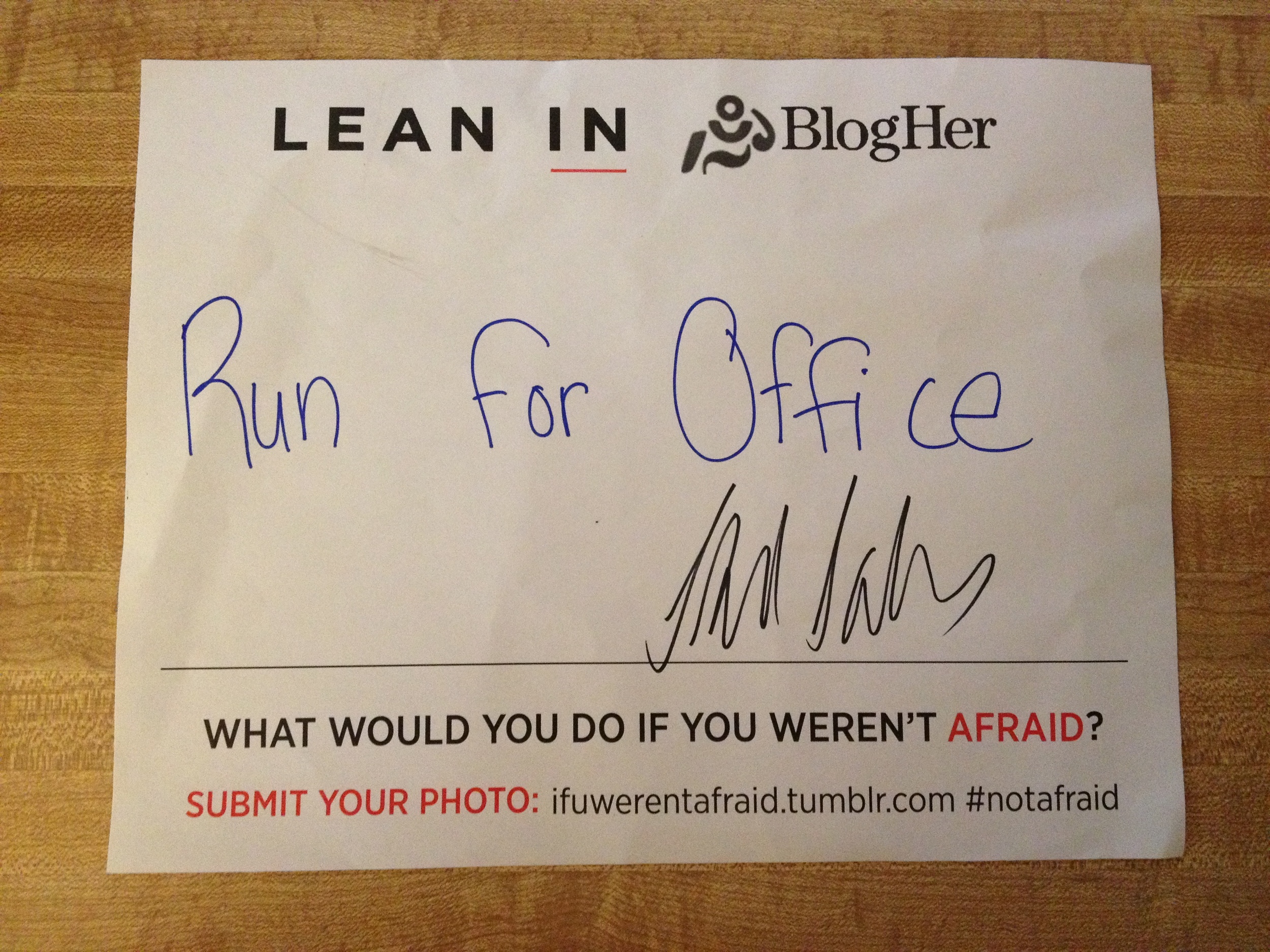
I am a huge Sheryl Sandberg fan. I’ve watched her TED Talks multiple times. In certain settings, I have quoted Lean In like the Bible. I follow Lean In groups on social media, and I think Sandberg is provoking some of the healthiest discussion taking place about women and work.
So, I was surprised by my viscerally negative reaction to the “Ban Bossy” campaign. I have liked (and probably pinned somewhere) the quote about telling little girls they have leadership characteristics, but the idea of banning the word “bossy” didn’t resonate with me.

I am a huge Sheryl Sandberg fan. I’ve watched her TED Talks multiple times. In certain settings, I have quoted Lean In like the Bible. I follow Lean In groups on social media, and I think Sandberg is provoking some of the healthiest discussion taking place about women and work.
So, I was surprised by my viscerally negative reaction to the “Ban Bossy” campaign. I have liked (and probably pinned somewhere) the quote about telling little girls they have leadership characteristics, but the idea of banning the word “bossy” didn’t resonate with me.
Perhaps that’s because I’ve recently realized that I am bossy. There’s no denying it. I make decisions quickly, and I like being a decision-maker. I’m unhappiest when I’m stuck following a prescription that makes no sense to me, and I will do my best to find a way to get unstuck in those situations. My husband jokes that I “don’t take direction well.” He’s mostly right. I’m just bossy, and understanding that about myself has led me to make better choices about my career.
Sure, “bossy” has a negative connotation, and it is arguably disproportionately applied to women (I don’t know about you; I’ve certainly labeled men “bossy”), but every trait is a two-sided coin. Being a leader often means having tendencies toward narcissism. Being entrepreneurial requires a capacity for risk that is reckless. Being influential can also mean being manipulative.
And being a “follower” is no connotative picnic, either. That word is fraught with negativity, yet we must have followers. The ability to observe, understand, and execute is the foundation of a workplace that functions effectively. Followers are successful in almost every industry at many levels, and leaders have to be exceptional followers to find a forum for leadership.
If it’s so important to ban “bossy,” are we not tempted to assign unearned positive status to other words? Lean In makes a compelling argument that the word “mentor” has become loaded with unrealistic expectations. “Flexibility” and “balance” sound like qualities every woman who interviews in a professional setting is seeking, but they can mask some very ugly assumptions about women with small children and some very harsh limitations on growth.
I don’t think banning a word changes the workplace. Sandberg is doing that, instead, by telling her stories. Through story, we come to understand the challenges others face at work. Stories help men understand why their male colleagues would choose to take a full paternity leave. Stories break through barriers around diversity and inclusion issues. I can tell a female candidate that our firm offers a flexible environment, but it’s far more powerful for me to talk to her about part-time attorneys holding meaningful positions of leadership and working on our most significant engagements.
If the “Ban Bossy” campaign is really designed to promote storytelling, that’s great. My fear is that the individuals who need to hear those stories will roll their eyes and walk away. To be a leader in any environment, you must be willing to accept all of the things that make you a leader—good and bad. You have to accept everything in context. You can call me “bossy” every day of the week as long as you’re willing to hear my stories and share your own with me.
Beth is a mom, wife, sister, friend, and HR executive. She's also on a journey to become a yoga teacher. She likes watermelon, reality television, and politics.
PS If you're interested in my take on #banbossy, click here and here.


What you need to know about pancreatic cancer
My friend Donna died this morning. I met Donna at a Halloween party. She had bright red cheeks and kept cracking jokes about hot flashes. Her vivacity and energy absolutely filled the room and I spent the rest of the evening glued to her side.
We talked about husbands and children and travel and food. We bonded instantly over our shared passion for all things party. By the end of the evening, we were planning a zombie prom for the next year. We roped the cohost of the current party we were attending in joining our zombie prom efforts and were already discussing venues and invitation ideas as people began heading for home.
Over the course of the next year, I got to know Donna better. We joined a book club together. She welcomed me into her home for holiday parties and baby showers and book club dinners always with barrels full of laughter and generosity.
A year after our first meeting, a few weeks before our Zombie Prom, Donna was diagnosed with pancreatic cancer. All I knew about pancreatic cancer was what I had gleaned from Randy Pausch and his last lecture. All I knew was that it was a death sentence. I was terrified that she would be gone by Christmas.

My friend Donna died this morning. I met Donna at a Halloween party. She had bright red cheeks and kept cracking jokes about hot flashes. Her vivacity and energy absolutely filled the room and I spent the rest of the evening glued to her side.
We talked about husbands and children and travel and food. We bonded instantly over our shared passion for all things party. By the end of the evening, we were planning a zombie prom for the next year. We roped the cohost of the current party we were attending in joining our zombie prom efforts and were already discussing venues and invitation ideas as people began heading for home.
Over the course of the next year, I got to know Donna better. We joined a book club together. She welcomed me into her home for holiday parties and baby showers and book club dinners always with barrels full of laughter and generosity.
A year after our first meeting, a few weeks before our Zombie Prom, Donna was diagnosed with pancreatic cancer. All I knew about pancreatic cancer was what I had gleaned from Randy Pausch and his last lecture. All I knew was that it was a death sentence. I was terrified that she would be gone by Christmas.
However, by some miracle, Donna was a candidate for a rare surgery that is a powerful tool in the fight against pancreatic cancer. She set up a Facebook Page and asked my help naming it. (I didn’t realize how incredibly accurate my suggestion of Cancer: Battle Royale would be.) She made it to Christmas. She made it to the NEXT Christmas. She went on vacation with her family. She made memories with her children. She shared some of the most powerfully vulnerable moments I have ever seen anyone share during a journey like this. She was brave. She told people when she was feeling hopeful. She told people when she was feeling hopeless. It was an absolutely incredible thing to watch.
She also had time to become a passionate advocate for pancreatic cancer research. She joined our local chapter of the Pancreatic Cancer Action Network (PANCAN). She went to Washington, D.C. to lobby for change. She had just about everyone in Paducah wearing purple, including a famous local landmark.
I learned a lot from Donna during our short friendship but due to her advocacy this is one of the most important.
It does not have to be like this.
I had assumed that pancreatic cancer was deadly and that treatment options were limited because that’s just how it was. Because pancreatic cancer had not affected me directly, I didn’t spend a lot of time thinking about whether the reality of pancreatic cancer could change.
Donna taught me that it could change, it should change, it HAS to change.
All cancer used to be a death sentence. Breast cancer used to be a death sentence. However, as we’ve seen through breast cancer research and HIV/AIDS research, advocacy and awareness and research can help change all of that. You raise awareness so people know to look for symptoms. You raise money for research so we find better detection methods and more successful treatment options. You fight to make pancreatic cancer a treatable illness.
Unlike many other cancers, the survival rate for pancreatic cancer has remained substantially the same since the passage of the National Cancer Act over 40 years ago. The five-year survival rate has gone from 2 percent to 6 percent. Seventy-three percent of patients will die within the first year.
Lest you believe that pancreatic cancer is rare and will most likely not affect you think about this. While overall cancer incidence and death rates are declining, pancreatic cancer's rates are climbing and are projected to increase 55% by 2030. By 2020, pancreatic cancer is expected to become the second leading cause of cancer death in the United States.
This has to change.
Because of the pancreas's location and the lack of good detection methods, early detection is rare. Treatment options are extremely limited with only 15% of those diagnosed candidates for surgery - the best treatment option.
This has to change.
Only approximately 2 percent of the National Cancer Institute’s (NCI) budget is allocated to this leading killer. Worldwide pancreatic cancer research receives less than one percent of all private and government funding for cancer research.
This has to change.
We cannot leave it solely to the families of those left behind to advocate for change. They have a heavy burden and the challenge is huge. The Pancreatic Cancer Action Network is leading this fight and we can all help.
Become an advocate by sending messages to your Congressional representatives.
Participate in Pancreatic Cancer Advocacy Day on June 16th and 17th.
And spread the word!
PANCAN’s slogan is Know it. Fight it. End it. So, the least we can all do is know that the reality of pancreatic cancer is not set in stone and change is possible. The fight is worth it.
Donna taught me that.


Dylan Farrow and Questioning the Victim
Kristen Howerton, a blogger I very much respect, recently wrote a post on her blog Rage Against the Minivan addressing Dylan Farrow’s open letter on NYTimes.com and the subsequent reaction. Dylan Farrow, the adopted daughter of Mia Farrow and Woody Allen, broke her silence and publicly shared her story of abuse at the hands of Allen. Her letter has reopened the debate surrounding not only Allen’s guilt but our treatment of sexual abuse victims.
For her part, Kristen makes her point very clear.

Kristen Howerton, a blogger I very much respect, recently wrote a post on her blog Rage Against the Minivan addressing Dylan Farrow’s open letter on NYTimes.com and the subsequent reaction. Dylan Farrow, the adopted daughter of Mia Farrow and Woody Allen, broke her silence and publicly shared her story of abuse at the hands of Allen. Her letter has reopened the debate surrounding not only Allen’s guilt but our treatment of sexual abuse victims.
For her part, Kristen makes her point very clear.
In review, IT’S NEVER OKAY TO QUESTION SOMEONE’S ACCOUNT OF SEXUAL ABUSE unless you are the accused or representing the accused in a court of law. For everyone else, it’s not of our business, and publicly speculating that it’s a lie is perpetuating the rape culture that tells women that they should stay silent. Or worse, that it’s up for debate if they come forward.
Wondering if Dylan Farrow is telling the truth? It doesn’t matter. It’s not our place to question her story.
In many ways, I agree with her. We all know the dangers of victim-blaming. I can't imagine the strength it takes to give public voice to such an incredibly private struggle. However, I think the problem with Kristen's post is it assumes all victims and all victims' stories are the same.
Dylan Farrow is not accusing Woody Allen in a court of law where one could argue no one but the accused has the right of rebuttal. Dylan Farrow is accusing Woody Allen in the court of public opinion.
To expose yourself to the court of public opinion as a sex abuse victim is very brave. However, to expose yourself to the court of public opinion and expect no one to question your story is unrealistic.
Even if we shouldn't question the facts of her story, the timing of Dylan Farrow’s revelations are interesting. Both Dylan’s letter, as well as angry tweets from her mother and brother, came after Woody Allen was recognized with the Cecil B. DeMille Aware by the Hollywood Foreign Press. Their argument seems to be that the professional achievements of Woody Allen should never be celebrated because of the alleged sexual abuse.
She also seems to argue that anyone who has worked with Allen or merely enjoys his work is condoning sexual abuse. If you as a victim are accusing others of being complacent in your abuse then you cannot be surprised when those same people defend themselves by questioning your story.
Many, including the Academy Awards who have also recognized the artistic accomplishments of Woody Allen, argue that one’s professional achievements should be wholly and completely separate form one’s personal life.
I don't believe a complete separation is realistic or even achievable. And yet would not our museums be empty if we refused to enjoy the artwork of those with personal behavior with which we do not agree or even find repugnant? Pablo Picasso was a serial cheater. Auguste Rodin was 43 when he began a passionate affair with his 18-year-old student.
I’ve enjoyed many of Woody Allen's recent films and Blue Jasmine deserves to be seen by every one, not because of Allen’s work but because of the once-in-a-lifetime performance of Cate Blanchett.
Am I condoning the personal behavior of Woody Allen by seeing his films? By celebrating the genius that is Annie Hall? I feel like Dylan Farrow is saying I am but I’m not so sure.
I question that assertion and I believe I have a right to do so.
My podcasts


Subscribe to my weekly email


- August 2017
- March 2017
- January 2017
- November 2016
- October 2016
- September 2016
- August 2016
- June 2016
- May 2016
- April 2016
- March 2016
- February 2016
- January 2016
- December 2015
- November 2015
- October 2015
- September 2015
- August 2015
- July 2015
- June 2015
- May 2015
- April 2015
- March 2015
- February 2015
- January 2015
- December 2014
- November 2014
- October 2014
- September 2014
- August 2014
- July 2014
- June 2014
- May 2014
- April 2014
- March 2014
- February 2014
- January 2014
- December 2013
- November 2013
- October 2013
- September 2013
- August 2013
- July 2013
- June 2013
- May 2013