
Is your child racist?
Recently a friend of mine shared an incident involving her son that left her extremely upset. Her young son had innocently expressed a preference in playmates based on the color of another child’s skin. My friend was horrified and wondered where he had gotten the idea that we would judge one another based on the color of our skin.
I absolutely understood her reaction. No parent wants his or her child to express racist attitudes or stereotypes. However, the reality is that racism pervades our society and children – while maybe not tactful – aren’t stupid and are perceptive. They understand that race is important. So important in fact, that the adults in their lives don’t often talk about it and when they do they tiptoe around it.

Photo Credit: Lennart Tange via Compfight cc
Recently a friend of mine shared an incident involving her son that left her extremely upset. Her young son had innocently expressed a preference in playmates based on the color of another child’s skin. My friend was horrified and wondered where he had gotten the idea that we would judge one another based on the color of our skin.
I absolutely understood her reaction. No parent wants his or her child to express racist attitudes or stereotypes. However, the reality is that racism pervades our society and children – while maybe not tactful – aren’t stupid and are perceptive. They understand that race is important. So important in fact, that the adults in their lives don’t often talk about it and when they do they tiptoe around the subject.
Now, I wish I was smart enough to have come to this realization on my own. In actuality, I read a book several years ago that changed almost everything I thought about parenting and child development and PARTICULARLY affected how I felt about children and race.
In 2009, Po Bronson and Ashley Merryman wrote an amazing book called NutureShock: New Thinking About Children. The authors cover a variety of topics including the myth of praise and why kids lie, but one of the most revolutionary topics that got a lot of press at the time is why white parents don’t talk about race.
In a Newsweek cover article entitled “See Baby Discriminate”, the authors specifically addressed a 2006 experiment at the University of Texas by Birgitte Vittrup involving 100 white families with children 5 to 7 years old. The experiment was set up to address the fundamental assumption that children are “colorblind” and, if we don’t point out race as something important, they won’t see it.
So, what happened?
“They wanted their children to grow up colorblind. But Vittrup’s first test of the kids revealed they weren’t colorblind at all. Asked how many white people are mean, these children commonly answered, “Almost none.” Asked how many blacks are mean, many answered, “Some,” or “A lot.” Even kids who attended diverse schools answered the questions this way.
More disturbing, Vittrup also asked all the kids a very blunt question: “Do your parents like black people?” Fourteen percent said outright, “No, my parents don’t like black people”; 38 percent of the kids answered, “I don’t know.” In this supposed race-free vacuum being created by parents, kids were left to improvise their own conclusions—many of which would be abhorrent to their parents.”
The study goes on to explain that many white parents specifically instructed to discuss race with their children failed to do so. When questioned by the researchers, they admitted they simply didn’t know what to say.
Also, the authors found that additional research called into question another basic assumption about children and race, specifically that raising children in a diverse environment – so often held out as the gold standard among parents – created racially tolerant kids. Again, not so much. In fact, the more racially diverse the environment the more likely the children were to self-segregate.
Knowing all this, I have tried to discuss race openly and honestly with Griffin. However, I am the first to admit that is an incredibly difficult task. I wonder when I should bring it up. Should I wait until the occasion arises naturally? Or should I create conversations myself? I worry I will say the wrong thing or confuse him. I worry I will unconsciously pass on my own prejudices to him.
However, I was recently reminded how much I see the “burden” of this discussion through my own experience and how vastly more challenging this is for parents of other races. I realized how my central concern was that my white child not be perceived as racist.
I hadn’t even considered how these attitudes change the perception of children of other races.
I was listening to This American Life (shocking, I know) and the theme of the episode entitled “Is This Working?” was discipline in school. The first act began with the story of Tunette Powell and her son’s disciplinary problems in preschool. Tunette is black and had been a problem student in her youth. She worried that she had passed along her bad attitude to her children, despite all her best efforts to avoid exactly that. That was until Tunette attended a birthday party and heard story after story of white children in her son’s preschool acting much worse and receiving less harsh punishments.
Loathe to play the “race card,” Tunette began doing her research, as had some social scientists that This American Life interviews, and the results were disturbing.
Preschoolers.
Maybe it’s because I have one child that recently graduated from preschool and one currently in preschool, but that statistic left me in tears. Suddenly, my focus on how my white child perceived his black classmates became a much smaller part of the bigger picture of how black children are perceived and how they perceive themselves.
Griffin and I talk a lot about shame and guilt. We talk about how it is fine to feel guilt for something you did that is bad. However, it is NOT ok to feel shame that because of what you did you ARE bad. It is a discussion that always leaves me emotionally raw because I can’t imagine anything worse than my child feeling shame.
The thought that I would be in a constant battle against an entire system – even with a system with good intentions – that is teaching my child every single day that they ARE bad breaks my heart.
One of my favorite quotes regarding race is from novelist Chimamanda Adichie's Ted Talk "The Danger of A Single Story (which you should stop and listen to right now). She says,
“The single story creates stereotypes, and the problem with stereotypes is not that they are untrue, but that they are incomplete. They make one story become the only story.”
The complicated "story" is that many of the black children in Griffin’s kindergarten class will act up more in class. However, due to a variety of societal problems I am not smart enough to solve – problems like poverty, lack of educational and economic opportunity, and other problems inextricably tied up with the racial history of this country - the story can't begin and end with that child's behavior.
And how the hell am I supposed to explain that to a five-year-old?
Just like so many other seemingly impossible subjects we have to teach our kids about – things like sex and money and mental illness and religion – it’s really, really, really hard.
But that doesn’t mean we shouldn’t try.
Do you talk to your children about race?


Why I'm a Democrat
I wrote this post 8 years ago in 2006. I still feel the same way.
If I had to pinpoint a time when I began describing myself as a Democrat, it would be the winter of 2000. By this point, my transition from a good little Baptist conservative to what Cartman describes so aptly as a "college know-it-all hippie" was really in full swing. As you can imagine, 2000 was not the best year to switch parties because we started losing...a lot.

I wrote this post 8 years ago in 2006. I still feel the same way.
If I had to pinpoint a time when I began describing myself as a Democrat, it would be the winter of 2000. By this point, my transition from a good little Baptist conservative to what Cartman describes so aptly as a "college know-it-all hippie" was really in full swing. As you can imagine, 2000 was not the best year to switch parties because we started losing...a lot.
It wasn't always easy to stand strong. 2004 was particularly devastating with pundit after pundit proclaiming the death of the Democratic party. However, I became and remain a Democratic because I believe to my very core that this party is better at governing our country. I do not believe that Republicans are evil (at least not ALL of them) or that they hate America. I do believe that the basic ideas of the Republican party spell disaster for America.
Corporate welfare does not work. Leaving corporations free to pursue the almighty dollar and expecting them to do what's best for America in the process is absurd. And who can blame them? It is their job to make a profit at all costs and most of them are pretty good at it. However, it is not their job to watch out for working men and women. It is the government's. The middle and lower classes of this country do not ask for much but when they do we should deliver. Democrats deliver. They delivered Social Security. They delivered the Family and Medical Leave Act. And they will deliver a raise in the minimum wage.
Wedge issues might be an election strategy but they are not a governing strategy. Without a doubt, religious and social values are important. It was a strong faith in God that led Americans to demand an end to slavery, an end to segregation and the right to vote for women. However, reducing complex issues of morality and faith into divisive discussions on abortion and gay marriage is wrong. Morality in government really means less corruption. In the first 100 hours, Speaker Pelosi has already said the first item on her agenda will be to close the revolving door between legislators and lobbying.
Nation building does not work. It never has and it never will. Being strong on national security requires diplomacy and restraint, not brute force and moral judgment. Our experiment in Iraq has failed. By refusing to address our failure, we have also made North Korea and Iran more powerful and more dangerous. Without a doubt, we are less safe and less secure. Democrats will demand the accountability that has been sorely lacking in our government's foreign policy. Tough questions are ahead but that does not mean they should not be asked.
I believe in the Democratic party. Not because we are perfect or have all the answers - but because the foundation of our party is built on real solutions for this country.


Amal Clooney and why I changed my name
The hard-charging international barrister Amal Alamuddin recently married a movie star and changed her name to Amal Clooney reigniting the age-old feminist debate over whether or not a woman should change her name upon marriage.
My decision to change my name came down to a simple majority vote conducted among my bridesmaids in the car on the way to my rehearsal dinner.

The hard-charging international barrister Amal Alamuddin recently married a movie star and changed her name to Amal Clooney reigniting the age-old feminist debate over whether or not a woman should change her name upon marriage.
My decision to change my name came down to a simple majority vote conducted among my bridesmaids in the car on the way to my rehearsal dinner.
At the rehearsal, my uncle had asked how he should announce Nicholas and I at the end of the ceremony. I stood there paralyzed before finally admitting I still hadn't decided. Suddenly, my friends and relatives were weighing in from the audience.
“It's such an honor!”
“Do what you want.”
Finally, Nicholas yelled above the crowd, “Just say Nicholas and Sarah.”
The vote wasn't because I didn't take the decision seriously. Quite the opposite. I was a newly minted Women's Studies minor and whether or not to change my name seemed like the most serious decision I would ever make.
In fact, I came very, very close to calling off the engagement altogether after a serious fight with Nicholas over the issue. I had been battling the the pros and cons for months when I approached Nicholas with the perfect solution.
We would create a new name!
After all, it didn't bother me that I was changing my name. A name change seemed appropriately symbolic for this new phase in my life. I was changing everything else – my relationship status, my independence, my living arrangement, my location – so why not change my name as well?
What bothered me was that I was the only one changing my name.
I was taking his name. I was losing my identity as Sarah Lyn Stewart, while he got to maintain his. Where was the fairness in that? We were entering a committed relationship as equals so why was I the only one indicating that change to the outside world by changing my name?
So, here was the perfect solution. We'd create a new name! I even had one picked out. A professor at our liberal arts university had combined his and his wife's last names and I loved the ideas so we could do the same. The “H” from Holland and the “art” from Stewart to form Hart. Plus, how perfect that it sounded like heart!
I made my pitch to Nicholas.
He balked. I was devastated. Hours of fighting came down to one simple point. He wasn't asking me to change my name so he didn't think it was fair for me to ask him to change his.
It was a fair point. If he wasn't asking me to change my name, what was the issue any way?
I had talked about whether or not to change my name with my college mentor and women's studies professor. She hadn't changed her name and never regretted it. She even had an insanely common name that led to all manner of mix-ups and clerical errors. Still, she said she never even considered it.
However, she had also recently had a child when the issue had arisen all over again. In fact, that was one of my main problems with not changing my name. It seemed like you just delayed the debate until you had kids.
I strongly disliked it when women who had kept their last names automatically gave the children the husband's name. Something about that set very, very badly with me. After all, you carried the baby, you birthed the baby, then you had to spend the rest of your life explaining that they were yours without the easy societal indicator of the child's last name. NO. WAY.
My professor had decided to hyphenate her child's name, which seemed on the surface like a great idea for any future children. Of course, the reason I decided against hyphenating myself is because I am WAY too lazy (or efficient?) to spend precious seconds of my life writing out an insanely long last name. It seemed unfair to curse my future children to a fate I didn't want for myself.
Plus, what were they supposed to do when they got married and had children? Keep hyphenating forever. I didn't want to merely gift my indecision to the next generation. Thinking about generations is ultimately how I came to make peace with following the vote of my bridesmaids and changing my name.
Not only of future generations but past generations, which I had recently started thinking a lot about thanks to a new found interest in ancestry. I couldn't even begin to imagine how complicated my research would be if everyone had thrown caution to the wind and started making up the name-changing rules as they went. Sure, the practice of a woman taking her husband's name had some troubling and patriarchal history, but – let's be honest – so did marriage itself and I was still entering into that institution willingly.
After all, I felt confident other women in my family felt sad to leave their last names behind like I did but followed the pull of societal rules just the same – at least I'd be in good company. Truth be told, I have a conservative streak. I believe in the rules of society, and, while I think improvements can always be made, I follow a more pragmatic than revolutionary approach.
In the grand analysis, I decided the pros of changing my name outweighed the cons. I purposefully kept my maiden name and use all three professionally. I also get VERY angry if addressed in person or otherwise as Mrs. Nicholas Holland. The day of our wedding my new husband and I were announced as Sarah and Nicholas.
I've been Sarah Stewart Holland for over a decade now and I've built a new identity surrounding that name of which I am very proud. Not to mention, in one instance, changing my name changed the course of my life. Law school sections at my school are assigned alphabetically. As a Holland, I was in Section 2. Had I remained a Stewart I would have been in Section 4. While I know the people of Section 4 to be perfectly lovely, I cannot possibly imagine my life without the friendships I formed that first hard year with Goo, Harper, Halliday, Holz, and Israel (who have all since changed their names – go figure.)
I tell my story to say a lot of thought (and drama) went into my decision and I'm assuming the same for Amal Clooney. She deserves the benefit of the doubt and not to have her very personal decision turned into a feminist debate.
This decision to change your last name isn't an easy one – no matter how famous that name may be.
Did you change your name? Why or why not?
Brittany Maynard, Kara Tippetts, and the Right to Die
By now, most of you have read the story of Brittany Maynard. At 29 years old, Brittany was diagnosed with terminal brain cancer only a year after getting married. After brain surgery, she was told she had six months to live and decided to move to Oregon to take advantage of that state's Death with Dignity Law. After receiving a prescription for medication that will end her life, Brittany has chosen her last few weeks to advocate for the right to die.

By now, most of you have read the story of Brittany Maynard. At 29 years old, Brittany was diagnosed with terminal brain cancer only a year after getting married. After brain surgery, she was told she had six months to live and decided to move to Oregon to take advantage of that state's Death with Dignity Law. After receiving a prescription for medication that will end her life, Brittany has chosen her last few weeks to advocate for the right to die.
“Right now it’s a choice that’s only available to some Americans, which is really unethical,” she says.
”The amount of sacrifice and change my family had to go through in order to get me to legal access to death with dignity – changing our residency, establishing a team of doctors, having a place to live – was profound,” she says.
”There’s tons of Americans who don’t have time or the ability or finances,” she says, “and I don’t think that’s right or fair.”
I agree with Brittany Maynard wholeheartedly and, to be honest, I assumed most everyone else did, too. That was until a blog post started appearing in my Facebook feed. It's a guest post by Kara Tippetts on the blog A Holy Experience and is an open letter to Brittany Maynard. Entitled Dear Brittany: Why We Don’t Have To Be So Afraid of Dying & Suffering that We Choose Suicide, the post is a heartfelt and passionate plea from Tippetts to Maynard to reconsider her choice.
Tragically, Tippetts is uniquely situated to comment on Maynard's choice because she herself is battling terminal cancer. She speaks sincerely and eloquently about her own struggle and what she sees as the blessings and grace found within the journey of the dying and the struggle of suffering.
“Suffering is not the absence of goodness, it is not the absence of beauty, but perhaps it can be the place where true beauty can be known.”
I also agree with Tippetts to an extent. I also believe there can be beauty and grace in the midst of great suffering. I think running from death and grief is a fool's errand and the most profound moments of our human existence are when we allow space for vulnerability to experience the epic mix of joy and pain that is life itself.
However, I strongly disagree with Tippetts on two points. She argues that doctors assisting Maynard in her journey are breaking their Hippocratic oath to do no harm and uses the "beautiful partnership" she's built with her own doctors as evidence.
“Today my oncologist and I spoke of your dying, of my dying, and of the beautiful partnership I have with my doctors in carrying me to my last moments with gentle care. For two thousand years doctors have lived beside the beautiful stream of protecting life and lovingly meeting patients in their dying with grace.
The doctor that prescribed you that pill you carry with you that will hasten your last breath has walked away from the hippocratic oath that says, “first, do no harm.” He or she has walked away from the oath that has protected life and the beautiful dying we are granted. The doctors agreeing to such medicine are walking away from the beautiful protection of the hippocratic oath.”
Tippetts is extraordinarily lucky to have found such a partnership with her health care providers but the sad reality is that for millions of Americans "dying with grace" is not a choice they are given.
Earlier this year, a 21-member nonpartisan committee, appointed by the Institute of Medicine, the independent research arm of the National Academy of Sciences, released a report called Dying in America. The conclusion of the report was clear.
“The bottom line is the health care system is poorly designed to meet the needs of patients near the end of life,” said David M. Walker, a Republican and a former United States comptroller general, who was a chairman of the panel. “The current system is geared towards doing more, more, more, and that system by definition is not necessarily consistent with what patients want, and is also more costly.”
This report doesn't even include a discussion of death with dignity. The conclusion was, even for patients who want to face death as Tippetts has, the system does not work to their benefit. They are over-treated, over-medicated, and left with little choice in one of the most exquisitely personal decisions a human being can make - how to face death.
The personal manner of this choice is the second point in which I greatly disagree with Tippetts. She makes an impassioned plea based on her religious beliefs that only God should decide when we take our last breath and that a personal relationship with Jesus Christ is what Maynard needs in her life.
“He died and He overcame death three days later, and in that overcoming of death He overcame the death you and I are facing in our cancer. He longs to know you, to shepherd you in your dying, and to give you life and give you life abundant- eternal life.”
I'm not here to debate who should decide when I take my last breath. Kara Tippetts has every right in the world to believe that death with dignity is suicide and every right in the world to battle death on her own personal, spiritual, and emotional terms.
However, so does Brittany Maynard.
It is not the purpose of law to determine which philosophy is correct. A Death with Dignity law in all 50 states should exist so that no matter which road an American chooses to take when faced with the impossible journey of terminal illness that road is available to them.
Now, no one is arguing that crafting a law that allows someone to exercise his or her right to die would be easy. However, merely because a legislative task would be procedurally difficult or ethically complex does not mean we shouldn't try.
Oregon has had a death with dignity law for 17 years and has not been faced with a "slippery slope" situation in which depressed people or exploited elders are taken advantage of under the law. The numbers speak to the reality of the situation. Since its passage in 1997, 1,173 people have had prescriptions written under the act, and 752 have used them to die.
So, while I have nothing but the utmost respect for Kara Tippetts's journey and her plea to Brittany Maynard, I believe her intensely personal experience and religious beliefs are not enough to restrict those of any other American walking that difficult road.
We all must face death but we all deserve the right to face it on our own terms.
What are your thoughts on Brittany Maynard and death with dignity?
P.S. My further thoughts on Grief and the Choices We Make.





7th Grade Life List: Read Malcolm X
In 7th grade, I made a list of 60 goals I wanted to achieve in my life. Some were big (Win an Oscar, a Tony, and a Grammy) and some not so big (Read Gone with the Wind). After having a fabulous experience checking one SUPER item off, I decided to keep at it and achieve as many of my 7th grade goals as possible.
16. Read Malcolm X.
I have no idea why 7th Grade Sarah decided that she needed to read The Autobiography of Malcolm X. The Spike Lee biopic had come out in 1992 and perhaps I wanted to learn more about this incendiary figure.
Either way I'm glad she did.

In 7th grade, I made a list of 60 goals I wanted to achieve in my life. Some were big (Win an Oscar, a Tony, and a Grammy) and some not so big (Read Gone with the Wind). After having a fabulous experience checking one SUPER item off, I decided to keep at it and achieve as many of my 7th grade goals as possible.
16. Read Malcolm X.
I have no idea why 7th Grade Sarah decided that she needed to read The Autobiography of Malcolm X. The Spike Lee biopic had come out in 1992 and perhaps I wanted to learn more about this incendiary figure.
Either way I'm glad she did.
The Autobiography of Malcolm X begins at the beginning and tells the story of parents beaten down by a racist society. By the time Malcolm Little reaches middle school, his father is dead after a violent attack by the KKK and his mother has been committed to a mental hospital. Despite excelling at school, Malcolm's dreams of becoming an attorney are dashed when a teacher dismisses the idea of a black man ever holding such a role.
Passed around within his hometown of Omaha, Malcolm eventually moves to Boston where he lives with his half-sister Ella. During his time in Boston, Malcolm becomes a street hustler and eventually moves to Harlem where he fully adopts a life of crime. His description of that life was truly fascinating. He argues that so many that live that life because they have few options and less hope.
It's not a new position but to read someone's firsthand account of that life is illuminating in a way no societal study can be.
“The ghetto hustler is internally restrained by nothing. He has no religion, no concept of morality, no civic responsibility, no fear—nothing. To survive, he is out there constantly preying upon others, probing for any human weakness like a ferret. The ghetto hustler is forever frustrated, restless, and anxious for some ‘action’. ”
He is eventually sent to prison for burglary, where he converts to the teachings of Elijah Muhammad. Once Malcolm is released from prison, he officially adopts the name Malcolm X to symbolize his lost ancestry and becomes a minister for the Nation of Islam. Over several years, he transforms the church from a few communities of less than a 100 to 1,000s of converts across the United States.
I'm not going to lie. This part of the book was difficult to read. There are only so many times that someone can hear themselves and their race described as "the white devil" before it starts to wear on the psyche. However, for the same reason it was difficult for me as a white person to hear, I understand the appeal of this message to the black community and why Malcolm X was able to convert so many. His words are powerful and emotional and unapologetically incendiary.
One incident in particular stood out to me.
“I never will forget one little blonde co-ed after I had spoken at her New England college. She must have caught the next plane behind that one I took to New York. She found the Muslim restaurant in Harlem. I just happened to be there when she came in. Her clothes, her carriage, her accent, all showed Deep South white breeding and money. ...
Anyway, I’d never seen anyone I ever spoke before more affected than this little white college girl. She demanded right up in my face, “Don’t you believe there are any good white people?” I didn’t want to hurt her feelings. I told her, “People’s deeds I believe in, Miss — not their words.”
”What can I do?” she exclaimed. I told her, “Nothing.” She burst out crying, and ran out and up Lenox Avenue and caught a taxi.”
I'd like to believe I would be as affected as the "little blond co-ed" Malcolm X describes meeting. Reading his description, it felt like all of a sudden someone I understood - someone I could identify with - showed up in a story that was completely foreign. She was saying what I had been arguing in my head the entire time. Surely, not ALL white people were the devil!
And while sympathetic to the experiences that led him there, the abruptness of his reaction stunned me.
The beautiful part of Malcolm X's story is that this experience apparently affected him even more. He never forgot the "little blonde co-ed." Eventually, Malcolm X left the Nation of Islam and adopted a more tolerant view of other races. Several years after his conversion, Malcolm X was betrayed by members of the Nation of Islam and leaves the church in 1963. He makes several journeys to Africa and the Middle East, including a pilgrimage to Mecca.
These journeys are instrumental in changing his opinion of the white race and race in general. In 1964, he writes his "Letter from Mecca" praising the religion of Islam as the path to racial harmony.
“We were truly all the same (brothers)—because their belief in one God had removed the white from their minds, the white from their behavior, and the white from their attitude.”
He even began to regret his interaction with the "little blonde coed."
“I regret that I told her she could do ‘nothing.’ I wish now that I knew her name, or where I could telephone her, and tell her what I tell white people now when they present themselves as being sincere, and ask me, one way or another, the same thing that she asked.”
Sadly, Malcolm X never got to pursue his dreams of racial harmony through the spread of Islam. He never got to lead his organization, The Organization for Afro-American Unity. He never got to see his SIX daughters grow up. He never even got to see the birth of his twin daughters.
On February 21, 1965, he was gunned down in front of his family as he began addressing his organization.
After finishing his life story, I was struck not only by the tragic ending of a young life but by the wasted opportunity of a passionate intellect denied access to resources and education. Malcolm X did so much with the little that Malcolm Little was given, he himself wonders what would have become of him if he'd been allowed to attend college or pursue his dream of becoming an attorney.
However, it wasn't until I read the epilogue by Ossie Davis that I truly understood what made Malcolm X special - something no amount of education would have changed. No one in their right mind would claim that we live in a post-racial society. Racism still exists and it's impact is felt far and wide everyday.
And yet somethings have changed. We have strong black role models - including the President of the United States - who speak their mind and speak it truthfully. It's not always easy and it's always with consequence but those voices are there. From Kanye West proclaiming "George Bush doesn't care about black people." to Attorney General Eric Holder stating plainly that issues of race are far from solved, no one is waiting around politely for white people to dole out the crumbs of justice.
What I constantly have to remind myself is that was not always the case. Malcolm X lived during a time when telling the truth about race could (and did) get people killed.
“Protocol and common sense require that Negroes stand back and let the white man speak up for us, defend us, and lead us from behind the scene in our fight. This is the essence of Negro politics. But Malcolm said to hell with that! Get up off your knees and fight your own battles. That’s the way to win back your self-respect. That’s the way to make the white man respect you. And if he won’t let you live like a man, he certainly can’t keep you from dying like one!
Malcolm, as you can see, was refreshing excitement; he scared hell out of the rest of us, bred as we are to caution, to hypocrisy in the presence of white folks, to the smile that never fades. Malcolm knew that every white man in America profits directly or indirectly from his position vis-à-vis Negroes, profits from racism even though he does not practice it or believe in it.”
His words are still incendiary today. Can you even imagine how they sounded in 1960!?! And yet he said them. He said them loudly and unapologetically and this didn't just make him special, this made him a one man revolution.
Have you read The Autobiography of Malcolm X? What did you think?




How I learned to love my pale skin
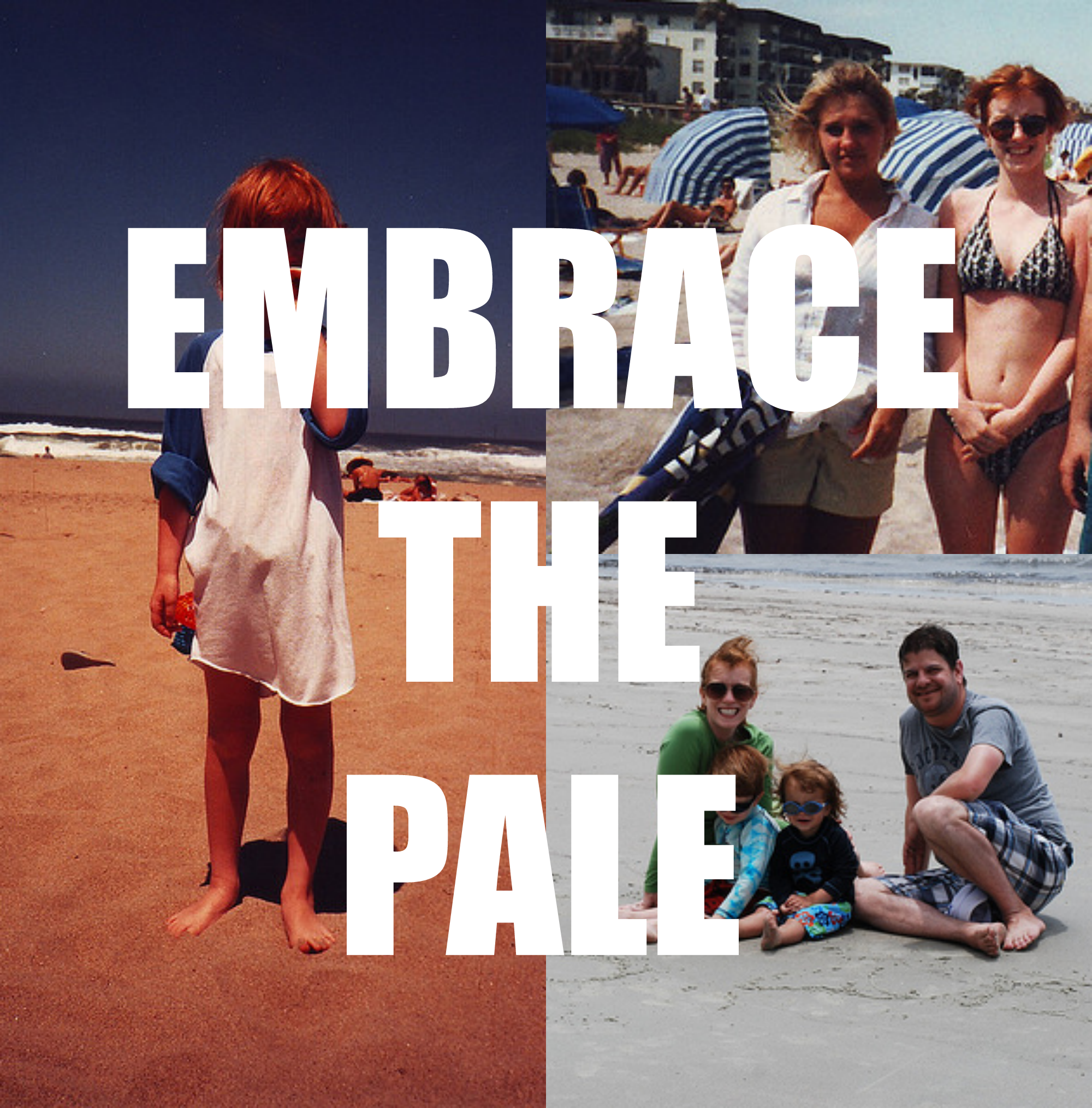
I don’t remember when being pale wasn’t a problem.
When I was younger, the threat of sunburn was forever hanging over my head. My mother was always coaxing me out of the pool for more sunscreen or - even worse - making me wear a t-shirt over my bathing suit.
As I grew up, it wasn’t only that being pale was a problem but NOT being tan was a curse.
I don’t remember when being pale wasn’t a problem.
When I was younger, the threat of sunburn was forever hanging over my head. My mother was always coaxing me out of the pool for more sunscreen or - even worse - making me wear a t-shirt over my bathing suit.
As I grew up, it wasn’t only that being pale was a problem but NOT being tan was a curse.
I remember a close friend in middle school excitedly reporting that my #1 crush might consider going out with me if I got a tan. The truly excruciating aspect was my reaction was one of excitement as well. It seemed doable. If I worked hard enough, surely even I could get a tan!
I’m assuming this experience, along with being surrounded by deeply tanned friends, is what led my 7th grade self to add “Get a dark tan” to her list of life goals. It is also what led me to try in vain all through high school to achieve that goal.

My best friend and I would lay out on my black asphalt driveway every afternoon. She would slather on baby oil and turn a deep dark brown after a few days. I would push the limits with 5 SPF tanning oil and check my swimsuit line day after day only to see the slightest change in pigment.
My mother (very wisely) threatened to take my car keys away from me should I ever so much as cross the threshold of a tanning salon. I still snuck two visits in during journalism camp (sorry, Mom!) where I spent my hard-earned money on 5 minute sessions - the max the owner recommended for me. I left the salon poorer, hotter, but no tanner.
It wasn’t until I got to college that my opinion of my skin began to change.
Suddenly, I wasn’t the lone pale girl in a sea of tans. I had lots of friends with lots of different complexions and lots of concerns far beyond getting and keeping a tan. I’m sure there were girls I went to college with who went to the tanning bed but I don’t remember hearing them talk about it. The pursuit of the almighty tan just didn’t seem to be on anyone’s radar.
My skin stopped begin a problem.
Well, not completely. I still had to avoid sunburns and still for many years I tried to achieve “a little bit of color.” Tanning beds became passé, but self-tans and spray tans presented a seemingly acceptable alternative. After all, peers are influential but overcoming the steady beat of a beauty industry that tells you pale skin isn’t beautiful doesn't come easy.
Slowly a combination of age, maturity, and plain old laziness has produced my current state of acceptance. I love my pale skin and I could give two shits about a tan. I don’t even see it as a “problem” anymore thanks to my new favorite product OF ALL TIME - the rash guard. This little thing has CHANGED. MY. LIFE. Do you have any idea how much mental energy (not to mention money) I spent every summer trying not to get burned?
A SHIT TON.
Then, I met this wonderful woman at the lake one summer (wish I remembered your name special lady who changed my life!!!) who had on super-adorable rash guard from Athleta. She told me and my equally pale mother how much she loved it and suddenly it clicked!
I put my kids in this magical SPF clothing why didn’t I get one for myself!
Game. Changer. Now, I throw that baby on and go. If I’m out of the water, I sit in the shade or cover my legs with a towel. I also always wear a hat. And I am never, ever embarrassed.
In fact, I’ve become a bit of a disciple about accepting the skin you’re in. I’ll never forget reading a fabulous post on Jezebel last year about tans entitled Tanning Is a Young, White, Female Problem. And It's Deadly. In particular, I was struck at the way the author’s criticism extended beyond the dangers of tanning to the idea that we all had to be tan.
“Where did we get this idea that fair skin is embarrassing, unflattering or a flaw in need of fixing by desperate means? By “desperate means,” we’re referring to baking in an indoor cancer coffin (a.k.a. tanning bed), lying unclothed in the blinding sun on a lava-hot lawn chair/trampoline/beach (a.k.a, sun bathing), paying good money to get hosed down with orangey-brown skin dye that sheds off in patches within 5-10 days (a.k.a. spray tanning), or slathering yourself in smelly orangey-brown solutions at home twice a day for two weeks while not touching any fabric or light walls for an hour because you will leave a distinctly “sun-kissed” look on everything (a.k.a. self-tanners).
I know what you’re thinking. “No one uses those sun reflectors anymore!” (And I hope you’re right.) And also, “You’ve obviously never tried [insert favorite brand] tanning lotion/spray/skin suit! Pasty skin problems solved!” But that’s all beside the point. The point is that tan skin is a manufactured beauty ideal, and people are literally paying for it with their lives, or at least with huge areas of skin and debilitating treatments.”
And she’s right! The beauty industry is making billions of dollars a year because they have convinced us our skin isn’t beautiful JUST THE WAY IT IS.
And that is Grade A bullshit.
Thankfully, people seem to be coming around. The Atlantic recently published a piece entitled, The End of Tanning? Tanning beds are thankfully becoming a thing of the past but also the proliferation of pale skinned celebrities who embrace their hues seems to indicate a shifting beauty idea as well.
And I sure as hell hope so. Women have real problems - equal pay, work/life balance, lack of political representation, how to make Amy Poehler our best friend (wait, is that just me?) - BUT being pale is not one of them.
Are you pale or naturally tan? Do you feel pressure to change the skin you're in?
P.S. Why how we view women's bodies matters and the importance of embracing our post-baby bodies.
Dear Fellow White People
We need to talk about Ferguson. I know there is a lot to talk about - the investigation, charges against the officer, the police response.
I want to talk about one thing in particular.
Yesterday, the Pew Research Center released the results of a nationwide survey on the events in Ferguson. The major finding:
80% of black Americans think this case raises important issues about race.
37% of white Americans feel the same.
What that says to me is that many MANY white people believe we have a fundamentally better understanding of what it is like to be black in America then black Americans.
As you recall, I feel pretty strongly on issues of race it is important to call things as I see them so let me be clear.
That is racist. That comes from a position of privilege. That is a problem.

Jeff Roberson/AP Photo
We need to talk about Ferguson. I know there is a lot to talk about - the investigation, charges against the officer, the police response.
I want to talk about one thing in particular.
Yesterday, the Pew Research Center released the results of a nationwide survey on the events in Ferguson. The major finding:
80% of black Americans think this case raises important issues about race.
37% of white Americans feel the same.
What that says to me is that many MANY white people believe we have a fundamentally better understanding of what it is like to be black in America then black Americans.
That is racist. That comes from a position of privilege. That is a problem.
I am not black. I do not have any idea what it is like to be black and, as much as I like to consider myself a thoughtful and intelligent person, nothing I can do, read, or experience myself can replace the experience of being black.
However, I do know what it is like to be a part of a group with less societal power. As a woman, I know what's it like to be treated differently and unfairly based on a physical characteristic I can not change. I also know that if you happen to be a man and you want to see a my head spin around backwards go ahead and mansplain why street harassment isn't that bad or why I'm overreacting to sexist advertisements.
It is infuriating. It is crazy-making. If I had a Molotov cocktail during some of these conversations, I can't promise you I wouldn't have thrown it.
I wish empathy and listening were enough to solve this problem. However, I've noticed something else going on in conversations I've had recently about Ferguson.
It's almost as if some people believe there are issues of race at play. However, the responsible party is not the white officer or the predominantly white police department but the black community itself. There's a lot talk about Michael Brown's past behavior. There's a lot of talk about looters and crime in the community. There's a lot of "Why are THEY rioting?" "THEY are making it worse."
So, the Pew Research result doesn't quite capture the problem because it misses the second half of that sentence. "This case doesn't raise important issues of race because black people bring it on themselves. If the police have to break a few rules, well then that's ok."
Again, that's RACIST and for a million reasons.
But here's why these issues of race go beyond individual perceptions.
The Declaration of Independence states plainly, "We hold these truths to be self-evident, that all men are created equal, that they are endowed by their Creator with certain unalienable Rights, that among these are Life, Liberty and the pursuit of Happiness."
Those natural rights are further enshrined within the Bill of Rights, which specifically guarantees among others freedom of speech, freedom of religion, freedom of the press, freedom of peaceful assembly.
What does that mean? It means you do not earn these rights and that you cannot transfer or surrender these rights. It means that someone does not sacrifice their fundamental rights because they are poor or are on government assistance. It means someone does not sacrifice their fundamental rights because they have a criminal record or because they harass the police. It means someone does not sacrifice their fundamental rights because they dress or speak or behave in a way you find distasteful or offensive.
It means even if every terrible stereotype about black people or poor people or women or Muslims was true (which they aren't!) IT DOES NOT MATTER.
The Constitution guarantees certain fundamental rights and, while you may surrender your liberty by breaking the law, you never surrender your right to be treated fairly under the law.
To me, it means if one group of American citizens believe they are being treated unfairly under the law then we should listen to them and not presume we - as the privileged party - know better.


Sex v. Gender: Why my boys wear nail polish
I encountered it time and time again with Amos. You see I have a thing about cutting your baby’s hair anyway. I think as soon as you cut their hair they’re not your baby anymore. Suddenly, they look so grownup and then everyone starts telling them what a big boy they are and then before you know it they’re in college.
No, thank you.
Plus, Amos just got cuter and cuter the longer his hair got and it got pretty dang long.
Over and over again, people would ask, “Don’t people think he’s a girl!?!” Or family and friends who jokingly call him girl names and tell him what a pretty girl he was.
Apparently, the mere idea that someone would confuse my little boy for a little girl was supposed to scare me into cutting it all off immediately.
I hear a similar thread of conversation among my friend’s with newborns. There is great concern with the perceived gender of outfits and bows and headbands and preventing confusion at all costs.
I just don’t get it.

I encountered it time and time again with Amos. You see I have a thing about cutting your baby’s hair anyway. I think as soon as you cut their hair they’re not your baby anymore. Suddenly, they look so grownup and then everyone starts telling them what a big boy they are and then before you know it they’re in college.
No, thank you.
Plus, Amos just got cuter and cuter the longer his hair got and it got pretty dang long.
Over and over again, people would ask, “Don’t people think he’s a girl!?!” Or family and friends who jokingly call him girl names and tell him what a pretty girl he was.
Apparently, the mere idea that someone would confuse my little boy for a little girl was supposed to scare me into cutting it all off immediately.
I hear a similar thread of conversation among my friend’s with newborns. There is great concern with the perceived gender of outfits and bows and headbands and preventing confusion at all costs.
I just don’t get it.
Now, I’m not a doctor. However, as far as I know, other people’s perception of your child’s sex has absolutely no effect on what resides between their chubby little legs. People can confuse your precious baby girl for a boy all day long and she will still be a girl. People can call your adorable baby boy a beautiful girl all day long and he will remain a boy.
Trust me. Amos was confused for a girl on multiple occasions and yet he remains a boy -completely and totally unaffected by being called a girl so many times.
My question is if it doesn’t change the sex of your child then why does it matter?
Well, I would argue because people aren’t really concerned about the SEX of a child which (for the most part) is set at birth. Sex is defined as the biological and physiological characteristics that define men and women. What people get all riled up about is GENDER and that is a WHOLE other ball game.
Gender as defined by the World Health Organization is “the socially constructed roles, behaviors, activities, and attributes that a given society considers appropriate for men and women.” In many ways, gender is defined from birth as well. In a million subtle ways, we treat boys and girls differently from the moment they exit the womb.
Now, we can debate whether or not the ways we treat boys and girls differently define those gender roles or whether these roles are found deep within our DNA. Truthfully, I don’t think it really matters. What is not up for debate is that some little boys and girls don’t fall within those predefined roles.
Some boys really love dolls and dress-up and the color pink. Some girls love football and cars and the color blue. My husband likes to cook for his family. I like to drink bourbon and argue about politics.
AND THAT’S OK.
What is NOT ok is when someone is made to feel shame because who they are or what they enjoy does not line up with society’s predefined roles for them.
People say they just want their kids to be happy but sometimes I wonder if they mean it. What if your little boy wants to stay home and raise kids? What if your little girl wants to join the Air Force? Our children are individuals wholly and completely separate from the baggage we carry about what’s “right” or “appropriate.”
And that is why I try to get out of the way when my sons show an interest in just about anything and, let me tell you, everyone else better get out of the way as well. You want to see me go all mama bear in zero to 60? Say something about Amos’s fingernail polish or Griffin’s pink fuzzy socks. I dare you.
Gender roles are an ongoing discussion in our house because it is incredibly important to me that THEY define what’s important to them – not society.
At Griffin’s four-year-old checkup, our pediatrician looked at him and exclaimed, “Griffin you’re such a pretty girl!”
Griffin responded, “I’m not a girl!”
“Well, how do you know?”
“Because I don’t have a vagina!”
The doctor burst out laughing and told me he’d never gotten that response before. I was so confused. “What do they usually say?” I asked. He told me most boys would say they weren’t a girl because they didn’t wear dresses or have long hair. (Seriously, with the hair again!?! Is anyone really debating that J-Law and her new pixie cut is not longer female? Or Ted Nugent is anything but male?!?)
I was incredulous. I told him gender is an ongoing discussion in our house. That we spend a lot of time talking about the physical differences between boys and girls and what other people think about what boys should do and what girls should do. However, ask Griffin the truth and this is what he’ll tell you.
“The only thing girls can do that boys can’t do is have babies. Everything else is up for grabs.”
What about you? How do you feel about traditional gender roles as they're applied to our kids?




My podcasts


Subscribe to my weekly email

- August 2017
- March 2017
- January 2017
- November 2016
- October 2016
- September 2016
- August 2016
- June 2016
- May 2016
- April 2016
- March 2016
- February 2016
- January 2016
- December 2015
- November 2015
- October 2015
- September 2015
- August 2015
- July 2015
- June 2015
- May 2015
- April 2015
- March 2015
- February 2015
- January 2015
- December 2014
- November 2014
- October 2014
- September 2014
- August 2014
- July 2014
- June 2014
- May 2014
- April 2014
- March 2014
- February 2014
- January 2014
- December 2013
- November 2013
- October 2013
- September 2013
- August 2013
- July 2013
- June 2013
- May 2013
In this series, I’m examining the science of parenting. In Part One, we discussed the the importance of the quality - not quantity - of time we spend with our kids. In Part Two, we looked at the science on what types of activities can be considered quality family time. In Part Three, I look at how our children spend their time, our perception of those activities, and what the science actually says.
Last week, I took the boys to our local park after school. I had just read an editorial making a strong case for free-range parenting. This quote in particular left me wondering if I give my own children enough opportunities to explore.