
Are people doing the best they can?
This weekend I finished the audio version of Brené Brown's new book Rising Strong.
Y'all. This book broke my brain.
If you are unfamiliar with Brené's work, stop what you are doing and watch this Ted Talk.
This weekend I finished the audio version of Brené Brown's new book Rising Strong.
Y'all. This book broke my brain.
If you are unfamiliar with Brené's work, stop what you are doing and watch this Ted Talk.
She is AMAZING. Her teachings on shame and vulnerability, including her books The Gifts of Imperfection: Let Go of Who You Think You're Supposed to Be and Embrace Who You Are and Daring Greatly, instruct everything I do. Her insights have helped me re-evaluate my relationships, my work, my creative process, my parenting.
In Rising Strong, she advocates "getting curious" about our emotions... in particular, when we are feeling self-righteous.
Not going to lie. I'm REAL good at feeling self-righteous. It's my go-to emotion when I'm feeling hurt or angry or unappreciated. During one of Brené's own bouts of self-righteousness, her therapist asks her a powerful question.
"Do you think people are doing the best they can?"
Brené answers with a resounding, "NO!" And as she goes on to explain why the "sewer rats and scofflaws" are keeping us all from living big, I found myself yelling along with the radio.
"EXACTLY! You tell them Brené!"
It's SO HARD to assume the best of people when they are hurting us or shaming us or even ignoring us. I don't want to assume the passive agressive woman at church is really doing the best she can. I don't even want to assume the best of people I dearly love - like my own husband - when I'm in the midst of feeling resentful and angry.
However, we've all been on the other side of judgment and pain. We've all been someone else's "sewer rat and scofflaw" and we all know that - at that time - we were doing the best we could.
Now hear me, that doesn't mean we were doing THE BEST THERE WAS TO DO.
When I yell at my four-year-old, I know it's not the best I'm capable of - objectively speaking. However, in that moment, considering my stress level, my energy level, and God knows what else I am doing the best I can with the tools available to me. I don't love him any less in that moment then when I am patient and calm. I'm just doing the best I can.
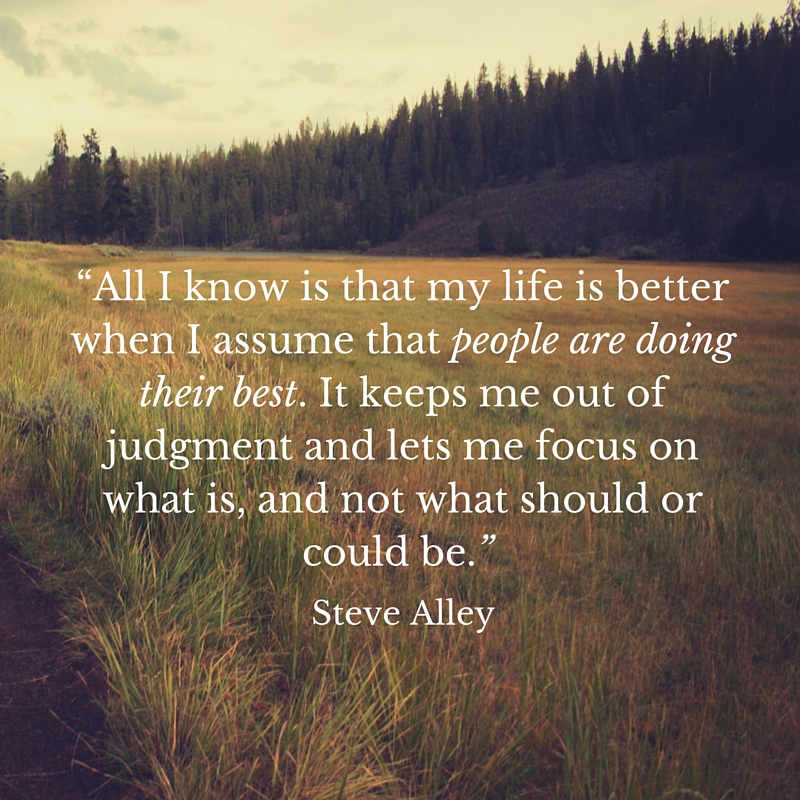
It's Brené's husband Steve who eventually states what feels like trurth to me. When she asks him if people are doing the best they can, he answers, “I don’t know. I really don’t. All I know is that my life is better when I assume that people are doing their best. It keeps me out of judgment and lets me focus on what is, and not what should or could be.”
She then quickly addresses the "murderers, assassins, and terrorists" question we all have.
Are murderer really doing the best they can?
Her answer?
Yes, but their best is DANGEROUS.
And that's when my brain broke. I've been struggling recently with the concept of choice and personal responsibility, when it comes to my kids and when it comes to society as a whole. As we learn more and more about how the brain responds under stress, how can we really ascribe choice and then punishment to people who are suffering under incredibly difficult situations - from poverty to addiction to trauma? With regards to the little terrorists I live with on a daily basis, how can we punish a four-year-old who literally can't act differently?
The brilliance of her answer is it separates EFFORT FROM RESULT.
Yes, you are doing the best you can and we acknowledge your humanity and suffering. However, the result of your actions are important as well. Whether you are hitting your brother or committing murder, why you did what you did is separate from why we can't allow you to do that again.
So, what do y'all think? Are people doing the best they can?
POLL TIME: Are people doing the best they can?
Posted by Sarah Stewart Holland on Wednesday, October 14, 2015


Being my own boss
I don’t like to have a boss.
For years, I couldn’t admit this to myself.
It felt cocky and egotistical. It felt like I was confessing a character flaw.

I don’t like to have a boss.
For years, I couldn’t admit this to myself.
It felt cocky and egotistical. It felt like I was confessing a character flaw.
I didn’t even have bad bosses to blame. My first boss Karen would buy me a lunch once a week. We’d sit in her office. She’d give me gifts from Aveda for doing a good job and make sure I didn’t have any concerns I needed to share.
Seriously.
My second boss Hal didn’t share my appreciation for Aveda. Yet, he did make me feel smart and supported and capable. He’s also hilarious and kind, which helps.
Still - even with some of the best bosses on the planet - I always bristled at hierarchy.
Then, I had a run-in with a boss that didn’t involve supportive lunches or Aveda. As is my way, I beat myself up about my role in the conflict. Then, I got upset. Then, I started inventing all the reasons I didn’t need to work for this particular boss anymore.
Finally, my husband (as is his way) cut through my bullshit with some well-timed wisdom.
I was making my case for quitting and he looked at me and said, “Sarah, you don’t like having a boss. That’s ok.”
Wait, IT IS?
It felt like a revelation. I didn’t like having a boss and THAT WAS OK.
For so long, I had carried my preference like a burden.
If I didn’t want a boss, that meant I had to BE the boss. What did I know about being the boss? Didn’t you have to be older? Didn’t you have to be an expert? Didn’t you need years of experience?
There was the answer - contained in my husband’s simple observation.
I don’t think it was an accident that this observation came from a man.
As a woman, likability is high on the list of societal requirements. Confidence (especially anything with a whiff of overconfidence) is very, very low.
I got the image above my doing a Google Image Search on the word boss. Almost every single image of a "boss" contains a man. The only woman is using an air horn on a cowering man. I can't make this stuff up, people!
Add in a massive case of imposter syndrome and it’s easy to understand why I was scared to proclaim I loved being in charge.
But, I’ve learned the alternative is much worse. Ignoring my personal boundaries and signing up for work that leaves me frustrated and resentful is simply not worth it. When I don't have real creative freedom and control over my work, I spend too much energy fighting circumstances I can't change and not enough energy producing work of which I can be proud.
For me, work is as much about the process as it is the result. That's not to say I can't be a team player - I can. However, the ability to listen to my own rhythms and follow my own ideas leaves me feeling energized instead of depleted.
Taking charge - unapologetically - is scary and exhilarating but WORTH IT every single time.
Book + Friend Bundling
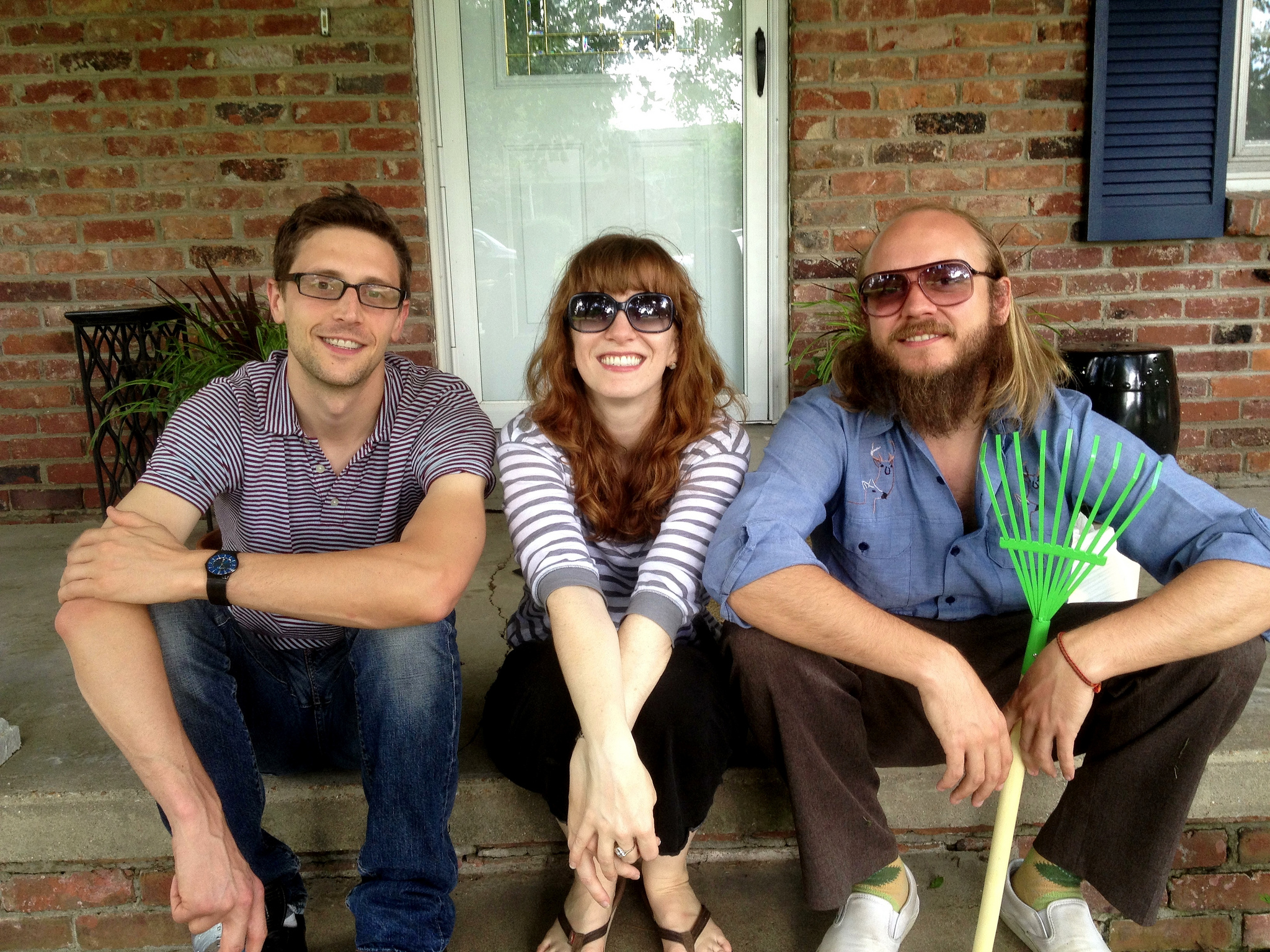
These two guys were my first book club guinea pigs.
I'm on Modern Mrs. Darcy - one of my FAVORITE blogs - talking about my new favorite way to connect with friends and family.
I love to read, but realized I was only finishing one or two books a month. I love connecting with friends and family, but realized recently I was going months without talking to the most important people in my life.
Then, I discovered “temptation bundling.” “Temptation bundling” is linking together two activities — one you should do but maybe avoid or have trouble making time for; and one you love to do but can be easily forgotten among more urgent tasks.
What if I combined my goal of reading more with connecting with family and friends?
5 Lessons from The Life-Changing Magic of Tidying Up
Several months ago, my dear friend Annie texted me pictures of her neatly organized drawers and told me to stop what I was doing and read Marie Kondo’s The Life-Changing Magic of Tidying Up: The Japanese Art of Decluttering and Organizing.
When Annie says, “Read this book. Do it now.” I do it.
I have been battling with my stuff for a long time. A few years back I announced a massive project in which I was going to declutter and inventory my entire house. Never happened. I tried going room by room and intensely declutter. Never happened.
I would walk around my house and feel like the piles of stuff were mocking me. I would spend weekends purging and organizing but never feeling like I got anywhere.
I was exactly what I didn’t want to be. I was a stuff manager.
The problem was I thought I already knew everything there was to know about organizing. What could Marie Kondo possibly teach me?
Turns out. A LOT.

Several months ago, my dear friend Annie texted me pictures of her neatly organized drawers and told me to stop what I was doing and read Marie Kondo’s The Life-Changing Magic of Tidying Up: The Japanese Art of Decluttering and Organizing.
When Annie says, “Read this book. Do it now.” I do it.
I have been battling with my stuff for a long time. A few years back I announced a massive project in which I was going to declutter and inventory my entire house. Never happened. I tried going room by room and intensely declutter. Never happened.
I would walk around my house and feel like the piles of stuff were mocking me. I would spend weekends purging and organizing but never feeling like I got anywhere.
I was exactly what I didn’t want to be. I was a stuff manager.
The problem was I thought I already knew everything there was to know about organizing. What could Marie Kondo possibly teach me?
Turns out. A LOT.

My former "junk" drawer.
1. Everything I knew about organizing was wrong.
Tackling organization a little bit at a time? WRONG. Going room by room? WRONG. Finding just the right “system” for organization? WRONG.
Marie Kondo throws out all the classic organizing advice bit by bit until she’s left with one simple truth.
2. We should be choosing what we want to keep, not what we want to get rid of.
That is POWERFUL insight right there.
For YEARS, I spent all my energy using my space to keep what I had. If I had an empty drawer, I filled it. If I collected extra supplies, I stored them. If I had space, why not?
Because the space in your house represents the space in your life and there is only a FINITE amount of it.
Even the very back corner of a little-used closet represents mental energy and how do you want to spend your mental energy? Managing stuff?
Well, NOT. ME.

My t-shirt drawer. BELIEVE in the vertical fold.
3. Every item in your home should spark joy.
The KonMari method requires you place every single item in your hand and ask does it spark joy? If it doesn’t, it goes!
I know that sounds extreme and she makes allowances for items that you use on a daily basis or need to but can’t afford to replace.
However, I still think those things bring joy. My little boxcutter tool doesn’t necessarily spark joy when I hold it in my hand. But you know what does? Having it perfectly stored in its own space and seeing that space occupied by something that I use almost daily!
4. It’s about the EMOTIONS - not the stuff.
“When you come across something that’s hard to discard, consider carefully why you have that specific item in the first place. When did you get it and what meaning did it have for you then? Reassess the role it plays in your life. If, for example, you have some clothes that you bought but never wear, examine them one at a time. Where did you buy that particular outfit and why? If you bought it because you thought it looked cool in the shop, it has fulfilled the function of giving you a thrill when you bought it. Then why did you never wear it? Was it because you realized that it didn’t suit you when you tried it on at home? If so, and if you no longer buy clothes of the same style or color, it has fulfilled another important function—it has taught you what doesn’t suit you. In fact, that particular article of clothing has already completed its role in your life, and you are free to say, “Thank you for giving me joy when I bought you,” or “Thank you for teaching me what doesn’t suit me,” and let it go. Every object has a different role to play. Not all clothes have come to you to be worn threadbare. It is the same with people. Not every person you meet in life will become a close friend or lover. Some you will find hard to get along with or impossible to like. But these people, too, teach you the precious lesson of who you do like, so that you will appreciate those special people even more.”

No. More. Stacking.
That passage fundamentally changed how I feel about my belongings. First of all, I realized that discarding something didn’t mean I thought it was worthless. Feeling like a once precious object was now worthless kept me from getting rid of it. Now, I realize I can say thank you for an object’s role in my life and then let. it. go.
The sweater I loved to snuggle up in our first winter back in Paducah? Thanks for the memories and goodbye. The book that changed my worldview in college? Thank you for the insight and goodbye. The CDs I listened to a thousand times in 2007 but never since? Thank you and goodbye.
5. Practice makes perfect.
Marie Kondo has a specific order in which you tackle your clutter - category by category. You begin with clothes then go one by one until you finally sort sentimental belongings.
Over the past few months, I’ve worked through each category with only kitchen accessories and the sentimental belongings left.
It has been FREEING.
She’s right. You get better and better at understanding which items bring you joy and which you can let go.
And, as I get better at it, I feel less like I live among my stuff and more like my home is a place of peace and joy.
If you’ve felt weighed down by your stuff, this book truly is life-changing.
Any of y'all already KonMarie converts?




My word for 2015
Every year I chose a word that represents something I want to work on for the upcoming year. It could be something I want more of in my life. It could be something I want to focus on in specific areas of my life. Either way - in addition to resolutions - I like to pick a word as a guiding concept to keep me centered all year long.
I've been picking a word for three years now. In 2013, my word was simplicity. In 2014, my word was growth. I've felt the power of having a word - especially this last year.
Unfortunately, I was having a lot of trouble picking a word this year.

Every year I chose a word that represents something I want to work on for the upcoming year. It could be something I want more of in my life. It could be something I want to focus on in specific areas of my life. Either way - in addition to resolutions - I like to pick a word as a guiding concept to keep me centered all year long.
I've been picking a word for three years now. In 2013, my word was simplicity. In 2014, my word was growth. I've felt the power of having a word - especially this last year.
Unfortunately, I was having a lot of trouble picking a word this year.
I wanted a word that represents the Buddhist principle of detachment. I've been thinking a lot about this concept. The idea of letting go of expectations and the stories we tell ourselves and the power we let other people and outside experiences have over our lives.
Clearly, I'm not the only one thinking a lot about this concept if the current issue of Real Simple is any indication

But "let it go" is three words and the related words weren't quite right. Obviously, detachment has too much of a negative connotation in English. The point is not to stop caring about the things and people you love. One friend suggested release, which I really liked but just couldn't connect with. I think because it implies one act of letting go as opposed to more of a daily practice.
Surrender was close. Accept was closer but still not it.
Finally, I told Nicholas I was going to look for the word in Sanskrit - the classical language of India and often used to describe spiritual concepts in yoga and Buddhism.
He was skeptical... to say the least.
Well, what do you know! Turns out there is a Sanskrit word for the practice of non-attachment - as opposed to Detachment.
“Yoga says no to detachment. Do not avoid situations in life or even in yourself, but learn to accept the existence of the things that are around you. Once you have accepted them and know their nature, then it is possible to become non-attached. The word ‘non-attachment’ does not really exist in English, but it exists in Sanskrit in the form of vairagya, meaning to to be free from attachment, without rejecting anything. It represents a state of mind that is continuously observing the nature of events and is unaffected. Non-attachment can easily be developed provided we can expand our awareness to see the reality behind things.”
I love this explanation and it perfectly sums up a concept that Dan Harris deals with a lot in one of my favorite books of 2014 - 10% Happier: How I Tamed the Voice in My Head, Reduced Stress Without Losing My Edge, and Found Self-Help That Actually Works--A True Story. (Seriously, y'all, if you do one thing for yourself in 2015, read this book!) How do we stay invested in our lives without becoming slaves to our emotions?
“Striving is fine, as long as it’s tempered by the realization that, in an entropic universe, the final outcome is out of your control. If you don’t waste your energy on variables you cannot influence, you can focus much more effectively on those you can. When you’re wisely ambitious, you do everything you can to succeed, but you are not attached to the outcome — so if you fail, you will be maximally resilient, able to get up, dust yourself off, and get back in the fray.”
It builds a type of resiliency. It allows some breathing room. Dan Harris describes it as the ability to respond to events in our lives instead of merely reacting.
I want that in my life. I want the ability to be in the presence of powerful feelings and events - including my love for children and husband - without being controlled by them. I want to be able to pour my entire effort into something without feeling like my value is defined by the outcome.
I don't want to detach from that love or that effort. I still want to be the passionate person I have always been.
So, vairagya is my word.
Do you have a word for 2015?
What Worked for Me in 2014
I LOVE this last little bit of time as the old year ends and the new year is about to begin. I love reflecting on a completed year and planning for an upcoming year. I basically complete every year-end reflection I come across and had just finished this personal audit from Unclutterer when I saw one of my favorites Modern Mrs. Darcy shared her similar reflections on what worked well for her in 2014.
So, here you go...
What worked for me in 2014?

I LOVE this last little bit of time as the old year ends and the new year is about to begin. I love reflecting on a completed year and planning for an upcoming year. I basically complete every year-end reflection I come across and had just finished this personal audit from Unclutterer when I saw one of my favorites Modern Mrs. Darcy shared her similar reflections on what worked well for her in 2014.
So, here you go...
What worked for me in 2014?
Therapy
I've been in therapy since March of this year. Despite facing an incredibly difficult loss (and 10.5 months of pregnancy in 2014!), I'm ending this year feeling happy and hopeful. Facing some difficult emotional truths was hard but it has left me stronger. My word for 2014 was growth - thanks to therapy I fully realized the power of that word.
Cleansing Creme
Y'all, I'm off shampoo forever. I've got a more detailed post on this coming later. Life. Changing.
Meditation
I already believed in the power of the present moment but reading this book recently confirmed it. Meditation has been a less than regular part of my daily routine. Since I've made it a must-do every morning (even if it's for only 5 minutes), I've noticed a huge difference.
Work Apps
I've started using Toggl for tracking my time, TripLog for tracking my mileage, Schedugram for managing multiple Instagram accounts, and Todoist for my to do list/project management. They have all saved me so. much. time.
Prepping for Christmas
Preparation is not celebration. Getting ready for Christmas doesn't rob the season of joy. It gives you the gift of time and peace when you need it the most. I'm gaging interest on how many of y'all would be interested in learning more about Christmas preparation. If you'd be interested in learning more, sign up here.
Saying No
I ended several work projects and watched the work I find most fulfilling grow. I also focused on my friendships and relationships that bring me the most joy. I've been trying to live by the recommendation of one of my favorite books this year - "Remember that if you don't prioritize your life someone else will."
What didn't work for me in 2014?
Pregnancy
When this baby is born in February, I will have been pregnant for 12 and a half of the last 14 months. Y'all, THAT IS TOO LONG. I want to drink. I want to bend and stretch and go back to yoga and climb up a ladder without worry. I'm incredibly grateful we were able to get pregnant so soon after our loss but WHEW! This is getting old.
Exercise
Yeah... I'm not so much doing that right now. See previous item.
Going Paleo
Remember when I ate (mostly) Paleo with such success? Yeah, me neither. Back on the wagon in 2015!
What has (and hasn't) worked for you in 2014? We're having a great discussion on Facebook!
"The Perfect Mother" and Self-Compassion
I would never have described myself as a perfectionist. My house is frequently cluttered. My desk is covered with projects and reminders and stray papers. My kitchen floor is filthy.
For the longest time, my desktop was giant colorful graphic proclaiming "DONE IS BETTER PERFECT." That creed is not empty words to me. I believe it. I don't let perfection slow down my desire to complete a project. Perfectionism is paralyzing, as I would often lecture other people.
No, I was not a perfectionist.
Except...
I've recently realized that perfectionism is a deep, deep river that flows far beneath my attitude towards my house's cleanliness or craft projects. Just because I'll publish a blog post with typos or slap together class treats that are far from Pinterest-worthy doesn't mean that perfectionism doesn't affect me.
The perfectionism that haunts me is far more insidious and harmful.
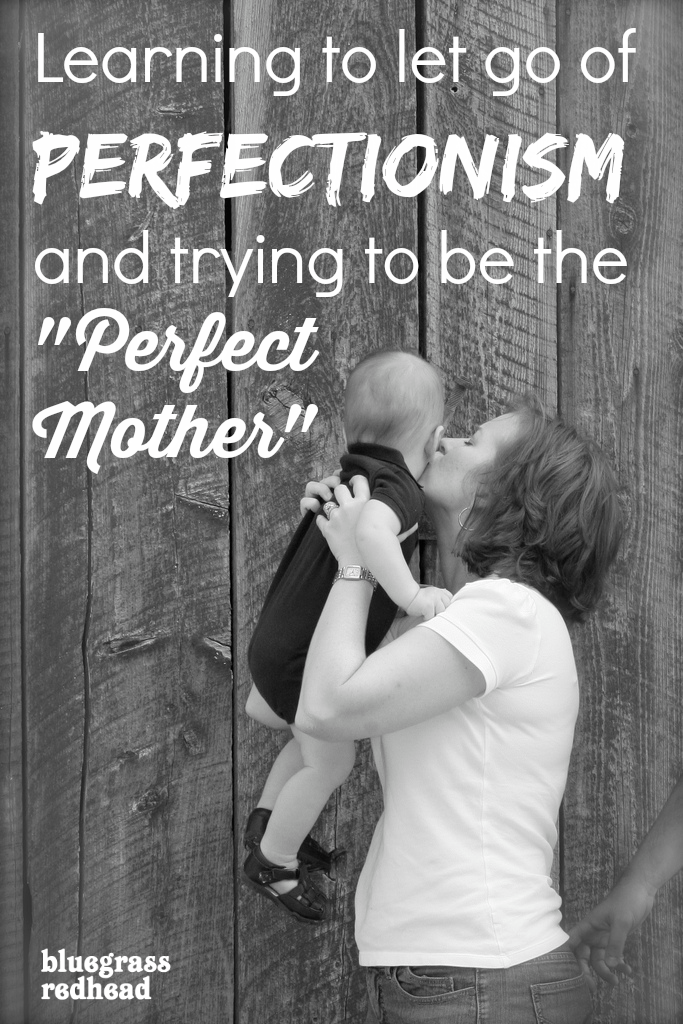
I would never have described myself as a perfectionist. My house is frequently cluttered. My desk is covered with projects and reminders and stray papers. My kitchen floor is filthy.
For the longest time, my desktop was giant colorful graphic proclaiming "DONE IS BETTER PERFECT." That creed is not empty words to me. I believe it. I don't let perfection slow down my desire to complete a project. Perfectionism is paralyzing, as I would often lecture other people.
No, I was not a perfectionist.
Except...
I've recently realized that perfectionism is a deep, deep river that flows far beneath my attitude towards my house's cleanliness or craft projects. Just because I'll publish a blog post with typos or slap together class treats that are far from Pinterest-worthy doesn't mean that perfectionism doesn't affect me.
The perfectionism that haunts me is far more insidious and harmful.
I want to be the perfect mother.
When I look back, I can see the seeds of this perfectionism take root when I decided I wanted to move back Paducah to raise a family. I was asking Nicholas to give up so much. I was pushing us to change our entire lives. I had to make my case that the stakes were high enough to justify the level of risk we were taking on.
For months, I made the same argument. We were bringing a human being in to the world. We had to do it RIGHT. This little baby wasn't being asked to be born. So, it was our duty to him to give him the best life we possibly could.
He had to have grandparents in his life. He had to have a community. He had to have good schools. Most importantly, he had to have parents that could BE THERE for him. Parents who didn't work all the time. Parents who could come to school programs. Parents who had real weekends to read stories and play games and go to the park.
And I still believe that.
I know moving to Paducah was the right decision for our family. However, I see now that pushing so hard for this vision of "perfect parenting" created a voice in my head that speaks loudly and clearly to this day.
Every. Single. Day.
I'm constantly striving to please that voice. Are the boys watching too much television? Are we reading enough books? Are they eating enough fruits and vegetables. Are they sleeping enough? Are we disciplining enough? Are we being too hard on them?
Am I doing it RIGHT?
I don't want to silence this voice completely. I firmly subscribe to the Jacqueline Onassis school of parenting. She once famously said, "If you bungle raising your children, I don't think whatever else you do matters very much." I couldn't agree more.
Raising your children should be taken seriously because it is a serious thing. I will never stop reading and researching child development and parenting techniques. I will never stop trying to improve. I want to be the best possible mother I can be. My children deserve that.
However, striving for the best and striving for perfection are too different things. My perfectionism comes from a deep desire to control things. If I can control my environment, then I don't have to acknowledge the deep vulnerability at the heart of raising another human being.
Erma Bombeck once described parenting as the decision to let your heart walk around outside your body. That is a truly scary prospect, but I can't change it or control it. I can perfectly portion my children's television consumption. I can feed them the most perfectly balanced meals ever created. I can read developmentally appropriate books while supervising mentally stimulating crafts ALL DAY LONG and it wouldn't matter.
The journey I've chosen to take as a mother is fundamentally chaotic and beyond my control. That lesson came crashing down hard over my head earlier this year when I lost our baby. The voice in my head was loud and unapologetic.
I had ONE JOB - to carry that baby - and I had failed. I had failed as a mother.
On a certain level, I knew how illogical I was being but the voice was crystal clear and truthfully it was only a matter of time before that voice got out of control. Since perfectionism is unattainable, I set up an unachievable standard for myself. And let me tell you, I was mean about it. I didn't realize how little self-compassion I had until I was describing these thoughts to my therapist.
"You're pretty hard on yourself, aren't you?" she replied.
I started crying, which is basically a big old fat "YEAH KIND OF."
I've also realized the harder I am on myself the harder I can be on those I love the most. After all, I'm beating the crap out of myself over here trying to be perfect so why can't you STEP IT UP!?!
But you know what? My perfectionism is NOT my husband's or my mother's or my best friend's problem. Plus, insider tip, being a judgmental nag isn't exactly the best way to motivate people... at least not in my experience.
Beyond the adults in my life, what am I teaching my children? If the whole point is to create the best lives for my children possible, do I think they will do as I say or do as I do? It is heartbreaking to me to imagine the harsh voice in my head ever inhabiting my children's lives.
So, I'm trying to let go of the perfectionism and be kinder to myself. I recently discovered the work of Dr. Kristin Neff, who has made self-compassion her life's work. If you have a few minutes, I highly recommend her TedX Talk.
She also has a great website where you can take a self-compassion quiz. My score was NOT great but that's ok. Gotta be compassionate about it! Plus, I'm working on it. She also offers lots of great tips and advice on how to be more self-compassionate.
One of her suggestions is to talk to yourself as you would a dear friend. I've thought a lot about that. Some of my dearest friends have suffered miscarriages or lost pregnancies. I would NEVER say to them the things I say to myself. Heck, I never even thought these things in relation to them. So, why the heck am I being so hard on myself?
For me, it all comes back to a toxic mix of perfectionism and a desire for control. I'm trying to let go of that. I've recently been reading about the Buddhist principle of detachment. It doesn't mean that you detach from action or desire. It means you detach from the results - from the things you truly can't control.
That seems particularly relevant to parenting.
In the end, all we can do is all we can do, then we have to let those little beings walk away ... even if they have our hearts in their hands.
Do you struggle with perfectionism?
The Truth That Changed My Marriage
Nicholas and I have been married for eleven years. We work hard. We have two small children. We recently lost a baby. In theory, these should be tough times for our marriage, but they have been just the opposite.
These past two years have been our happiest and most fulfilling as a couple.
My husband is still the man he has always been. He is attentive and caring and intelligent, but he didn’t magically stop doing all the things that annoy me (leaving his shoes around the house, paying too much attention to his iPhone, giggling to his favorite podcasts, this is not a comprehensive list). We still fight and he still hurts my feelings from time to time.
No, Nicholas didn’t change. I did.
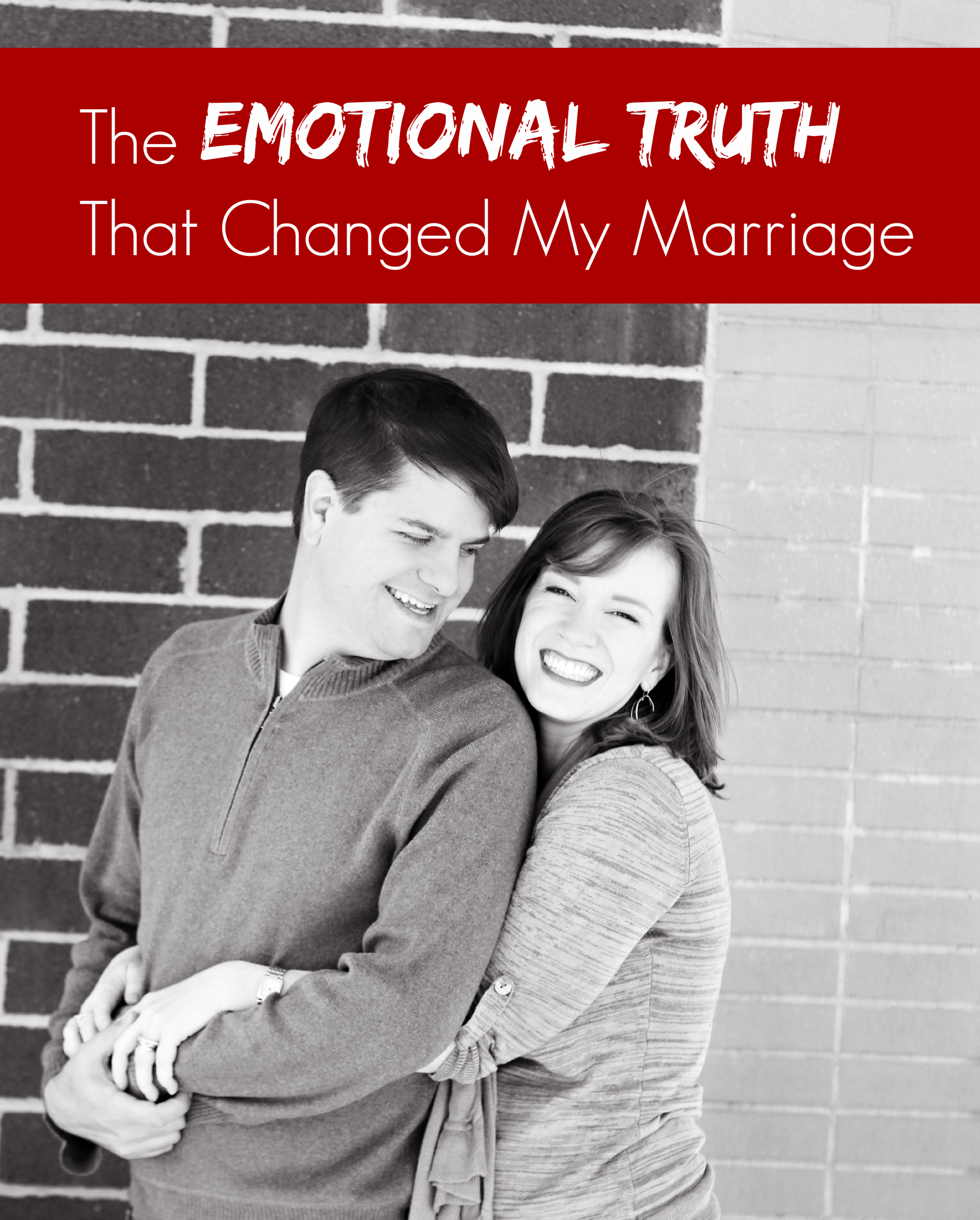
Nicholas and I have been married for eleven years. We work hard. We have two small children. We recently lost a baby. In theory, these should be tough times for our marriage, but they have been just the opposite.
These past two years have been our happiest and most fulfilling as a couple.
My husband is still the man he has always been. He is attentive and caring and intelligent, but he didn’t magically stop doing all the things that annoy me (leaving his shoes around the house, paying too much attention to his iPhone, giggling to his favorite podcasts, this is not a comprehensive list). We still fight and he still hurts my feelings from time to time.
No, Nicholas didn’t change. I did.
It all began when my best friend and I read Grace for the Good Girl by Emily Freeman. The book is built around the author’s Christian journey, but I think it has important truths for anyone no matter their spiritual beliefs.
Emily speaks specifically about the three parts of the soul: our mind, our emotions, our free will and how easy it is to become a slave to the tyranny of emotion.
“There is no alternative to my own point of view. I am held captive by my own thoughts and emotions. I am my only point of reference.”
As I was reading this, I realized this is similar to what I read several years ago in a VERY different spiritual book called A New Earth by Eckhart Tolle. He called the emotions the “ego” so I’m not sure I ever quite made the connection but the point is similar.
My emotions are relevant but they are not reality.
For years, I’d let my emotions rule my marriage. If I felt neglected, it was because I was actually being neglected. If I felt unloved or hurt during a fight, it was because Nicholas didn’t actually love me and wanted to hurt me. It is embarrassing to admit how many times I thought during a normal marital fight, “Well, he doesn’t love me. We should probably get divorced.”
Y’all. Nobody – I mean NOBODY – loves me more than Nicholas Holland. And I suppose on some level I knew this because obviously we aren’t divorced. Outside the highly emotional environment of the fight itself, actual logic would take over.
Still, it was exhausting to ride that emotional roller coaster constantly. Not to mention, poor, poor Nicholas. (Sorry, again, honey!) I can still remember how confused he often looked during our worst arguments as I would cry over how he clearly didn’t love me.
It’s not that my emotions were unimportant. They were relevant then. They are relevant now. If I feel hurt or neglected or even unloved, I need to recognize that and say so. However, I have to constantly remind myself that the reality of the situation is much more complex than how I feel in that moment.
Recently, my therapist drew a Venn diagram explaining the importance of one’s emotional life in relationship to other aspects of our lives.
It looked like this.

See how lovely and balanced that is?
Yeah, mine was more like this.

Truthfully, recognizing that I need to beef up my other circles has not only made me a happier wife, but a happier person. It has also become increasingly essential as I face the very emotional reality of pregnancy after the loss of our baby.
During the tough days surrounding my former due date, I felt a lot of things. Mainly, I felt like our baby was dead. I had to remind myself that that emotion was relevant. It was relevant because I am still grieving the loss of our little one. It was relevant because I am incredibly anxious about the arrival of our son in February.
However, it was not reality. Our baby is very much alive.
And when I took a deep breath and tried to focus on some of those other aspects of my life I felt so. much. better. I listened to the logic in the voices of my husband and friend and doctor who reminded me my pregnancy and baby were healthy. I focused on my physical self by taking long walks outside. I worked on my spiritual self by meditating and writing.
And guess what? It worked!
Now, real talk. Is my Venn diagram now perfectly balanced? HA! That’s a big old no. More often than not my emotions are still elephant stomping all over my other circles.
However, when that happens, I remind myself that how I feel is relevant. It’s just not reality.
How do you manage your emotions? What realizations have changed the relationships in your life?
My podcasts


Subscribe to my weekly email


- August 2017
- March 2017
- January 2017
- November 2016
- October 2016
- September 2016
- August 2016
- June 2016
- May 2016
- April 2016
- March 2016
- February 2016
- January 2016
- December 2015
- November 2015
- October 2015
- September 2015
- August 2015
- July 2015
- June 2015
- May 2015
- April 2015
- March 2015
- February 2015
- January 2015
- December 2014
- November 2014
- October 2014
- September 2014
- August 2014
- July 2014
- June 2014
- May 2014
- April 2014
- March 2014
- February 2014
- January 2014
- December 2013
- November 2013
- October 2013
- September 2013
- August 2013
- July 2013
- June 2013
- May 2013