12 Pieces of Great Advice
So, here's the thing. Lena Dunham is my favorite person. Ok, not favorite as in FAVORITE of all time. She's my favorite person who I don't actually know.
I'm officially unseating Oprah. That's how much I love Lena.
She has a new book Not That Kind of Girl (which I have obviously already pre-ordered) coming out and to promote it she did this awesome series of advice videos that are not to be missed. Everything I love about her is present in these videos - her intelligence, her sense of humor, her empathy.
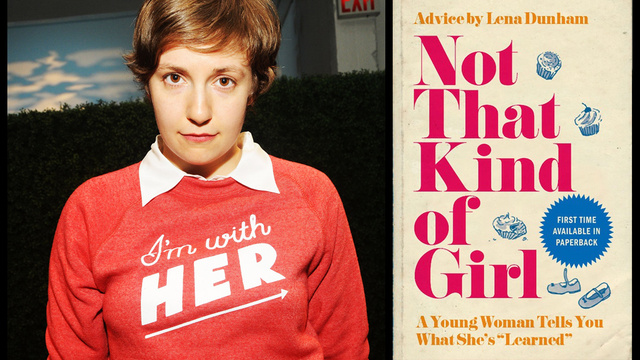
Image courtesy of FLURT
So, here's the thing. Lena Dunham is my favorite person. Ok, not favorite as in FAVORITE of all time. She's my favorite person who I don't actually know.
I'm officially unseating Oprah. That's how much I love Lena.
She has a new book Not That Kind of Girl (which I have obviously already pre-ordered) coming out and to promote it she did this awesome series of advice videos that are not to be missed. Everything I love about her is present in these videos - her intelligence, her sense of humor, her empathy.
1. Can you dress provocatively and be a feminist?
" I bought a see through rain dress. I don't have a lot of place to wear it but I'm gonna."
2. How to make peace with your body
"Where as when I was at my biggest - and like running around Brooklyn in a romper - it was raining men."
3. When to end a friendship
"I'll hope you buy it but even if you don't I still feel very connected to you."
4. Why you shouldn't sleep with "garbage trash people"
"I had a train of the most disastrous despicable van dwelling monsters in my bed and in my life."
5. Overcoming insecurities as a writer
"And by sharing things that are close to you, you will connect to other people who feel alone in the world."
6. On Mental Illness
I just love that she included this one, which isn't funny or clever, but rather important and empathetic.
7. How to deal with bullies
"A foreigner!!
8. Ending bad sex
"I don't think I even thought about whether I was enjoying sex until I was like 25."
9. What if your partner isn't funny
"It's right up there with - you know - don't hit me in the face and be vaguely attractive."
10. How to stop obsessing about death
"It's actually a little comical to me that I would think I have any authority to be afraid of it."
11. Comparing yourself to others
"Keep your side of the street clean."
12. Being told to be quiet
"Then I also said the word vagina very loud in the chocolate store."
Bonus points to whoever can find those kick ass earrings she has on.
How I learned to love my pale skin
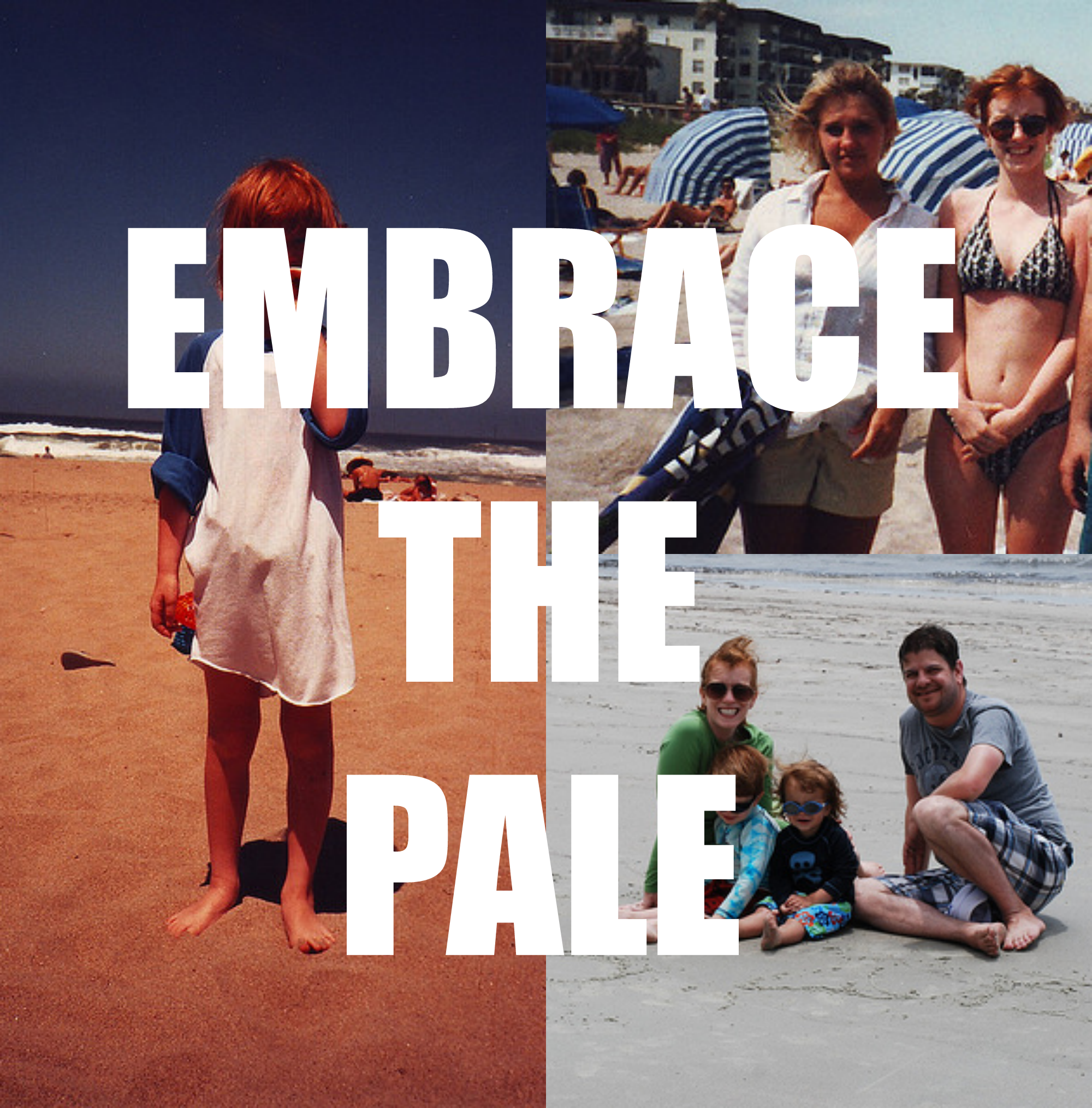
I don’t remember when being pale wasn’t a problem.
When I was younger, the threat of sunburn was forever hanging over my head. My mother was always coaxing me out of the pool for more sunscreen or - even worse - making me wear a t-shirt over my bathing suit.
As I grew up, it wasn’t only that being pale was a problem but NOT being tan was a curse.
I don’t remember when being pale wasn’t a problem.
When I was younger, the threat of sunburn was forever hanging over my head. My mother was always coaxing me out of the pool for more sunscreen or - even worse - making me wear a t-shirt over my bathing suit.
As I grew up, it wasn’t only that being pale was a problem but NOT being tan was a curse.
I remember a close friend in middle school excitedly reporting that my #1 crush might consider going out with me if I got a tan. The truly excruciating aspect was my reaction was one of excitement as well. It seemed doable. If I worked hard enough, surely even I could get a tan!
I’m assuming this experience, along with being surrounded by deeply tanned friends, is what led my 7th grade self to add “Get a dark tan” to her list of life goals. It is also what led me to try in vain all through high school to achieve that goal.

My best friend and I would lay out on my black asphalt driveway every afternoon. She would slather on baby oil and turn a deep dark brown after a few days. I would push the limits with 5 SPF tanning oil and check my swimsuit line day after day only to see the slightest change in pigment.
My mother (very wisely) threatened to take my car keys away from me should I ever so much as cross the threshold of a tanning salon. I still snuck two visits in during journalism camp (sorry, Mom!) where I spent my hard-earned money on 5 minute sessions - the max the owner recommended for me. I left the salon poorer, hotter, but no tanner.
It wasn’t until I got to college that my opinion of my skin began to change.
Suddenly, I wasn’t the lone pale girl in a sea of tans. I had lots of friends with lots of different complexions and lots of concerns far beyond getting and keeping a tan. I’m sure there were girls I went to college with who went to the tanning bed but I don’t remember hearing them talk about it. The pursuit of the almighty tan just didn’t seem to be on anyone’s radar.
My skin stopped begin a problem.
Well, not completely. I still had to avoid sunburns and still for many years I tried to achieve “a little bit of color.” Tanning beds became passé, but self-tans and spray tans presented a seemingly acceptable alternative. After all, peers are influential but overcoming the steady beat of a beauty industry that tells you pale skin isn’t beautiful doesn't come easy.
Slowly a combination of age, maturity, and plain old laziness has produced my current state of acceptance. I love my pale skin and I could give two shits about a tan. I don’t even see it as a “problem” anymore thanks to my new favorite product OF ALL TIME - the rash guard. This little thing has CHANGED. MY. LIFE. Do you have any idea how much mental energy (not to mention money) I spent every summer trying not to get burned?
A SHIT TON.
Then, I met this wonderful woman at the lake one summer (wish I remembered your name special lady who changed my life!!!) who had on super-adorable rash guard from Athleta. She told me and my equally pale mother how much she loved it and suddenly it clicked!
I put my kids in this magical SPF clothing why didn’t I get one for myself!
Game. Changer. Now, I throw that baby on and go. If I’m out of the water, I sit in the shade or cover my legs with a towel. I also always wear a hat. And I am never, ever embarrassed.
In fact, I’ve become a bit of a disciple about accepting the skin you’re in. I’ll never forget reading a fabulous post on Jezebel last year about tans entitled Tanning Is a Young, White, Female Problem. And It's Deadly. In particular, I was struck at the way the author’s criticism extended beyond the dangers of tanning to the idea that we all had to be tan.
“Where did we get this idea that fair skin is embarrassing, unflattering or a flaw in need of fixing by desperate means? By “desperate means,” we’re referring to baking in an indoor cancer coffin (a.k.a. tanning bed), lying unclothed in the blinding sun on a lava-hot lawn chair/trampoline/beach (a.k.a, sun bathing), paying good money to get hosed down with orangey-brown skin dye that sheds off in patches within 5-10 days (a.k.a. spray tanning), or slathering yourself in smelly orangey-brown solutions at home twice a day for two weeks while not touching any fabric or light walls for an hour because you will leave a distinctly “sun-kissed” look on everything (a.k.a. self-tanners).
I know what you’re thinking. “No one uses those sun reflectors anymore!” (And I hope you’re right.) And also, “You’ve obviously never tried [insert favorite brand] tanning lotion/spray/skin suit! Pasty skin problems solved!” But that’s all beside the point. The point is that tan skin is a manufactured beauty ideal, and people are literally paying for it with their lives, or at least with huge areas of skin and debilitating treatments.”
And she’s right! The beauty industry is making billions of dollars a year because they have convinced us our skin isn’t beautiful JUST THE WAY IT IS.
And that is Grade A bullshit.
Thankfully, people seem to be coming around. The Atlantic recently published a piece entitled, The End of Tanning? Tanning beds are thankfully becoming a thing of the past but also the proliferation of pale skinned celebrities who embrace their hues seems to indicate a shifting beauty idea as well.
And I sure as hell hope so. Women have real problems - equal pay, work/life balance, lack of political representation, how to make Amy Poehler our best friend (wait, is that just me?) - BUT being pale is not one of them.
Are you pale or naturally tan? Do you feel pressure to change the skin you're in?
P.S. Why how we view women's bodies matters and the importance of embracing our post-baby bodies.
How do you want to be buried?

Recently, I came upon an article in Fast Company that left me pondering an issue I've already thought a lot about.
What do I want to happen to my body when I die?
“With her Urban Death Project, designer Katrina Spade has been working on a greener alternative for the last three years. Along with the environmental issues, the design also considers the problem of space—cemeteries in the U.S. take up about a million acres of land, and as populations grow, even more space is needed. Spade wanted to find an answer that would allow people to be buried in cities.
The design uses composting to turn bodies into soil-building material for nearby farms and community gardens, so people literally become part of the city they once lived in. A four-story building, which Spade envisions being built in neighborhoods across a city, would serve both as composter and a place for ritual, where family members could see the deceased person for the last time. The composting process would take about thirty days.”
I have always been bothered by the idea of my body being pumped full of toxic chemicals then placed in the ground in big metal box. However, I also think it's important for my family to have a place to go and feel my presence if they chose to.
I have to admit this idea appeals to me.
What do you think? What do you want to happen to your body when you die?


My Most Popular Personal Posts of the Year
I had a plan to post my favorite or most popular post of the year but I was having trouble choosing just one. THEN, I realized it's my blog and I don't have to! So, here are several of my most popular person posts of the year.
It was an intense year. I went through one of the toughest experiences of my life, an experience I wouldn't have survived without being able to share how I was feeling with all of you. These weren't easy posts to write but they were the most important.
Click any photo to be taken to the post.
I had a plan to post my favorite or most popular post of the year but I was having trouble choosing just one. THEN, I realized it's my blog and I don't have to! So, here are several of my most popular person posts of the year.
It was an intense year. I went through one of the toughest experiences of my life, an experience I wouldn't have survived without being able to share how I was feeling with all of you. These weren't easy posts to write but they were the most important.
Click any photo to be taken to the post.




What you need to know about pancreatic cancer
My friend Donna died this morning. I met Donna at a Halloween party. She had bright red cheeks and kept cracking jokes about hot flashes. Her vivacity and energy absolutely filled the room and I spent the rest of the evening glued to her side.
We talked about husbands and children and travel and food. We bonded instantly over our shared passion for all things party. By the end of the evening, we were planning a zombie prom for the next year. We roped the cohost of the current party we were attending in joining our zombie prom efforts and were already discussing venues and invitation ideas as people began heading for home.
Over the course of the next year, I got to know Donna better. We joined a book club together. She welcomed me into her home for holiday parties and baby showers and book club dinners always with barrels full of laughter and generosity.
A year after our first meeting, a few weeks before our Zombie Prom, Donna was diagnosed with pancreatic cancer. All I knew about pancreatic cancer was what I had gleaned from Randy Pausch and his last lecture. All I knew was that it was a death sentence. I was terrified that she would be gone by Christmas.

My friend Donna died this morning. I met Donna at a Halloween party. She had bright red cheeks and kept cracking jokes about hot flashes. Her vivacity and energy absolutely filled the room and I spent the rest of the evening glued to her side.
We talked about husbands and children and travel and food. We bonded instantly over our shared passion for all things party. By the end of the evening, we were planning a zombie prom for the next year. We roped the cohost of the current party we were attending in joining our zombie prom efforts and were already discussing venues and invitation ideas as people began heading for home.
Over the course of the next year, I got to know Donna better. We joined a book club together. She welcomed me into her home for holiday parties and baby showers and book club dinners always with barrels full of laughter and generosity.
A year after our first meeting, a few weeks before our Zombie Prom, Donna was diagnosed with pancreatic cancer. All I knew about pancreatic cancer was what I had gleaned from Randy Pausch and his last lecture. All I knew was that it was a death sentence. I was terrified that she would be gone by Christmas.
However, by some miracle, Donna was a candidate for a rare surgery that is a powerful tool in the fight against pancreatic cancer. She set up a Facebook Page and asked my help naming it. (I didn’t realize how incredibly accurate my suggestion of Cancer: Battle Royale would be.) She made it to Christmas. She made it to the NEXT Christmas. She went on vacation with her family. She made memories with her children. She shared some of the most powerfully vulnerable moments I have ever seen anyone share during a journey like this. She was brave. She told people when she was feeling hopeful. She told people when she was feeling hopeless. It was an absolutely incredible thing to watch.
She also had time to become a passionate advocate for pancreatic cancer research. She joined our local chapter of the Pancreatic Cancer Action Network (PANCAN). She went to Washington, D.C. to lobby for change. She had just about everyone in Paducah wearing purple, including a famous local landmark.
I learned a lot from Donna during our short friendship but due to her advocacy this is one of the most important.
It does not have to be like this.
I had assumed that pancreatic cancer was deadly and that treatment options were limited because that’s just how it was. Because pancreatic cancer had not affected me directly, I didn’t spend a lot of time thinking about whether the reality of pancreatic cancer could change.
Donna taught me that it could change, it should change, it HAS to change.
All cancer used to be a death sentence. Breast cancer used to be a death sentence. However, as we’ve seen through breast cancer research and HIV/AIDS research, advocacy and awareness and research can help change all of that. You raise awareness so people know to look for symptoms. You raise money for research so we find better detection methods and more successful treatment options. You fight to make pancreatic cancer a treatable illness.
Unlike many other cancers, the survival rate for pancreatic cancer has remained substantially the same since the passage of the National Cancer Act over 40 years ago. The five-year survival rate has gone from 2 percent to 6 percent. Seventy-three percent of patients will die within the first year.
Lest you believe that pancreatic cancer is rare and will most likely not affect you think about this. While overall cancer incidence and death rates are declining, pancreatic cancer's rates are climbing and are projected to increase 55% by 2030. By 2020, pancreatic cancer is expected to become the second leading cause of cancer death in the United States.
This has to change.
Because of the pancreas's location and the lack of good detection methods, early detection is rare. Treatment options are extremely limited with only 15% of those diagnosed candidates for surgery - the best treatment option.
This has to change.
Only approximately 2 percent of the National Cancer Institute’s (NCI) budget is allocated to this leading killer. Worldwide pancreatic cancer research receives less than one percent of all private and government funding for cancer research.
This has to change.
We cannot leave it solely to the families of those left behind to advocate for change. They have a heavy burden and the challenge is huge. The Pancreatic Cancer Action Network is leading this fight and we can all help.
Become an advocate by sending messages to your Congressional representatives.
Participate in Pancreatic Cancer Advocacy Day on June 16th and 17th.
And spread the word!
PANCAN’s slogan is Know it. Fight it. End it. So, the least we can all do is know that the reality of pancreatic cancer is not set in stone and change is possible. The fight is worth it.
Donna taught me that.
12 Years A Slave and my family's history with slavery
12 Years A Slave is an amazing film. Well-acted, well-directed, well-written, it is a testament to the craft of film-making and worthy of the Academy Award for Best Picture. More than that, 12 Years A Slave is an important film. The true story of Solomon Northup – a free man who was kidnapped and forced into slavery over a hundred years ago – forces all of us to see the reality of American slavery stripped of the usual Hollywood tropes of happy slaves singing in the field (see Gone with the Wind) or the white savior (see Amistad, Lincoln).
This film has started a discussion – a discussion that for far too long we as a society have avoided. This film has started a discussion about the brutality of the slave system and the repercussions of that system that we still feel to this day – in part because that system still exists in many parts of the world.
I am not an academic. I am not an expert. However, slavery is a part of my own story and it is a story I feel that I should share in an effort to continue the discussion that 12 Years A Slave began.

12 Years A Slave is an amazing film. Well-acted, well-directed, well-written, it is a testament to the craft of film-making and worthy of the Academy Award for Best Picture. More than that, 12 Years A Slave is an important film. The true story of Solomon Northup – a free man who was kidnapped and forced into slavery over a hundred years ago – forces all of us to see the reality of American slavery stripped of the usual Hollywood tropes of happy slaves singing in the field (see Gone with the Wind) or the white savior (see Amistad, Lincoln).
This film has started a discussion – a discussion that for far too long we as a society have avoided. This film has started a discussion about the brutality of the slave system and the repercussions of that system that we still feel to this day – in part because that system still exists in many parts of the world.
I am not an academic. I am not an expert. However, slavery is a part of my own story and it is a story I feel that I should share in an effort to continue the discussion that 12 Years A Slave began.
Many of my ancestors were slave owners. If I proudly proclaim that I am an eighth generation Kentuckian and that my family has been on this land for hundreds of years, then I must also honestly and openly acknowledge the darker aspects of that heritage.
Using the 1850 and 1860 United States Federal Census Slave Schedules, I have pieced together which of my relatives owned slaves and how many. This is what I found.

The 1850 Slave Schedule
Peyton Randolph Jennings was my great-great-great-great-great-grandfather. He was born in Kentucky in 1793 and lived there until his death in 1863. The 1850 Slave Schedule reports he owned a single slave – an 11-year-old “mulatto” girl. Ten years later, the 1860 Slave Schedule reports he now owned a 22-year-old “mulatto” woman, who I can only assume was the same person. None of his sons were ever recorded as owning slaves, so I have no idea what happened to this woman upon his death in 1863. The Emancipation Proclamation had been signed but did not apply to slave states not in rebellion, including Kentucky.

Henry Babb Walters
This is my great-great-great grandfather Henry Babb Walters. He was born in Tennessee in 1826 and died there in 1892. The 1850 Slave Schedule shows that he owned a 12-year-old female slave. The histories I've read report that more whites owned a single slave than any other number and my own family history seems to reflect that. Although many often owned a male slave to help with farm work, female slaves were also chosen to help with housework. The female slave owned by Henry Babb Walters does not appear on the 1860 Slave Schedule, nor do any other slaves under his name.
My great-great-great-great grandfather George Washington Hocker owned two female slaves, according to the 1850 Slave Schedule. One woman was thirty-five years old. The other was twenty years old. Since George Washington Hocker lived until 1895, I have no idea what happened to these two woman as there is no record of them in the 1860 Slave Schedule.

Jesse Lunsford Tapp
My great-great-great-great grandfather Jesse Lunsford Tapp owned the most slaves of any of my ancestors, at least according to any evidence I could find among the slave schedules. According to the 1860 Slave Schedule, he owned seven slaves – a 63-year-old man, a 60-year-old woman, a 33-year-old man, a 30-year-old woman, a 16-year-old girl, and two young boys ages 8 and 2. I have no idea if these people were a family or what happened to them after the war. All I know is that Jesse Tapp lived until 1899 in Hopkins County, Kentucky, where he raised 12 children, including the mother of my great-great-grandmother Dessie Tapp.
What I do know is that slavery touches every branch of my family tree but has never been discussed with me. I grew up with a profound sense of family history. When I was born, three of my great-great grandparents were still alive and I had close relationships with six of my great-grandparents. Many of them had to know of our family's involvement with slavery but due to their own antiquated views on race I'm sure it was nothing they felt required to address.
I do.
I stated on Facebook recently that watching a fake version of the horrific events of Solomon Northup's life was the least I could do, but it isn't. I can do more. I can share the specific details of my own family's history in an effort to make that history real. Knowing the abstract outlines of our country's history with slavery is not enough, especially when that narrative has been gussied up and dumbed down over time. Reading a history book cannot compare to knowing that a member of your own family owned a two-year-old child.
If the past were “the past” then I would not feel as obligated to share my family's story. However, the truth is I benefit to this day from wealth and resources built upon not only the institution of slavery, but the racist attitudes it perpetuated that still exist. My family had access to land and education and to societal advancement that was off limits to many because of the color of their skin or – worse – was built upon the labor of those enslaved due to the color of their skin.
That is the reality we all live with today, no matter what our family's story.
The other reason I wanted to discuss “the past” is because sadly this isn't a story that only exists in the history books of 1860. The United Nations estimates that anywhere between 27 to 30 million people are currently enslaved against their will, including an estimated 5.5 million children. Anyone forced to work against their will either through bonded labor or forced marriage or sex trafficking is enslaved and, despite the illegality of slavery across the world, slavery still exists.
It is not an easy reality to acknowledge, although I would never compare it to the pain of those whose own family members were enslaved. The history of my family is a painful part of my own story and the knowledge that slavery is the story for millions of people across the world is unbearable. It is a complicated and difficult subject about which to talk. However, we have to talk about it. We have to talk about what we can do about it.
We should all see 12 Years A Slave but that cannot be all we do.

My Word for 2014
Every year I pick a word. A word to focus on as I move through the year. It's not a resolution. It's not a goal. The word is my north star for the next 365 days. A positive idea or concept. Something I want more of in my life.
It's a practice I learned from Ali Edwards and last year was the first year I chose a word with great intention and focused on it throughout 2013. My word was simplicity. I know some of you who know me well will chuckle at the thought of me and simplicity inhabiting the same sentence.
I tend to complicate my life at every turn. I tend to say yes at every opportunity. I tend to add instead of subtract. However, despite all that, I do feel like focusing on simplicity last year was beneficial to me. I'm never going to be a different person. No word can change who I am but focusing on simplicity helped me to see the basic foundation of happiness in my life. It helped me to strip away the complications in several areas until I was left with the simple things that make my life so wonderful.
This year my word is growth.

Every year I pick a word. A word to focus on as I move through the year. It's not a resolution. It's not a goal. The word is my north star for the next 365 days. A positive idea or concept. Something I want more of in my life.
It's a practice I learned from Ali Edwards and last year was the first year I chose a word with great intention and focused on it throughout 2013. My word was simplicity. I know some of you who know me well will chuckle at the thought of me and simplicity inhabiting the same sentence.
I tend to complicate my life at every turn. I tend to say yes at every opportunity. I tend to add instead of subtract. However, despite all that, I do feel like focusing on simplicity last year was beneficial to me. I'm never going to be a different person. No word can change who I am but focusing on simplicity helped me to see the basic foundation of happiness in my life. It helped me to strip away the complications in several areas until I was left with the simple things that make my life so wonderful.
This year my word is growth.
I had already been thinking about this word a lot when I read this passage in Happier at Home by Gretchen Rubin.
Although I’d initially underrated its value, the true significance of the fourth element— the atmosphere of growth—had become clearer to me over time. As William Butler Yeats wrote, “Happiness is neither virtue nor pleasure nor this thing nor that, but simply growth. We are happy when we are growing.” Research supports his observation: It’s not goal attainment, but the process of striving after goals— that is, growth— that brings happiness. I wanted an atmosphere of growth to pervade my home: I’d make it more beautiful and functional, fix broken things, clear clutter, enlarge its scope, and become master of my own stuff.
That's exactly what I wanted. I want to grow our family. I want to grow my business. I want to grow this blog. I want this to be smart growth. I don't want to be bigger just to be bigger.
That's why my word isn't bigger.
I want growth as an individual, as a writer, as a mother, as a wife. I want to keep striving towards betterment in all areas of my life. I want to keep growing, even when things feel safe and comfortable and good.
Growth.
What is your word for 2014?

I'm thankful for Facebook
For the third year in a row, I'm participating in the Month of Thankfulness challenge on Facebook. For the month of November, you post a status every day on someone, something, some place for which you are thankful.
I absolutely love it.
First because it helps me be truly mindful of all the things in my life for which I am grateful. In my experience, it takes about a week to cover children, spouses, family members we already spend a lot of conscious time appreciating. Then, you have to move beyond the round of the obvious and start paying attention every day to the things that bring you joy.
Second, there are so few opportunities to tell the people in our lives how important they are to us, especially in a public way. It's a wonderful thing to proclaim how much you love your best friend or how our life is better because a certain person is in it.
I've enjoyed it so much this year it got me thinking how much I truly love the social media platform that made it all possible.
That's right I'm thankful for Facebook.

For the third year in a row, I'm participating in the Month of Thankfulness challenge on Facebook. For the month of November, you post a status every day on someone, something, some place for which you are thankful.
I absolutely love it.
First, because it helps me be truly mindful of all the things in my life for which I am grateful. In my experience, it takes about a week to cover children, spouses, family members we already spend a lot of conscious time appreciating. Then, you have to move beyond the obvious and start paying attention every day to the things that bring you joy.
Second, there are so few opportunities to tell the people in our lives how important they are to us, especially in a public way. It's a wonderful thing to proclaim how much you love your best friend or how our life is better because a certain person is in it.
I've enjoyed it so much this year it got me thinking how much I truly love the social media platform that made it all possible.
That's right I'm thankful for Facebook.
Look, I know it's not cool to like Facebook. I know it's got its problems, including privacy and advertising and the fact that we all probably check it too much. I also know that you don't NEED Facebook to practice gratitude.
And yet there is Facebook making it so easy and so gratifying. I find Facebook makes a lot of the best things in my life easier and more gratifying. I maintain relationships with people I know I wouldn't be connecting with otherwise. People who support me and make my life so much better with their comments and sharing. Far away family members are a part of my children's lives thanks to Facebook.
Facebook makes the good times better and the bad times a little easier to bare. When my dear friend Amelia was involved in a car accident last year, Facebook was my lifeline. I lived far away from her and her family but her mother's updates made me feel connected to the community of people all over the country who loved Amelia. When she passed away, instead of feeling alone in my grief, I was able to reach out to people who had loved her like I had. We told stories and shared photos and just generally held each other up and Facebook made it all so easy.
I still go to Amelia's Facebook wall and post there occasionally. I don't really know why but it makes me feel better somehow to share a book I know she'd love or look at other people's photos of her from high school.
Facebook makes that all possible.
So, this Thanksgiving season, I'm thankful for Facebook.
Do you love or loathe Facebook?

My podcasts


Subscribe to my weekly email


- August 2017
- March 2017
- January 2017
- November 2016
- October 2016
- September 2016
- August 2016
- June 2016
- May 2016
- April 2016
- March 2016
- February 2016
- January 2016
- December 2015
- November 2015
- October 2015
- September 2015
- August 2015
- July 2015
- June 2015
- May 2015
- April 2015
- March 2015
- February 2015
- January 2015
- December 2014
- November 2014
- October 2014
- September 2014
- August 2014
- July 2014
- June 2014
- May 2014
- April 2014
- March 2014
- February 2014
- January 2014
- December 2013
- November 2013
- October 2013
- September 2013
- August 2013
- July 2013
- June 2013
- May 2013