
A Perfect Pair Baby Shower
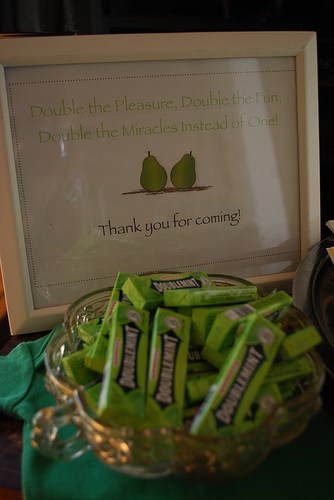
Not only am I pregnant, but two of my closest friends from college are also due within weeks of me – one with twins! In an effort to save our friends multiple car trips, we scheduled both Aimee’s and Erin’s baby showers last weekend. It was a party planning bonanza and I thought I’d share some of the adorable details.
First up on Saturday was Aimee’s shower celebrating the arrival of twin boys – Noah and Charlie. Our theme was “A Perfect Pair.”
Brown and green were also the colors in her nursery and we tried to use baby items she could take and use in their room – blankets, onesies, and a name banner. The adorable invitations above were from Paperlicious. We played a Twin Baby Babble Word Game that I designed to match the invitations. We also had a “Pear Tree” where everyone could write their hopes for the babies on little paper pears to hang on the tree. The momma-to-be took them all home in a little book at the end of the shower.
Everything went beautifully and we passed out Doublemint gum as party favors as everyone was leaving.
Just in case you have a twin shower around the corner – I’m sharing a free printable version of the Twin Baby Babble game with all of you!
Enjoy!
Why you can't spoil an infant
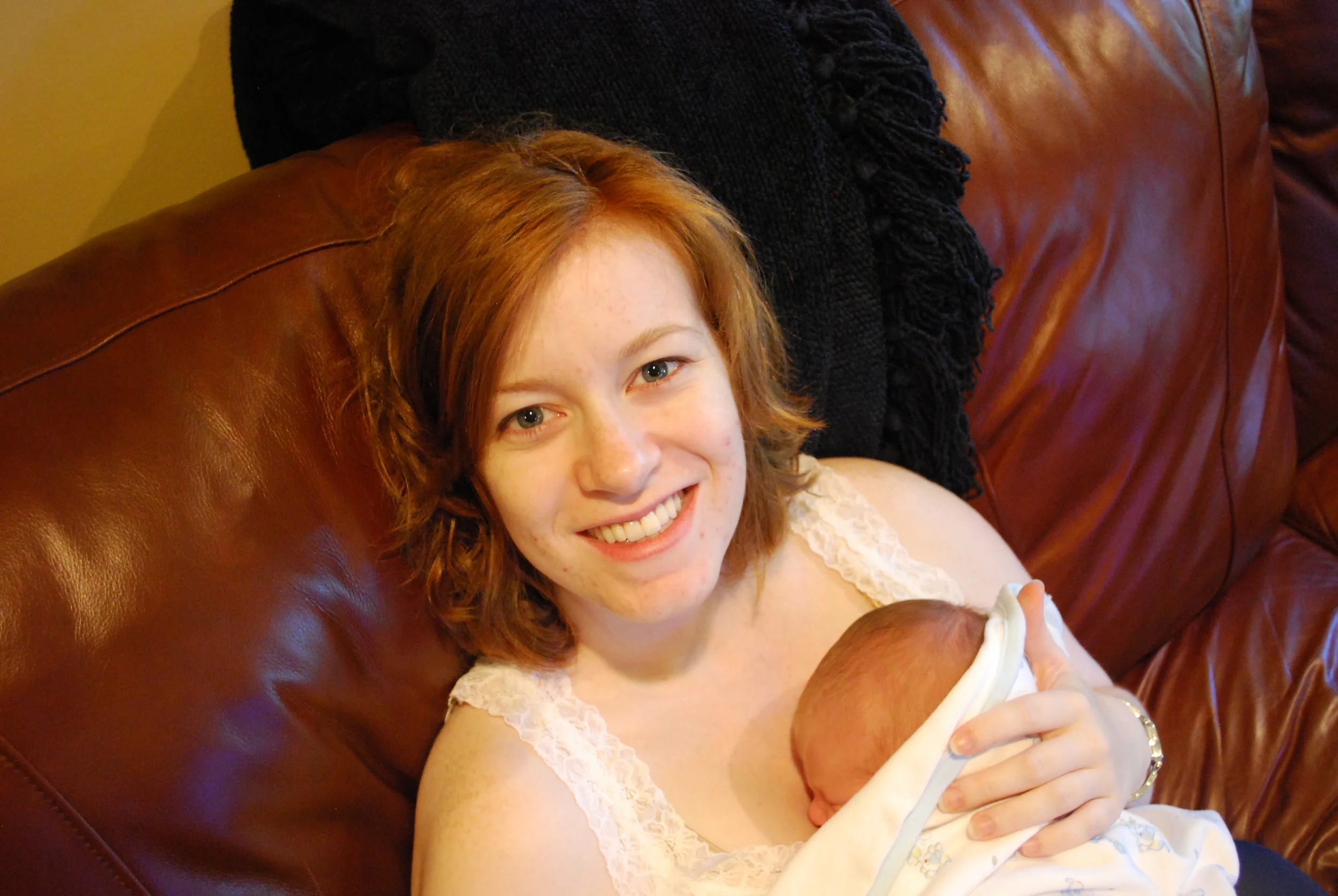
I love holding my babies. I've always felt like holding a sleeping infant is a form of meditation and I can feel my heart rate slow and my body relax as Felix naps on my chest.
I don't get to hold him enough. There are chores to do and places to go and I feel like I'm always rousing him to shove him in his car seat or his swing. I hate it and I get downright weepy when our snuggle time suffers.
And yet...
Since the week he was born I've heard the same message.
“You need to put that baby down.”
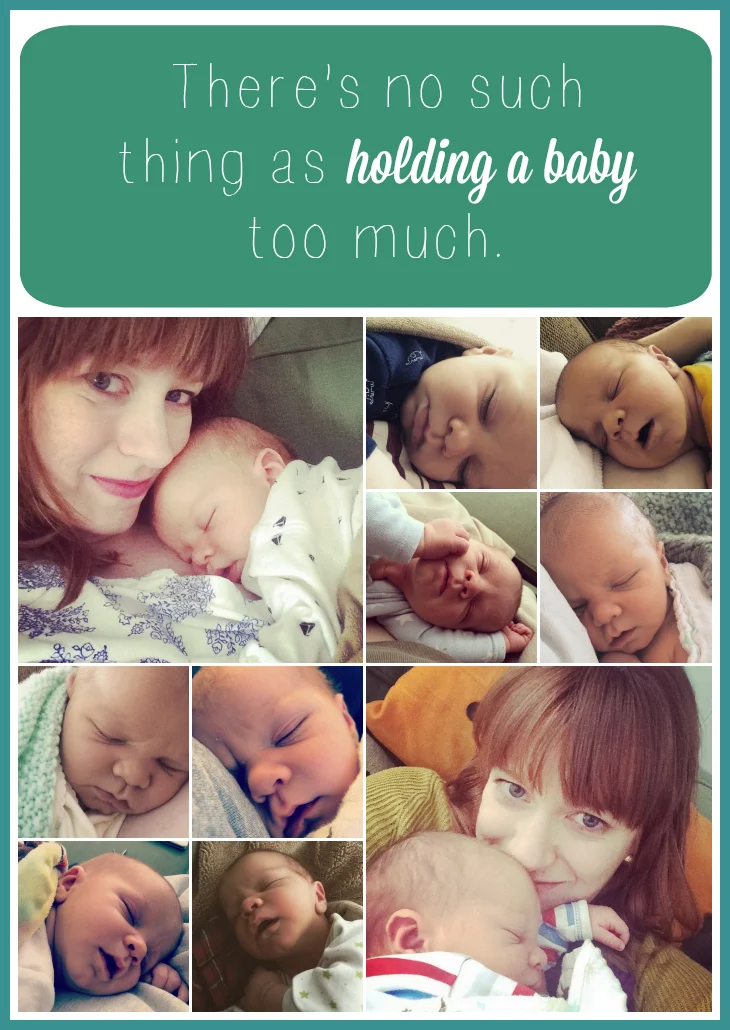
I love holding my babies. I've always felt like holding a sleeping infant is a form of meditation and I can feel my heart rate slow and my body relax as Felix naps on my chest.
I don't get to hold him enough. There are chores to do and places to go and I feel like I'm always rousing him to shove him in his car seat or his swing. I hate it and I get downright weepy when our snuggle time suffers.
And yet...
Since the week he was born I've heard the same message.
“You need to put that baby down.”
“You'll spoil him! You shouldn't hold him while he sleeps!”
“He's going to want to be held all the time, you know?”
Y'all. It's time to settle this once and for all.
YOU CAN'T SPOIL AN INFANT.
I am a true believer in Dr. Harvey Karp and his theory on the Fourth Trimester. Basically, human beings are born less developed than other mammals. We're born before our nervous systems are fully developed because our big brains wouldn't fit through the birth canal if we hung out too much longer.
According to Karp, during the first three months of life infants are basically still fetuses and respond to womb-like environments. He recommends recreating that environment with the 5 S's - sucking, shushing, swaddling, swaying, and side position.
Let me tell you. It WORKS.
And it is easiest to recreate with a baby in your arms (although let's all take a moment and send blessings and gratitude to the inventor of the baby swing!).
I can't imagine how stressful and disorienting it must be to be an infant. Anything I can do to ease that transition is worth it, even if that means holding him constantly.
Honestly, I don't really have a choice. I have a physical reaction to my baby's cries. I can feel the cortisol flood my system as my blood pressure and heart rate rises. The idea of putting Felix down so he doesn't “get used to” not having his deepest needs met is not something I'm interested in.
I like to tell people I'm a hardcore attachment parent... for three months. I believe in the fundamental philosophy that you create happy, confident children by meeting their needs consistently. Now, as they get older, the philosophies on how to meet those needs can vary.
However, with an infant, it's pretty simple. Babies like to be held.
Not to mention that I find the idea of babies “manipulating” adults ludicrous. Y'all, Felix is legitimately overwhelmed by pooping most days. The idea that he is capable of the advanced psychological development necessary to manipulate me into getting what he wants is downright laughable.
Now, I do believe as he gets older and more developed I will need to cut the proverbial cord so he can learn to self-soothe, entertain himself, and grow more independent. However, the idea that his age is not a massive contributing factor to those determinations is insane.
For example, a New York Times editorial recently asked “Do you have the guts?” to sleep train at 8 weeks. Apparently, Dr. Michel Cohen of the popular Tribeca Pediatrics in Manhattan advocates sleep training babies at 8 weeks of age. From what I can tell, he began this practice because some babies slept through the night so that meant ALL babies could sleep through the night. No matter that some of his patients report FOUR HOURS of endless crying by their infants with no successful training as a result!
I have successfully sleep-trained two children at 6 months – both of whom cried for 45 minutes the first night and then 15 minutes or less the next. Anecdotally, every friend I have who has sleep-trained at a similar age also reports approximately 45 minutes the first night. at 6 months – both of whom cried for 45 minutes the first night and then 15 minutes or less the next. Anecdotally, every friend I have who has sleep-trained at a similar age also reports approximately 45 minutes the first night.
I would argue this is because most babies are incapable of self-soothing before that age. (To those of you who have babies who sleep happily through the night at birth – keep that stuff to yourself!) In fact, Dr. Ferber – Mr. Cry It Out himself – doesn't recommend sleep training before four months because a child is not developmentally capable of self-soothing.
So, for the first three months at least, this momma will be holding her baby and breastfeeding on demand and generally loving him up whenever I can.
After all, Baby Felix is getting bigger every day and before long his needs won't be simple … nor will they be met with a nice, long nap on my chest.





Amos's Nursery

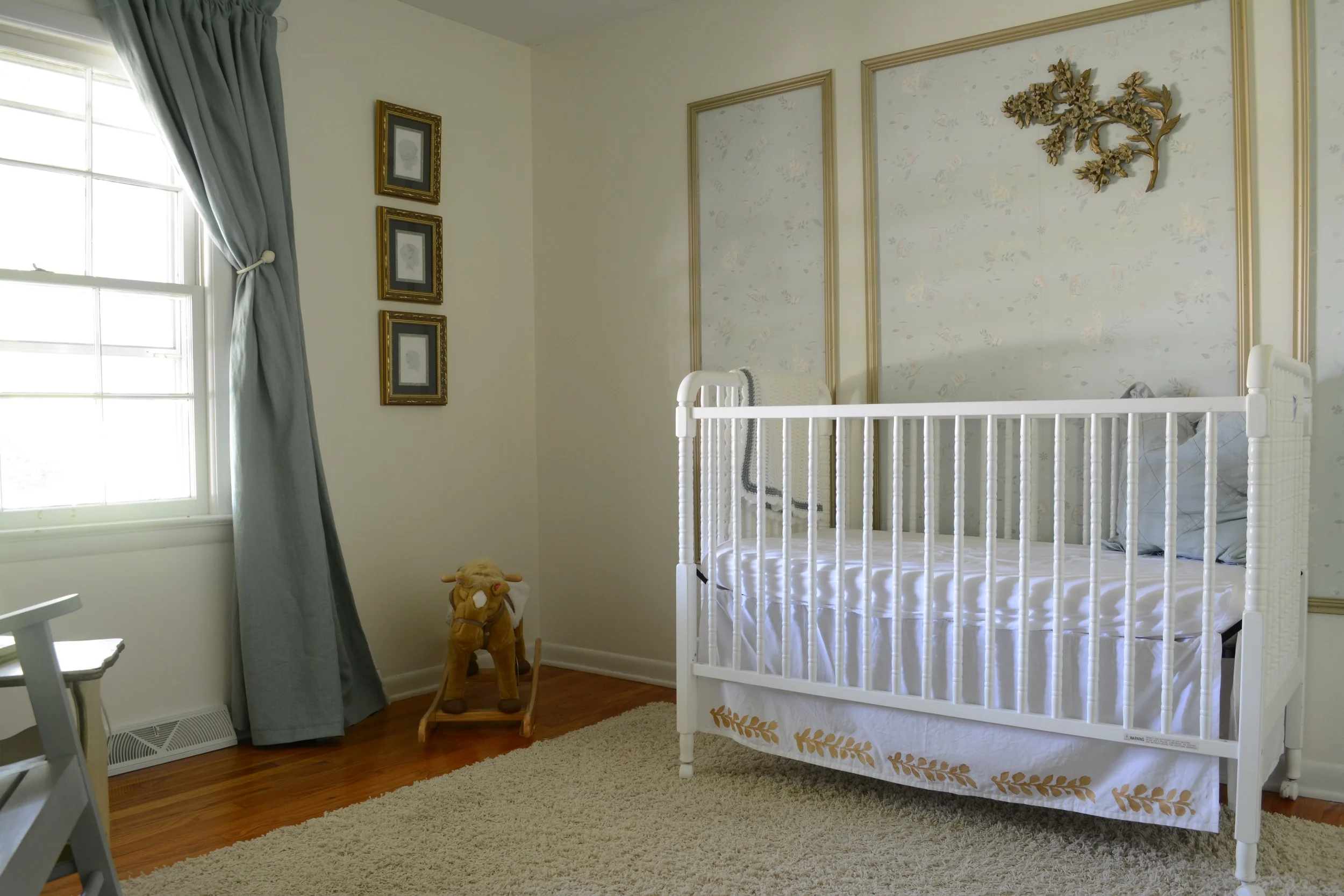
The centerpiece of the room is the wall decal by Designed Designer. I wanted the main palette to be a soft gray and white with pops of orange so I painted the walls Sherwin Williams Grayish.
We've been so happy with Griffin's Baby Mod crib that we went with Baby Mod Modena 3-in-1 Fixed-Side Convertible Crib for Amos. My mom sewed the crib skirt out of Waverly Cross Section in Charcoal, which also makes an appearance on the pillow in the rocker and and the closet curtain. My mom made all of these and I'm so grateful! The gorgeous hand crocheted blanket was a gift from my friend Annie.

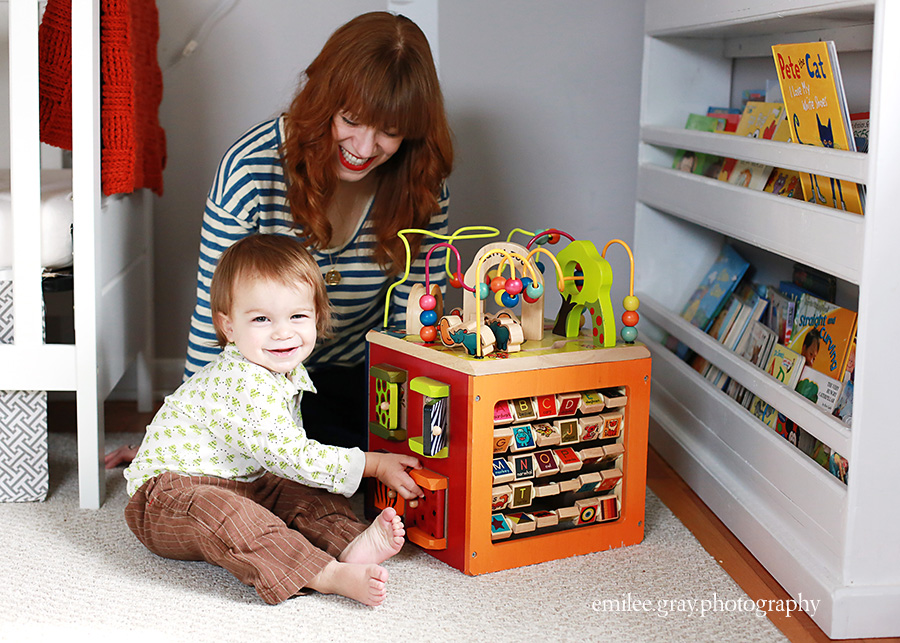
The bookshelf is an original built by my stepdad. Griffin has an identical shelf, which I partially credit for his passion for books. I love how it makes books a part of the room and how easily accessible they are. The birdhouse nightlight was also crafted by my stepfather from a basic birdhouse bought at Michael's. I cut the little squirrel and bunny decals on my Silhouette using white flocked vinyl.
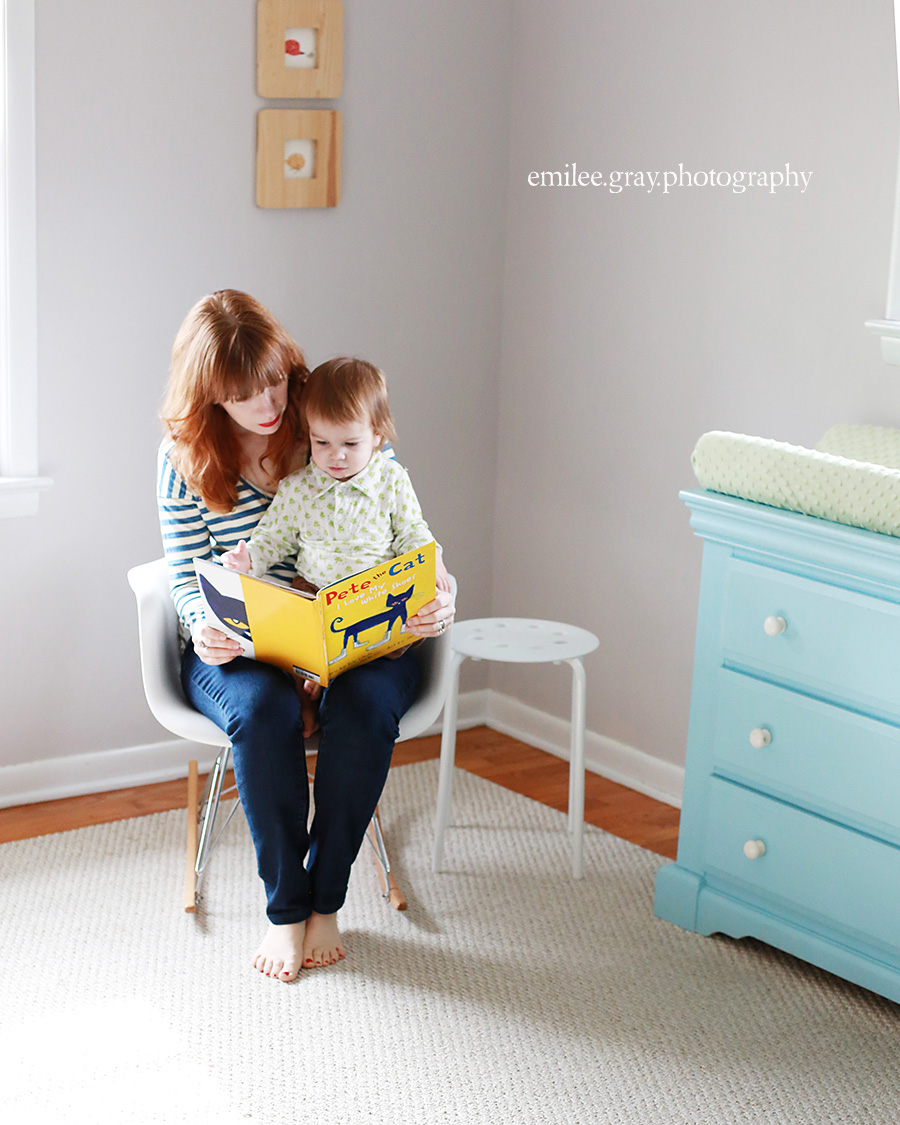
I got my Eames (ripoff) rocker as planned and added a grey knitted pouf from CB2 andMarius stool from Ikea. One of my favorite pieces in the room are the limited edition Heather Ross prints hanging above the rocker. (I had them first, btw!)
Beyond my original palette of gray, white, and orange, I brought in a light blue and green using the Give a Hoot Shower Curtain from Target. I bought one curtain to hang in front of the closet and an additional one for the rocker pillow and window shades. For the shades, I simply cut out some of the owls and used spray adhesive to adhere them to my roller shades.
The changing table was a generous gift from a friend which I painted blue to match the owls in the curtain. The color is Sherwin Williams Liquid Blue. I love the way the yarn initials fit above the table.

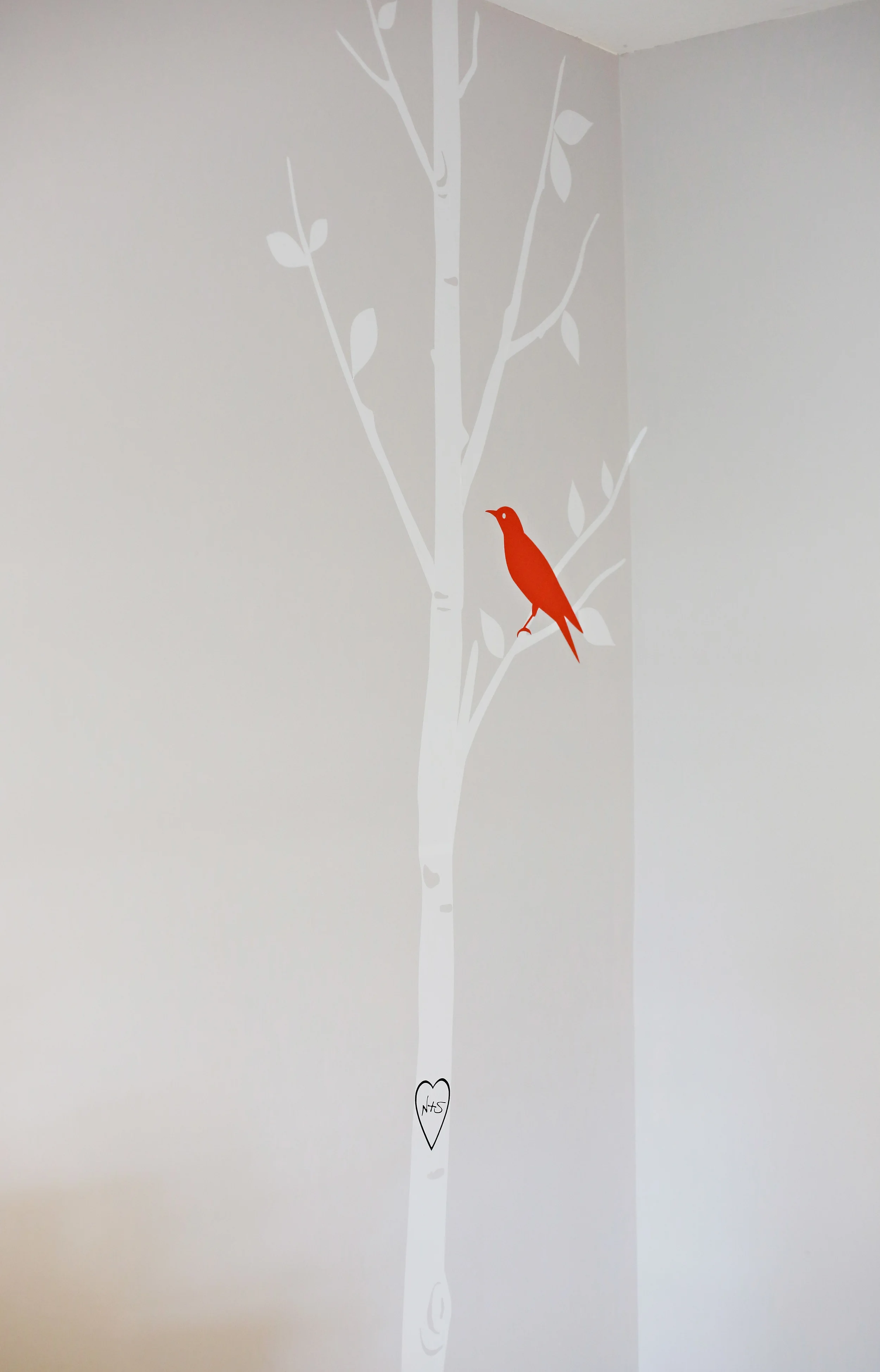
This tree is one of my favorite touches. I decided at the last minute to move one of the decals in to the corner of the room and then I added a black vinyl decal (cut on my Silhouette of course) that make it look like Nicholas and I carved our initials in the tree. Nicholas thinks it's cheesy, but I don't care

Below the tree is a table and chairs my grandparents gave to me as a child. As far as the closet, since I never EVER close Griffin's closet doors I decided to remove the doors in Amos's room and make it part of the room. I painted the inside of the closet the same orange as the birds. It was scary at first but I really like the way in turned out.
In fact, I love the way the entire room turned out. It's so serene and is one of my favorite rooms in the house. We took Amos's newborn portraits in there and I have to say he seemed pretty at ease there as well.






One year later
Although memories may bring pain, they also bring comfort, for as long as you remember, this child is still part of you.
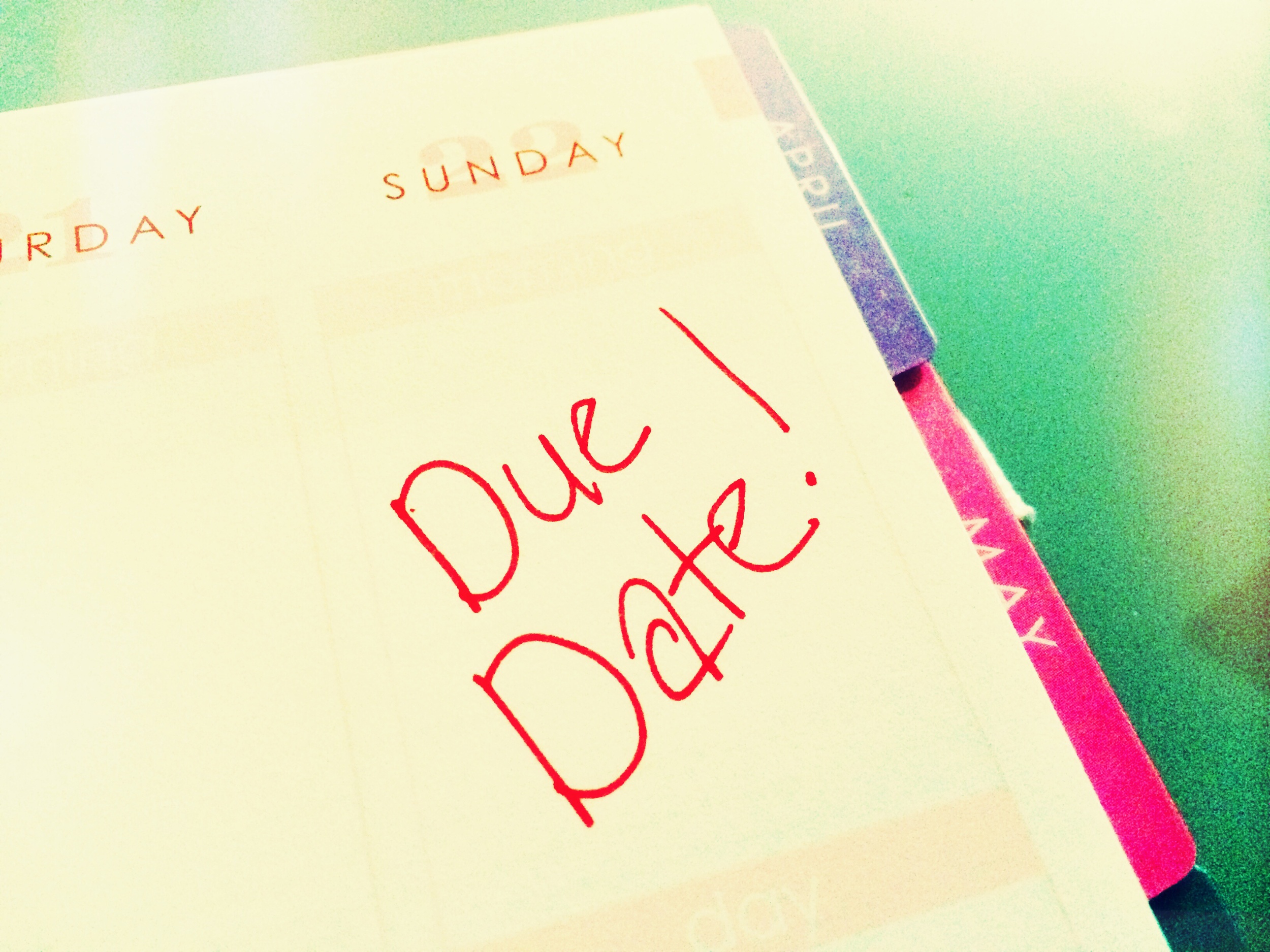
I don’t know the exact moment our baby died. It’s a strange thing the not knowing. It seems like something I should know. I should know the precise moment everything changed. It seems like that is the moment I should take to remember the passing of a year.
I know the day I found out the baby was gone.

I don’t know the exact moment our baby died. It’s a strange thing the not knowing. It seems like something I should know. I should know the precise moment everything changed. It seems like that is the moment I should take to remember the passing of a year.
I know the day I found out the baby was gone.
April 10, 2014.
I know the day I had surgery.
I know the day we had a memorial service.
April 24, 2014.
I’ve decided that April 15 will be the day I mark the passing of a year because that is the day the baby and I were separated. As long as that little body was still a part of my body, our journey together hadn’t ended.
Our short journey together still brings so much sadness - even a year later.
Some things have changed. I don’t sit in my car and cry. I don’t constantly process a long list of what if’s and if I’d only’s. I don’t feel a sharp jagged pain when I see pregnant women or babies.
I don’t blame myself. That one took a lot of time and a lot of hard work.
I still wonder though. I wonder whether the baby was a boy or girl. I wonder what he or she would have looked like. I wonder what it would have been like to have a seven-month-old.
But these are like little daydreams that leave as quickly as they come.
****
My midwife told me at the time that nothing would heal my pain but the birth of another child. I really didn’t want her to be right. I didn’t want to feel like I was replacing one baby with another.
The tragedy of pregnancy loss has a way of multiplying into the future. You not only lose a baby. It feels like you lose hope. Getting pregnant again. Being pregnant for nine long months. Safely delivering a baby. These all seem like impossibilities as your stomach slowly deflates and you bleed and bleed and bleed.
But my midwife was right. Having another baby did heal me in a way but not in the way I expected.
A year ago I was terrified I would never feel the weight of a baby in my arms but here he is. He’s nursing. He’s asleep on my chest. He’s in my arms.
I didn’t replace one baby with another. I said goodbye to all those fears and opened up space in my heart to finally say goodbye to the baby we lost.
****
We chose to have the baby cremated and scatter the ashes. For months, I hid the empty urn away and it would bring a rush of pain when I would stumble across it in a drawer.
It felt wrong to throw it away but morbid to keep it out in the open. I didn’t know what to do.
Finally, I asked a family friend who owns the local funeral home what I should do with it. She said I could throw it away or maybe discard the lid and turn it into a vase.
A month before Felix was born that’s what I decided to do. I bought some giant flowers made out of burlap and mixed in some scrap metal flowers I’d bought at an arts fair but for which I’d never found the right spot. Now, the vase sits on my desk. I like the sharp edges of the metal flowers. I like that I took one of the few momentos of my baby’s short life and turned it into something that brings a bittersweet smile to my face.
They remind me that sometimes beauty can be found in hard spots. They remind me that a year after being physically separated the baby is still a part of my life and always will be no matter how many years pass.




Do Sex Offender Registries Work?
Last week, my husband and I were watching Our America with Lisa Ling. In an episode titled “State of Sex Offenders,” Ling spent time in Florida, a state with some of the toughest sex offender registry laws in the country. She interviewed men forced to live in tents in the woods due to zoning laws, a sex offender who helps other sex offenders find places to live, a sex offender recently released from prison, and Lauren Book, one of the state’s high profile survivors of sexual molestation and the driving force behind many of Florida’s registry laws.
During the show, I found myself feeling something that as a mother you are never supposed to feel—sympathy for sex offenders.
Recently, I had a conversation with a group of mothers about a recent (and heinous) child abuse case in Arkansas. We debated whether or not one should ever feel sympathy for child abusers and I was reminded of this post I wrote several years ago on Salt & Nectar.
Last week, my husband and I were watching Our America with Lisa Ling. In an episode titled “State of Sex Offenders,” Ling spent time in Florida, a state with some of the toughest sex offender registry laws in the country. She interviewed men forced to live in tents in the woods due to zoning laws, a sex offender who helps other sex offenders find places to live, a sex offender recently released from prison, and Lauren Book, one of the state’s high profile survivors of sexual molestation and the driving force behind many of Florida’s registry laws.
During the show, I found myself feeling something that as a mother you are never supposed to feel—sympathy for sex offenders.
It all started with Randy Young, the sex offender who helps newly released offenders find places to live. As he explained his reasons for doing what he does, I expected to hear that as a registered offender himself he knew the difficulties these men and women would encounter upon release from prison. Instead, he spoke about his mother and how she would drive him into dangerous neighborhoods desperately trying to find him a place to live. He could not live with her due to the registry laws that prevent a sex offender from living within 2000 feet of a place children congregate. He said he wanted to prevent the families of other sex offenders from going through the pain his own mother experienced.
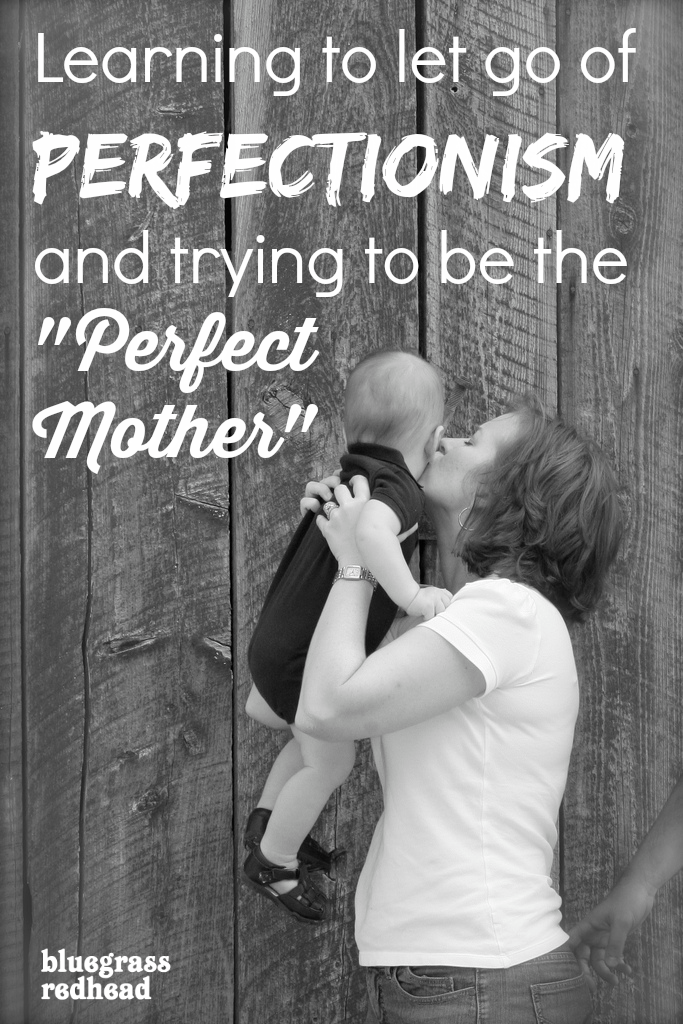
There it was. Staring me right in the face. These men were sons and their mothers loved them as much as I loved my own son. And for me, nothing makes me feel someone else’s humanity more profoundly than realizing a mother once held that person—as a tiny, helpless infant—in her arms and loved them unconditionally.
As a society, we have gone out of our way to strip all humanity from this group—to the point where many are forced to live like the animals we believe them to be. We call them monsters because what they do is indeed monstrous. We call them predators because they prey on the most vulnerable of victims. But no matter what we call them or how we treat them, the difficult reality is that they are still human beings. They are someone’s son, someone’s wife, someone’s father, someone’s sister.
In a way, I think it makes us all feel better. If we don’t think of them as people, then we don’t have to worry about the people in our own lives. Of course, our doctor/neighbor/babysitter wouldn’t be capable of something like this. We would never invite a monster in to our home or our lives. If we can get on the Internet and find out where the real monsters live, then we can keep our kids safe.
The truth is most studies estimate 80-90% of molestation victims know their perpetrator and the same percentage of perpetrators have never been convicted of a sexual offense before. And according to some recent studies, the popular idea that all sexual offenders are likely to re-offend is unrealistic if not downright wrong. Unless, you factor in the opinion of many law enforcement agencies that feel that registry laws actually make a sex offender more likely to re-offend because it removes them from their support system and encourages them to disappear. So, what this tells me is these registry laws are not protecting children from the actual threat—a trusted member of their community who in all likelihood wouldn't be on the registry to begin with. Not only that, but that by continuing to punish the offenders after they are out of prison we might in fact be increasing the chances that they will harm a child.
So, what are we to do?
As a mother, I’m realizing that I can’t protect Griffin from everything. I can’t read the mind of every person he comes in contact with to determine whether it holds my worst fear. And I can’t help but feel that if I focus my energy on controlling everyone else I’m fighting a losing battle. Instead, I try to focus my energy on Griffin. We’ve already started talking about body parts and, as he grows older, I plan to continue that discussion to include appropriate and inappropriate touching. I never want him to feel like the subject of his body or sex is something to be ashamed of or embarrassed about.
But beyond that there is a message that I want Griffin to get loud and clear. A message I plan to repeat as often as humanly possible—which is there is NOTHING he can’t tell me. Nothing. I want him to understand that no matter what anyone else says there is nothing he could do or say that would make me stop loving him. I think as parents we feel this so profoundly we think it can go unsaid but it can’t.
At the end of the day, I know that if the unthinkable did happen, it wouldn’t be the police or a registry or even the offender I would blame—it would be myself. So, it’s up to me to do everything in my power to protect my son, including—and perhaps most importantly—giving him the tools and skills to protect himself.


The science of parenting: Is it safe to play outside?
In this series, I’m examining the science of parenting. In Part One, we discussed the the importance of the quality - not quantity - of time we spend with our kids. In Part Two, we looked at the science on what types of activities can be considered quality family time. In Part Three, I look at how our children spend their time, our perception of those activities, and what the science actually says.
Last week, I took the boys to our local park after school. I had just read an editorial making a strong case for free-range parenting. This quote in particular left me wondering if I give my own children enough opportunities to explore.

In this series, I’m examining the science of parenting. In Part One, we discussed the the importance of the quality - not quantity - of time we spend with our kids. In Part Two, we looked at the science on what types of activities can be considered quality family time. In Part Three, I look at how our children spend their time, our perception of those activities, and what the science actually says.
Last week, I took the boys to our local park after school. I had just read an editorial making a strong case for free-range parenting. This quote in particular left me wondering if I give my own children enough opportunities to explore.
“ ‘We are depriving them of opportunities to learn how to take control of their own lives,’ writes Peter Gray, a research professor at Boston College. He argues that this increases ‘the chance that they will suffer from anxiety, depression, and various other mental disorders,’ which have gone up dramatically in recent decades. He sees risky, outside play of children among themselves without adult supervision as a way of learning to control strong emotions like anger and fear.”
So, I decided on that day to let Griffin cross the street from our local neighborhood park and go to the market to buy juice for him and his brother. I gave him $10 and instructed him to watch carefully for cars, be polite and respectful to the cashier, and come back to the park as soon as he was done.
I watched him cross the street with a lump in my throat and loud voices in my head screaming about all the things that could go wrong. He could get hit by a car. He could be approached by a stranger or a predator. He could break something or otherwise wreak havoc in the store.
The two friends at the park (and even my own husband) were shocked I had let him go. They voiced the fears already marching through my head.
However, I took a deep breath and reminded them (and myself) that he was mere yards away, that he would be fine, and - most importantly - I try not to make decisions out of fear and teach my children to do the same.
The pride on that child's face upon his return was a sight to behold and all the confirmation I needed that I had done the right thing. Being trusted with money, helping out his little brother, and showing his mom he could do it was such a big deal to this little kindergartener.
In fact, he did such a good job. He's also been allowed to play outside alone in our cul-de-sac with two older neighbor boys.
The debate surrounding this type of “free-range” parenting is particularly relevant to the discussions regarding the recent study concluding that quality time with our kids is more important than quantity. Yes, we need time together as a family.
However, our kids also need time alone - away from parental influence and supervision - to explore, to problem-solve, to learn to control their own lives and emotions.
Unfortunately, OUR emotions are getting in the way.
But what’s the real reason?
“There appears to be no link between play patterns and play provision; children are no more likely to play outdoors, or play further away from home if there are adequate opportunities provided within their neighbourhood. Rather, the evidence of this paper is that the most significant influence on children’s access to independent play is not the level of public provision of play facilities but parental anxieties about children’s safety and the changing nature of childhood”
We are AFRAID. Plain and simple.
What exactly are we afraid of?
Recently, I was discussing letting Griffin walk home alone from the bus stop. This is literally .1 miles from my home and that’s if he doesn’t cut through my neighbor's yard. My stepfather exclaimed I couldn’t do that because someone could stake out his schedule and snatch him.
Y’all. That is insane.
The chances of that happening are about the same as Griffin inventing a hovercraft to fly that .1 mile home and achieving this technological marvel before the end of the school year.
The fact is that this is the safest time to be a child in all of human history.
Child victimization has been in a steady decline for forty years. Based on the crime statistics kept since the 1970s: child sexual abuse is down 53 percent; physical abuse is down 52 percent; aggravated assault is down 69 percent; robbery is down 62 percent; larceny is down 54 percent.
Thanks to anti-bullying and public education campaigns, bullying has dropped by a third in the last five years.
The odds of your child actually being kidnapped and murdered stand at about 1.5 million to one.
1.5 million to one.
So, the actual risk of letting your children play outside alone is incredibly low. The irony is the actual BENEFIT of letting your children play outside alone is incredibly HIGH.
Children who play outside have lower rates of obesity. Children exposed to dirt and germs have healthier immune systems. Studies have shown children learn important social skills on the playground and that outside play can reduce stress and the symptoms of ADHD.
What is actually dangerous to children?
Cars.
In other words, driving your children all over town for carefully monitored and adult-directed play is MORE DANGEROUS than opening your front door and telling them to “Go outside and play!”
This is something I've written about before. The presence of any risk doesn't define a situations as dangerous for kids OR adults.
In an article entitled "Why Parents Should Stop Overprotecting Kids and Let Then Play," editor at large for Psychology Today Hara Estroff Marano best captures the situation.
"Risk is an inherent part of life. Success and happiness hinge not on the elimination of risk but on the reasonable management of risk."
I think this might be about more than risk.
I've recently learned through my own struggles with anxiety that the presence of anxiety often means we feel a lack of control. We want to control every aspect of our children's lives. I know I do. The less rational part of my brain tells me if I'm there controlling every aspect of their lives I can keep bad things from happening.
But you know - and I know - that's absurd.
Bad things happen and they will happen to our kids - despite our best efforts. All we can hope for is that we will have prepared them as best we can. We have to TRUST that they can make good decisions and give them the opportunity to try within reasonable boundaries. We have to say, "I know it's scary but I know you can do it."
We have to open the door wide and let them go outside and play.
Do you let your children play outside alone? Did you play outside alone as a kid?
The science of parenting: What does "quality time" mean?
In part one of this series, I discussed a recent study that found increased maternal time was not necessary for happy kids. In fact, it was the quality of time - not quantity of time that counts. In this post, I ask what does the science say about quality time?
I'll never forget a conversation I once had with a close friend about being a work-at-home mom. She was bemoaning the hours she spent during a recent snow day keeping her kids entertained by playing My Little Ponies.
I was sympathetic to her plight but told her I couldn't really commiserate.
"I don't really play with my kids," I told her.

In part one of this series, I discussed a recent study that found increased maternal time was not necessary for happy kids. In fact, it was the quality of time - not quantity of time that counts. In this post, I ask what does the science say about quality time?
I'll never forget a conversation I once had with a close friend about being a work-at-home mom. She was bemoaning the hours she spent during a recent snow day keeping her kids entertained by playing My Little Ponies.
I was sympathetic to her plight but told her I couldn't really commiserate.
"I don't really play with my kids," I told her.
She was shocked and asked why I didn’t feel guilty for not playing with my children since I was home all day. I told that I read books obviously and played the occasional game of Candyland but, overall, I expected them to entertain themselves.
Truthfully, I have never carried a lot of guilt about constantly playing with my kids. Before I ever became a mom, I read an article arguing that parental play was unnecessary and often detrimental. Kids need time to engage in their own forms of creative play and often adults over-direct, over-instruct, and plain old get in the way.
After all, the idea of "playing" with your kids is a recent invention. My mother didn't spend hours playing with me. As an only child, I spent hours playing by myself. My mother never EVER felt pressure to entertain or constantly engage with me.
If I told her I was bored, I got the same response she got from her mom and the same response my grandmother had received from my great-grandmother.
"Only boring people are bored."
That or she helpfully suggested I could clean the stove.
My family spent quality time together, but it was not always on MY terms. For some reason, time together as a family has now come to mean time together entertaining the children.
In her phenomenal book All Joy and No Fun: The Paradox of Modern Parenting, Jennifer Senior speaks to this new intensive model of parenting.
“ The way most historians describe this transformation is to say that the child went from “useful” to “protected.” But the sociologist Viviana Zelizer came up with a far more pungent phrase. She characterized the modern child as “economically worthless but emotionally priceless.” Today parents pour more capital—both emotional and literal—into their children than ever before, and they’re spending longer, more concentrated hours with their children than they did when the workday ended at five o’clock and the majority of women still stayed home. Yet parents don’t know what it is they’re supposed to do, precisely, in their new jobs. “Parenting” may have become its own activity (its own profession, so to speak), but its goals are far from clear.” ”
It makes sense on a certain level. If our goal is to raise happy, healthy children then let's do whatever makes them happy. Let's play Legos for hours. Let's fill every moment of our free time with birthday parties and bounce houses and extracurricular activities.
Though our hearts might be in the right place, this intensive form of parental interaction which begins with lots of play time and so often becomes helicopter parenting isn't good for anyone.
A recent survey of college freshmen with self-described helicopter parents was found to be less capable of dealing with real world problems. The study found, “Students with helicopter parents tended to be less open to new ideas and actions, as well as more vulnerable, anxious and self-consciousness, among other factors, compared with their counterparts with more distant parents.”
So, what does the science say about positive forms of quality time?
As we all re-arrange our lives and schedules to fit the demands of our “economically worthless but emotionally priceless” children, one form of scientifically-proven quality time has suffered.
Unfortunately, the family dinner has become rare just as the science on family dinners has become more and more conclusive. Kids who eat with their families three or more times a week are less likely to be overweight, perform better academically, and are less likely to engage in risky behaviors such as drug abuse and early sexual activity.
I grew up eating dinner regularly with my family and it is still the source of some of my fondest memories. We try to eat dinner every night as a family and we have Sunday family dinners with my parents and grandmother every week as well.
Now, in the spirit of full disclosure, my husband cooks. He plans our week’s meals and goes to the grocery store during the weekend. Then, he comes home most nights of the week and prepare a delicious meal for us. So, it is VERY easy for me to talk about family dinners and how beneficial they are to our family.
I understand that is not the reality for most families but I also know that a family dinner could also be a family breakfast or weekend brunch or basically any time when the family is interacting as a whole and not catering to the whims of a child.
I truly believe that the most beneficial time for children is time that both the parents AND child enjoy. I don’t particularly enjoy playing Minecraft (or talking about it for hours) or going to Chuck E. Cheese or watching hours of Curious George. I do enjoy seeing my children happy and so I make some time for those activities.
However, my favorite family time is when we are all engaged together. We are eating a meal and talking about our days. We are walking the Greenway Trail and sharing stories. We are geocaching and solving a challenge by working together.
After all, I don't believe my goal is to make my children happy at the cost of my own happiness or the happiness of our family as a whole. I'm not just raising children. I'm raising a family and time spent to that end is truly valuable.
How do you spend quality time as a family?
PART ONE: How much time should we spend with our kids?
PART THREE: Is it safe to play outside?
The science of parenting: How much time should I spend with my kids?
At least once a week, I have the same conversation. I’ve had this conversation with working moms and stay-at-home moms. It is usually during a meeting or other week night obligation and it always begins with a mommy friend expressing guilt about being away from her kids.
Despite encouragement and reassurance that her kids are fine, I always get the same response, “I just feel like I should BE there.”

This is the first part of a series in which I explore whether or not how we FEEL about parenting issues reflects the actual FACTS.
At least once a week, I have the same conversation. I’ve had this conversation with working moms and stay-at-home moms. It is usually during a meeting or other week night obligation and it always begins with a mommy friend expressing guilt about being away from her kids.
Despite encouragement and reassurance that her kids are fine, I always get the same response, “I just feel like I should BE there.”
Now, let's examine the facts. American mothers spend more time with their children than in any other time in history. If you were born in the 1970s and you currently work full time, there is a strong chance that you spend more time with your children while working full time, then your mom did even if she stayed home.

Y’all, that is bananas.
We have invented a lot of time-saving technology in the past thirty years but we didn't add more hours to our day! That means we are sacrificing sleep, self-care, and practically ALL of our free time to spend more time with our kids.
And on top of it all, we still feel guilty!
Well, do we feel guilty for a reason? Were our mothers and their mothers before them absentee parents who harmed their kids? Despite all this additional time, is there a chance our children still need more?
Turns out. NO.
This week the Journal of Marriage and Family published the first large-scale longitudinal study of parent time which found NO (zero, zilch, nada) positive effects from spending large amounts of time with your children. The study focused specifically on maternal time and found with regards to children ages 3 to 11 it was the quality of time spent with children not the quantity that matters.
Here’s a quote from the study itself.
“Both time mothers spent engaged with and accessible to offspring were assessed. In child-hood and adolescence, the amount of maternal time did not matter for offspring behaviors, emotions, or academics, whereas social status factors were important. ”
Read that. Read it again. Keep reading it until it sinks in.
The amount of maternal time DID. NOT. MATTER.
This is what happens when we parent based on emotion instead of facts. I’ve written before about the way in which I let emotions almost ruin my marriage. If I felt like Nicholas didn’t love me, surely that meant Nicholas didn’t love me.
Turns out. Not so much.
I’ve just recently come to realize that this principle also applies to parenting. Just because I feel like I’m not doing enough for my kids doesn’t mean I’m actually failing my children.
Emotions are based on all manner of input from our own insecurities, experiences from our own childhood, and especially outdated and sexist cultural assumptions about the role of women in the home.
We all to take a step back and look at the science, look at the evidence, look at our own reality.
We might feel guilty for working outside the home but the reality is less time with our kids is not harmful. We might feel like we should spend all our time as stay at home moms engaged with our children but the reality is more doesn't always equal better.
Don't’ get me wrong. Emotions are important. Emotions steer us in the right direction most of the time. However, they cannot be our entire roadmap.
Now, if you actually miss your kids, that's one thing. If you miss your kids, then don't let anyone guilt you into leaving your family. Stay home. Soak 'em up. By all means.
However, in the immortal words of Leslie Knope, “ 'Do you miss your kids while you're at work?' Of course I do. Everybody does. And then, you know, sometimes I don't."
If you don't miss your kids, then STOP FEELING GUILTY ABOUT IT.
Depending on their age, kids need lots of things. Babies and toddlers do need lots of time to form loving attachments with their primary caregiver. Surprisingly, at the other end of the age range, the study found that more maternal time did have a positive impact on teenagers. (Of course, when you think about the huge biological and psychological growth that happens during those two time periods maybe it’s not that surprising.)
However, from the ages of 3 to 11, your children do not need every single second of your spare time. Assuming your children live with you for 18 years that is HALF of their childhood.
So, listen to the scientists. Take a break. Take a walk. Heck, take a child-free vacation.
And leave your guilt behind.
How much time do you spend with your kids? Do you feel like it's never enough?
PART TWO: How should our kids be spending their time if it's not with us?
PART THREE: Is it safe to play outside?
My podcasts


Subscribe to my weekly email
- August 2017
- March 2017
- January 2017
- November 2016
- October 2016
- September 2016
- August 2016
- June 2016
- May 2016
- April 2016
- March 2016
- February 2016
- January 2016
- December 2015
- November 2015
- October 2015
- September 2015
- August 2015
- July 2015
- June 2015
- May 2015
- April 2015
- March 2015
- February 2015
- January 2015
- December 2014
- November 2014
- October 2014
- September 2014
- August 2014
- July 2014
- June 2014
- May 2014
- April 2014
- March 2014
- February 2014
- January 2014
- December 2013
- November 2013
- October 2013
- September 2013
- August 2013
- July 2013
- June 2013
- May 2013
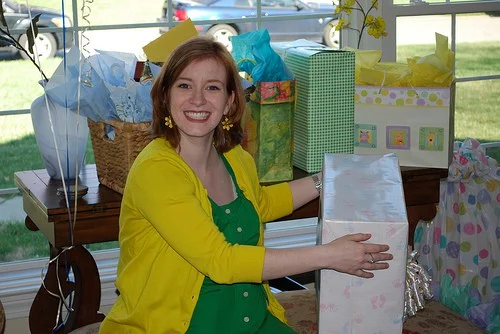
Since I’m at the peak of my reproductive years, I always have about nine friends who are pregnant at any given time. No matter where I am, one of them is there. With her swollen belly, she insists she is the biggest pregnant woman to walk the earth. I smile. I promise her I was bigger…MUCH bigger. She smiles—sure I’m just trying to make her feel better.
Then, I pull up this picture on my phone.